What Is an Interest Rate Swap?

What Is an Interest Rate Swap?
If you’ve ever asked yourself, “what is an interest rate swap?” you’re not alone. Interest rate swaps are among the most widely used financial derivatives in the world, yet they remain a mystery to many outside the finance industry. At their core, interest rate swaps are contracts that allow two parties to exchange interest payment obligations, helping businesses and investors manage risk, reduce costs, and gain more predictable cash flows.
This guide breaks down everything you need to know about interest rate swaps, how they work, the different types available, real-world examples, and the risks involved, so you can understand this powerful financial tool with confidence.
What Is an Interest Rate Swap?
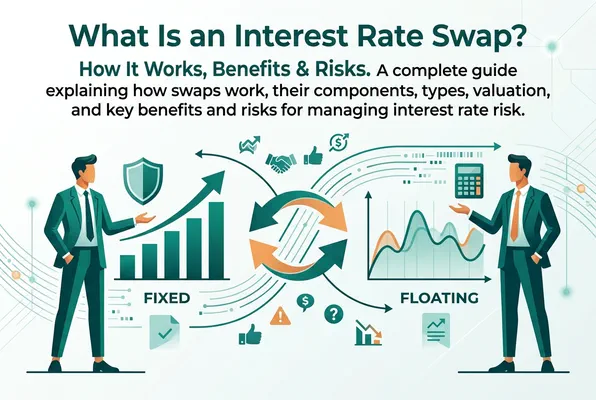
An interest rate swap is a derivative contract in which two parties agree to exchange streams of interest payments over a specified period. Typically, one party pays a fixed interest rate, while the other pays a floating (variable) interest rate, both calculated on the same notional principal amount.
It’s important to note that the notional principal itself is never exchanged, only the interest payments are swapped. This makes interest rate swaps a relatively low-risk way to manage interest rate exposure without affecting the underlying loan or investment structure.
How Is a Swap Rate Determined?
The swap rate is the fixed rate of interest agreed upon in a swap transaction in exchange for a floating rate. It reflects expectations about future interest rates, the current market environment, the length of the contract, and prevailing conditions in the swap market. When entering into a plain vanilla swap, the fixed swap rate is generally structured so that the initial value of the agreement is close to zero for both parties. As market conditions change, however, the value of the swap can fluctuate.
Key Components of an Interest Rate Swap
- Notional Principal: The hypothetical amount used to calculate interest payments. It is not exchanged between parties.
- Fixed Rate: A set interest rate agreed upon at the start of the contract.
- Floating Rate: A variable rate tied to a benchmark, such as SOFR (Secured Overnight Financing Rate) or, historically, LIBOR.
- Settlement Dates: Specific dates when interest payments are exchanged.
- Maturity Date: The date when the swap agreement ends.
How Does an Interest Rate Swap Work?
To understand how an interest rate swap functions, consider two companies with different financing needs:
- Company A has a loan with a variable interest rate but prefers the predictability of fixed payments.
- Company B has a loan with a fixed interest rate but believes rates will fall, preferring variable payments.
Through an interest rate swap agreement, Company A and Company B can exchange their interest rate obligations. Company A pays Company B a fixed rate, while Company B pays Company A a floating rate, both based on the same notional amount. Neither party changes their original lender; they simply exchange interest payment streams with each other.
This arrangement allows both companies to align their debt structure with their financial strategy and risk tolerance, without needing to refinance their original loans.
How Market Movements Affect a Swap Contract
Once an interest rate swap is active, changes in interest rates can significantly affect its value. If interest rates rise, a party receiving a fixed swap rate may benefit relative to current market rates, while falling rates can have the opposite effect. Because rates change continuously, the value of the swap can fluctuate throughout its lifetime. This is particularly relevant for companies using swaps to manage interest rate risk, as the economic value of their hedge may change even though the contractual rate payments remain fixed.
Types of Interest Rate Swaps
Interest rate swaps come in several varieties, each suited to different financial goals.
1. Fixed-for-Floating Swap
This is the most common type of interest rate swap. One party pays a fixed rate, and the other pays a floating rate based on a reference benchmark. It’s widely used by corporations and financial institutions to hedge against interest rate volatility.
2. Floating-for-Floating Swap (Basis Swap)
In a basis swap, both parties exchange floating rates, but each is tied to a different benchmark or index. This type is often used to manage risks between different floating-rate benchmarks.
3. Fixed-for-Fixed Swap
Less common, this type involves exchanging fixed rates denominated in different currencies, often overlapping with currency swap structures.
4. Overnight Indexed Swap (OIS)
An OIS involves exchanging a fixed rate for a floating rate tied to an overnight rate index, such as SOFR. These are frequently used for short-term interest rate risk management and have become increasingly important since the phase-out of LIBOR.
Interest Rate Swaps and Other Financial Contracts
Interest-rate swaps are part of a broader group of financial contracts used to manage exposure to changing rates. Forward contracts, for example, can lock in an interest rate for a future period, while swaps generally involve multiple exchanges of interest payments over the life of the contract. Companies with floating rate loans may use swaps to create a more predictable fixed-rate exposure, while investors in fixed income markets may use them to adjust their interest-rate exposure without directly changing the underlying asset. The appropriate type of swap depends on the company’s financing structure, objectives, and expectations about the future rate environment.
Why Do Businesses and Investors Use Interest Rate Swaps?
Interest rate swaps serve multiple strategic purposes in corporate finance and investment management.
Hedging Against Interest Rate Risk
Companies with variable-rate debt may worry about rising interest rates increasing their borrowing costs. By swapping into a fixed rate, they lock in predictable payments, protecting their budget from market volatility.
Reducing Borrowing Costs
Sometimes, due to differences in credit ratings or market access, one party can borrow more cheaply in a fixed-rate market while another has an advantage in the floating-rate market. By swapping, both parties can effectively lower their overall borrowing costs, a concept known as comparative advantage.
Speculation
Some investors and institutions use interest rate swaps to speculate on the direction of future interest rates, aiming to profit from anticipated rate movements.
Asset-Liability Management
Financial institutions, such as banks and insurance companies, use interest rate swaps to align the interest rate sensitivity of their assets and liabilities, reducing mismatches that could threaten profitability.
Valuation and Present Value of an Interest Rate Swap
The valuation of a swap compares the expected future cash flows from each leg of the swap. One stream of interest payments is typically based on a fixed rate, while the other is linked to a floating rate index. To determine the current value, these future payments are converted into their present value using appropriate market rates. This process helps counterparties understand what the swap contract is worth in the current market and what it might cost to terminate or replace the agreement.
A Practical Example of an Interest Rate Swap
Let’s say Company X has a $10 million loan with a floating interest rate tied to SOFR + 2%. Concerned about rising rates, Company X enters into a swap agreement with Bank Y.
- Company X agrees to pay Bank Y a fixed rate of 5% annually on the $10 million notional amount.
- Bank Y agrees to pay Company X the floating SOFR + 2% rate on the same notional amount.
If SOFR rises, Company X benefits because it continues to pay only the agreed fixed rate of 5%, while receiving payments from Bank Y that offset its rising floating-rate loan costs. This example illustrates how an interest rate swap can effectively convert variable-rate debt into fixed-rate debt.
Benefits of Interest Rate Swaps
- Predictability: Helps businesses forecast cash flows more accurately.
- Risk Management: Protects against unfavorable interest rate movements.
- Flexibility: Can be customized to match specific notional amounts, durations, and payment structures.
- Cost Efficiency: Potentially lowers overall borrowing costs through comparative advantage.
- No Principal Exchange: Reduces the amount of capital at risk compared to other financial instruments.
Risks Associated with Interest Rate Swaps
While interest rate swaps offer valuable risk management benefits, they are not without drawbacks.
Credit Risk Between Swap Counterparties
An interest rate swap is anagreement between two counterparties, which means that credit risk is an important consideration. Each party depends on the other to make the required rate payments throughout the contract. The level of exposure can change as movements in interest rates alter the value of the agreement. Banks and other financial institutions may use collateral arrangements, netting agreements, and central clearing to help manage this counterparty exposure, depending on the type of swap and the applicable market structure.
Counterparty Risk
There is always a risk that the other party in the swap agreement may default on their payment obligations. This risk has been mitigated in many markets through the use of central clearinghouses and collateral requirements.
Market Risk
Interest rate swaps are sensitive to changes in interest rates. If rates move unfavorably, one party may end up paying more than they would have without the swap.
Liquidity Risk
Exiting or unwinding a swap agreement before maturity can be complex and costly, particularly for customized or less liquid swaps.
Basis Risk
In basis swaps, differences between the two floating rate benchmarks can create unexpected mismatches in cash flows.
Interest Rate Swaps vs. Other Derivatives
It’s helpful to distinguish interest rate swaps from other common financial instruments:
- Interest Rate Swap vs. Forward Rate Agreement (FRA): An FRA is a single-period agreement to exchange interest payments, while a swap involves multiple periodic exchanges over time.
- Interest Rate Swap vs. Currency Swap: A currency swap involves exchanging both principal and interest payments in different currencies, while an interest rate swap typically involves the same currency and only interest payments.
- Interest Rate Swap vs. Interest Rate Options: Options give the holder the right, but not the obligation, to exchange interest rates, whereas swaps are binding agreements for both parties.
Who Uses Interest Rate Swaps?
Interest rate swaps are used across a wide range of sectors, including:
- Corporations: To manage debt servicing costs and align financing structures with business strategy.
- Banks and Financial Institutions: For asset-liability management and risk mitigation.
- Governments and Municipalities: To manage public debt more efficiently.
- Institutional Investors: Including pension funds and insurance companies seeking to hedge long-term liabilities.
The Role of Interest Rate Swaps in the Global Financial Market
Interest rate swaps are among the largest and most liquid segments of the global derivatives market, with trillions of dollars in notional value outstanding. Since the transition away from LIBOR, benchmarks like SOFR have become central to how these swaps are structured, especially in the U.S. market. This evolution underscores the ongoing importance of interest rate swaps in maintaining financial stability and enabling effective risk management across industries.
Final Thoughts on What Is an Interest Rate Swap
So, what is an interest rate swap, really? It’s a powerful financial tool that allows two parties to exchange interest rate obligations, helping to manage risk, optimize borrowing costs, and bring greater predictability to financial planning. Whether used by multinational corporations, banks, or institutional investors, interest rate swaps play a critical role in modern finance.
Understanding the mechanics, types, benefits, and risks of interest rate swaps can empower you to make more informed financial decisions, whether you’re managing corporate debt, evaluating investment strategies, or simply expanding your financial literacy.

Written by
Dominik KonoldFounder
Dominik is the founder of Finflexia and an expert in treasury accounting, financial instrument valuation and IFRS compliance. Since 2016, he's been a certified Professional Risk Manager (PRMIA) and also lectures for the Association of Public Banks and the Academy of International Accounting. He built Finflexia to help treasury teams automate complex accounting workflows.
Related Posts
What Is an FX Swap? Understanding Foreign Exchange Swaps
This article explains what an FX swap is, how it works, and how it is used to manage foreign currency, liquidity, and financial risks.
Hedge Ratio: Complete Guide to Risk Management
This guide explains the hedge ratio, how it is calculated, and how it is used to manage risk effectively across futures, options, currencies, commodities, and investment portfolios.
Debit Valuation Adjustment (DVA): Understanding Valuation Adjustments
This comprehensive guide explains debit valuation adjustments (DVA), valuation adjustments, credit risk, CVA, derivative pricing, and practical risk management strategies for financial institutions.
Ready to simplify your treasury accounting?
See how Finflexia helps you manage financial instruments with ease. Book a demo to learn more.
Book a Demo