What Is an FX Swap? Understanding Foreign Exchange Swaps

Foreign exchange markets can feel complex, especially when terms like “FX swap,” “forward,” and “currency swap” get used interchangeably. If you’ve ever asked yourself what is a FX swap and how it fits into the broader world of currency trading, you’re not alone. This guide breaks down the concept in plain language, explains how FX swaps work in practice, and shows why they matter for businesses, banks, and investors managing currency exposure.
What Is a FX Swap?
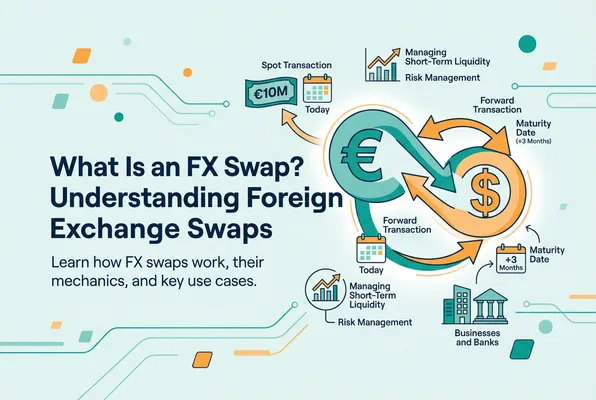
An FX swap (foreign exchange swap) is a financial instrument in which two parties agree to exchange a specific amount of one currency for another at the current spot rate, and then reverse that exchange at a later date using a predetermined forward rate. Essentially, it’s a combination of a spot transaction and a forward transaction bundled into a single agreement.
FX swaps are widely used by banks, corporations, and institutional investors to manage short-term liquidity needs in different currencies without taking on unwanted long-term currency risk. Unlike speculative trading, the primary purpose of an FX swap is to facilitate temporary currency exchange while locking in the terms of the reverse transaction upfront.
Key Characteristics of a FX Swap
- Two legs: A near-leg (spot transaction) and a far-leg (forward transaction).
- Fixed exchange rates: Both the initial and reverse exchange rates are agreed upon at the start.
- Short to medium term: Typically ranges from overnight to one year, though longer durations exist.
- No net currency exposure at maturity: Because the swap reverses the initial exchange, net exposure is neutralized once the contract matures.
How Does a FX Swap Work?
To understand how an FX swap functions, it helps to break the transaction into its two components.
The Near Leg (Spot Transaction)
At the start of the agreement, one party exchanges Currency A for Currency B at the prevailing spot exchange rate. For example, a European company needing US dollars might exchange euros for dollars today.
The Far Leg (Forward Transaction)
At a specified future date, the parties reverse the transactio, exchanging Currency B back for Currency A, at a rate agreed upon when the swap was initiated. This forward rate accounts for the interest rate differential between the two currencies, a concept known as the “swap points” or “forward points.”
Example of a FX Swap in Practice
Imagine a company based in the UK needs US dollars for three months to pay a supplier, but its main cash reserves are in British pounds. The company could:
- Enter into an FX swap with a bank, exchanging pounds for dollars today at the spot rate.
- Agree to reverse the transaction in three months, exchanging dollars back for pounds at a forward rate set today.
This allows the company to access the dollars it needs immediately, while eliminating uncertainty about the exchange rate it will pay when converting back to pounds later.
Why Do Businesses and Banks Use FX Swaps?
FX swaps serve several important functions in global finance:
1. Managing Short-Term Liquidity
Companies operating internationally often have cash flows in multiple currencies. FX swaps allow them to convert currency temporarily to meet payment obligations without permanently altering their currency holdings.
2. Hedging Currency Risk
Because the forward rate is locked in at the start of the swap, businesses can hedge against unfavorable currency movements during the swap’s term. This is particularly valuable for companies with predictable foreign currency cash flows.
3. Accessing Foreign Currency Funding
Banks and financial institutions frequently use FX swaps to raise funds in foreign currencies at competitive rates, especially when direct borrowing in that currency is more expensive or less accessible.
4. Balance Sheet Management
Since FX swaps involve a temporary exchange rather than a permanent conversion, they help institutions manage their balance sheets without taking on unwanted long-term currency exposure.
FX Swap vs. Currency Swap vs. Forward Contract
These three instruments are often confused, but they serve different purposes and have distinct structures.
FX Spot and FX Forward in Currency Management
When companies conduct foreign exchange transactions, they often need to decide whether they require an immediate currency exchange or a transaction at a future date. An FX spot transaction is generally used when one currency needs to be exchanged for another currency in the near term, whereas an FX forward allows the exchange rate for a future transaction to be agreed in advance. For example, a company with expenses in USD but revenues in EUR can use these instruments to manage the timing of its currency requirements. The combination of spot and forward transactions is particularly relevant when companies are used for hedging against unfavorable exchange rate movements. In this context, an FX swap can provide access to an immediate currency while simultaneously establishing a future exchange, helping the company manage its FX risk without permanently changing its underlying currency position.
FX Swap vs. Forward Contract
A forward contract involves only a single future exchange of currencies at a rate agreed upon today. An FX swap, by contrast, involves both an immediate (spot) exchange and a future (forward) exchange, making it a combination of two transactions rather than one.
FX Swap vs. Currency Swap
While the names sound similar, a currency swap typically involves the exchange of principal and periodic interest payments over a longer period, often years. An FX swap, on the other hand, usually only involves the exchange of principal amounts at the start and end of the agreement, with interest rate differentials embedded in the forward rate rather than paid separately.
| Feature | FX Swap | Currency Swap | Forward Contract |
|---|---|---|---|
| Duration | Days to 1 year (typically) | Multiple years | Single future date |
| Interest Payments | Embedded in rate | Paid periodically | None |
| Transactions | Two (spot + forward) | Two (principal exchange) + periodic interest | One |
| Common Use | Short-term liquidity | Long-term funding/hedging | Hedging a single future payment |
How Foreign Currency Swaps Work
While an FX swap normally focuses on a short-term exchange, a foreign currency swap can be structured over a considerably longer period. Under a swap agreement, two foreign parties agree on an exchange of one currency for another currency and subsequently exchange interest payments in different currencies. The parties may exchange the principal amounts in different currencies at the beginning and at the end of the agreement. During the life of the contract, one party pays interest based on a fixed or floating rate, while the other party makes payments according to the agreed terms. This structure allows both parties to obtain access to a currency they may need while managing their financing arrangements.
Interest Rates and the Notional Amount
An important element of a currency swap is the notional amount, sometimes referred to as the notional principal. This amount determines the basis on which interest payments are calculated, although it is not necessarily exchanged at every interest payment date. Depending on the type of swap, the interest rate can be fixed or floating. A floating rate may change over time as the underlying reference rate changes. Historically, benchmarks such as LIBOR were widely used to determine floating-rate payments, although modern contracts increasingly rely on alternative reference rates. Changes in the floating rate can therefore affect the size of future interest payments and the overall cost of the transaction.
Rate Differentials
One of the most important concepts in understanding FX swaps is the interest rate differential between the two currencies involved. This differential determines the “swap points”, the difference between the spot rate and the forward rate.
If Currency A has a higher interest rate than Currency B, the forward rate will typically reflect a discount on Currency A (or premium on Currency B), ensuring that neither party gains an arbitrage advantage simply by swapping currencies. This relationship is rooted in the covered interest rate parity principle, a cornerstone of international finance theory.
Who Uses FX Swaps?
FX swaps are used across a wide range of market participants:
- Central banks: To manage currency reserves and provide liquidity to financial systems, especially during periods of market stress.
- Commercial banks: To fund foreign currency loans or manage short-term currency mismatches.
- Multinational corporations: To manage cash flow needs across different currency zones.
- Institutional investors: To hedge currency exposure in international portfolios.
- Hedge funds: To exploit interest rate differentials or manage currency risk in trading strategies.
Historical Development of Currency Swaps
The development of currency swaps is closely connected to the growth of international financial markets and cross-border borrowing. A well-known early example dates back to 1981 between the World Bank and IBM, with Salomon Brothers acting as an intermediary. In this transaction, IBM swapped obligations involving Swiss francs and deutsche marks, allowing the parties to benefit from differences in their respective borrowing costs. This example demonstrated how exchanging principal and interest payments between two different currencies could create financing opportunities that were otherwise more difficult to achieve directly.
Risks Associated with FX Swaps
While FX swaps are generally considered a lower-risk instrument compared to speculative currency trading, they are not without risk.
Managing Currency and Interest Rate Risks
Currency swaps are particularly relevant for financial management because they can address both currency and interest rate risks within one transaction. A company that has revenues in EUR but needs USD financing, for example, may use a swap to align its financing currency with its expected cash flows. Depending on the structure, the parties can exchange interest payments and transform a fixed-rate obligation into a floating-rate obligation, or the other way around. This flexibility can be useful when exchange rate moves or rate changes create uncertainty around future financing costs.
Practical Considerations and the Maturity Date
The terms of a swap are determined by the parties involved and normally specify the currencies, the notional amount, interest calculation method, payment dates and maturity date. Companies and investors may use these contracts when they need to pay expenses in a foreign currency or want to match assets and liabilities denominated in different currencies. Before entering into such an agreement, however, the parties must consider the risks associated with foreign currency swaps, including changes in exchange rates, interest rates and the creditworthiness of the counterparty. Depending on the contract, a party may also need to negotiate with the counterparty if it wants to exit the swap before maturity.
Counterparty Risk
Since an FX swap is a bilateral agreement, there is a risk that the counterparty may default on their obligation, particularly on the far leg of the transaction.
Interest Rate Risk
Unexpected changes in interest rates can affect the relative attractiveness of the swap, although since rates are locked in advance, this mainly affects future decisions rather than the current contract.
Liquidity Risk
In times of market stress, the availability of counterparties willing to enter into FX swaps may diminish, potentially making it harder to roll over or unwind positions.
How FX Swaps Fit into the Broader FX Market
FX swaps are among the most heavily traded instruments in the global foreign exchange market, often surpassing spot transactions in daily trading volume according to data from the Bank for International Settlements. Their popularity stems from their flexibility, efficiency, and the crucial role they play in global funding markets.
For businesses navigating cross-border payments, understanding what a FX swap is and how it can be used strategically is an important step toward more effective currency risk management. Whether you’re a treasury manager at a multinational corporation or an investor managing an internationally diversified portfolio, FX swaps offer a practical tool for bridging short-term currency needs.
Final Thoughts
So, what is a FX swap? At its core, it’s a powerful yet straightforward financial tool that allows two parties to exchange currencies temporarily, combining a spot transaction with a forward transaction to manage liquidity, hedge risk, and access foreign currency funding. By understanding how FX swaps work, and how they differ from related instruments like forwards and currency swaps, businesses and investors can make more informed decisions when navigating the global currency markets.
As international trade and cross-border financial activity continue to grow, FX swaps remain a cornerstone instrument for managing currency exposure efficiently and effectively.

Written by
Dominik KonoldFounder
Dominik is the founder of Finflexia and an expert in treasury accounting, financial instrument valuation and IFRS compliance. Since 2016, he's been a certified Professional Risk Manager (PRMIA) and also lectures for the Association of Public Banks and the Academy of International Accounting. He built Finflexia to help treasury teams automate complex accounting workflows.
Related Posts
Debit Valuation Adjustment (DVA): Understanding Valuation Adjustments
This comprehensive guide explains debit valuation adjustments (DVA), valuation adjustments, credit risk, CVA, derivative pricing, and practical risk management strategies for financial institutions.
What Is CVA? Understanding Credit Valuation Adjustment and Counterparty Risk
This guide explains how Credit Valuation Adjustment (CVA) prices, hedges, and regulates the risk that a derivatives counterparty defaults.

Hypothetical Derivative Method Explained
To better understand the practical application of hedge accounting, the following sections examine key concepts related to hedge effectiveness, hypothetical derivatives, and cash flow hedges.
Ready to simplify your treasury accounting?
See how Finflexia helps you manage financial instruments with ease. Book a demo to learn more.
Book a Demo