What Is a Convertible Bond? How a Convertible Security Works
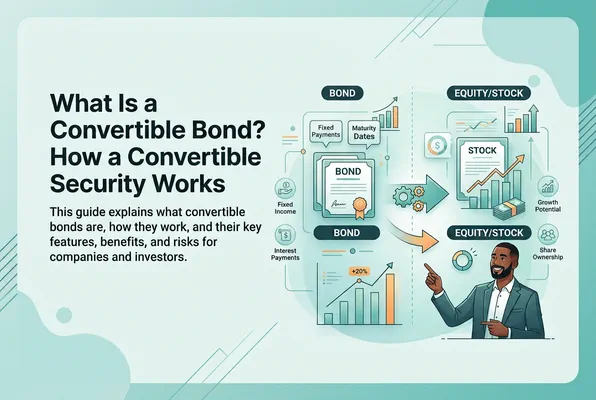

Convertible bonds occupy a unique space in the investment world, blending the stability of fixed-income securities with the growth potential of equities. If you’ve ever asked yourself, “What is a convertible bond?”, you’re exploring one of the most versatile financial instruments available to both companies raising capital and investors seeking balanced returns.
This guide breaks down everything you need to know about convertible bonds, how they work, their key features, advantages, risks, and how they compare to other investment options.
What Is a Convertible Bond?
A convertible bond is a type of corporate debt security that gives the holder the right to convert the bond into a specified number of shares of the issuing company’s common stock. Essentially, it starts its life as a bond, paying regular interest (coupon payments) and promising repayment of principal at maturity, but carries an embedded option to convert into equity under certain conditions.
This hybrid nature is what makes convertible bonds so appealing. Investors receive the security of fixed-income payments while retaining the opportunity to participate in the company’s stock price appreciation. If the stock performs well, bondholders can convert their holdings into shares and capture that upside. If it doesn’t, they can simply hold the bond to maturity and collect interest and principal like a traditional bondholder.
Key Characteristics of Convertible Bonds
To fully understand what a convertible bond is, it helps to look at its core components:
- Face value (par value): The amount the bondholder receives at maturity if not converted.
- Coupon rate: The fixed interest rate paid periodically, usually lower than comparable non-convertible bonds.
- Conversion ratio: The number of shares an investor receives per bond upon conversion.
- Conversion price: The price per share at which the bond can be converted, calculated by dividing the face value by the conversion ratio.
- Maturity date: The date when the bond’s principal is due if not converted earlier.
- Call provisions: Many convertible bonds include call features allowing the issuer to redeem the bond early under specific conditions.
How Does a Convertible Bond Work?
When a company issues a convertible bond, it sets the terms upfront, including the coupon rate, conversion ratio, and maturity date. Investors purchase the bond much like any other corporate bond, lending money to the company in exchange for periodic interest payments.
The defining feature kicks in when the company’s stock price rises above the conversion price. At that point, converting the bond into shares becomes more valuable than holding it as debt. Investors can exercise their conversion right, exchanging the bond for equity and benefiting from the stock’s appreciation.
If the stock price never reaches the conversion threshold, the investor simply holds the bond until maturity, receiving interest payments along the way and the full face value at the end, functioning just like a standard bond investment.
Example of a Convertible Bond in Action
Imagine a company issues a convertible bond with a face value of $1,000, a conversion ratio of 20 shares, and a coupon rate of 3%. This means the conversion price is $50 per share ($1,000 ÷ 20).
- If the company’s stock rises to $70 per share, converting the bond yields shares worth $1,400 (20 x $70), significantly more than the bond’s $1,000 face value. The investor would likely convert.
- If the stock stays at $40 per share, converting would only yield $800, less than the bond’s face value. The investor would hold the bond and continue collecting interest.
This example illustrates why convertible bonds are often described as offering “the best of both worlds.”
How the Value of a Convertible Bond Is Determined
The value of a convertible bond depends on several factors beyond its face value and coupon payments. The market price is influenced by bond prices in the broader market, changes in the interest rate, and the performance of the underlying stock. When the underlying stock price rises, the value of the convertible bond may increase because investors have greater potential to convert the bond into shares. The bond floor, which represents the approximate value of the bond as a conventional bond without the conversion feature, can provide a useful reference when assessing its value. As a result, the value of the underlying stock and the value of the bond can move in different ways depending on market conditions.
Why Do Companies Issue Convertible Bonds?
Understanding what a convertible bond is also means understanding why issuers choose this financing method. Companies, particularly growth-stage or capital-intensive businesses, often issue convertible bonds for several strategic reasons:
- Lower interest costs: Because of the added conversion feature, convertible bonds typically carry lower coupon rates than traditional bonds, reducing the company’s borrowing costs.
- Delayed equity dilution: Issuing convertible bonds allows companies to raise capital without immediately diluting existing shareholders, dilution only occurs if and when bonds are converted.
- Attracting investors: The potential for equity upside makes convertible bonds attractive to investors, even when the company’s credit rating isn’t top-tier.
- Flexible capital structure: Convertibles offer companies a middle ground between issuing pure debt and pure equity.
Convertible Financing for Issuing Companies
For issuing companies, convertible debt can provide an alternative form of convertible financing to conventional bonds or an immediate stock offering. Companies may offer convertible bonds when they want to raise capital while postponing potential equity dilution. The terms of the bond, including the conversion rate, maturity, interest rate, and other features, are normally outlined in the prospectus provided to investors. Depending on the structure, the company may repay the principal at maturity if investors do not convert the bond. This makes convertible financing a flexible option for bond issuers seeking capital while giving investors the possibility of future participation in the company’s equity.
Benefits of Convertible Bonds for Investors
Convertible bonds offer a distinctive risk-reward profile that appeals to a wide range of investors. Here are the primary benefits:
1. Downside Protection
Because convertible bonds function as debt instruments, they provide a safety net not found in common stock. Investors receive fixed interest payments and are entitled to principal repayment at maturity, assuming the issuer doesn’t default.
2. Upside Potential
The conversion feature allows investors to benefit from stock price appreciation, something traditional bonds cannot offer. This makes convertible bonds particularly attractive during bullish market conditions or when investing in high-growth companies.
3. Income Generation
Even while waiting for potential conversion opportunities, investors earn regular coupon payments, providing a steady income stream.
4. Portfolio Diversification
Convertible bonds can serve as a diversification tool, bridging fixed income and equity exposure within a single asset class, which can help smooth out portfolio volatility.
The Role of the Underlying Stock
The underlying stock is one of the most important factors affecting convertible securities. A convertible bond gives investors the right to exchange the bond for a certain number of shares of common stock according to its conversion rate. For example, if one bond can be exchanged for 20 shares, the number of shares per bond remains defined by the terms of the issue. If the stock price rises substantially above the conversion price, convertible bondholders may decide to convert their bonds because the shares have become more valuable. Conversely, if the stock price falls, investors may prefer to keep the bond and continue receiving interest rather than convert it into shares.
Risks Associated With Convertible Bonds
While convertible bonds offer appealing benefits, they are not without risks. A well-rounded understanding of what a convertible bond is requires examining the potential downsides:
- Lower yields: Because of the embedded conversion option, convertible bonds generally offer lower coupon rates than comparable non-convertible bonds, reducing fixed income if conversion never occurs.
- Credit risk: Convertible bonds are still subject to the issuer’s creditworthiness. If the company defaults, bondholders may not recover their full investment.
- Subordination: Convertible bonds often rank below senior debt in the capital structure, meaning bondholders may receive less in a bankruptcy scenario.
- Interest rate sensitivity: Like all bonds, convertible bonds are sensitive to interest rate changes, which can affect their market value.
- Dilution risk for shareholders: While beneficial for bondholders, conversion can dilute existing shareholders’ ownership stakes, potentially pressuring stock prices.
Convertible Bonds vs. Traditional Bonds vs. Stocks
| Feature | Convertible Bond | Traditional Bond | Common Stock |
|---|---|---|---|
| Fixed Income | Yes (lower rate) | Yes (higher rate) | No |
| Equity Upside | Yes (via conversion) | No | Yes |
| Principal Protection | Yes (if held to maturity) | Yes | No |
| Volatility | Moderate | Low | High |
| Priority in Bankruptcy | Below senior debt | Senior to equity | Last priority |
This comparison highlights why convertible bonds are often described as a “hybrid” security, they sit between the risk-reward profiles of pure debt and pure equity instruments.
Convertible Bonds and Preferred Stock
Convertible securities can take different forms, and convertible preferred stock is another example of an instrument that combines characteristics of fixed-income and equity investments. Convertible preferred stock is a form of preferred stock that may allow investors to exchange their preferred shares for a predetermined number of shares of common stock. Unlike a traditional convertible bond, it is not structured as convertible debt and does not represent the same type of bond issued by a company. The specific rights, conversion conditions, dividends, and ranking of convertible preferred stock depend on the terms established by the issuing company.
Types of Convertible Bonds
Not all convertible bonds are structured the same way. Common variations include:
- Vanilla convertible bonds: The most basic structure, offering standard conversion rights at a fixed ratio.
- Mandatory convertibles: These require conversion into equity at maturity, rather than giving investors a choice.
- Reverse convertibles: Give the issuer, not the investor, the option to convert the bond into equity, often used in structured products.
- Exchangeable bonds: Similar to convertibles, but convertible into shares of a different company than the issuer, often a subsidiary or affiliate.
When Can Investors Convert a Bond?
The ability of investors to convert a bond is determined by the specific terms of the security. Some convertible bonds allow conversion at any time after a specified date, while others permit conversion only at predetermined times or when certain conditions are met. The prospectus explains when bondholders can convert their bonds, the applicable conversion rate, and the number of shares they will receive. If the conditions are satisfied, investors can exchange the bond for shares rather than continue holding the debt. These differences are important when comparing types of convertible securities because conversion rights can have a significant effect on both the market price and the overall value of the convertible bond.
Who Should Consider Investing in Convertible Bonds?
Convertible bonds can be a strategic fit for investors seeking a balance between income and growth. They may be particularly suitable for:
- Moderate-risk investors looking for equity exposure with some downside protection.
- Income-focused investors who still want participation in potential stock gains.
- Portfolio diversifiers aiming to reduce overall volatility while maintaining growth potential.
As with any investment, it’s essential to assess your risk tolerance, investment horizon, and overall portfolio strategy before adding convertible bonds to your holdings.
Final Thoughts
So, what is a convertible bond? It’s a powerful financial instrument that merges the predictability of fixed-income investing with the growth potential of equity markets. By offering regular interest payments alongside the option to convert into shares, convertible bonds provide a unique risk-reward balance that can enhance diversification and offer downside protection with upside potential.
Whether you’re a conservative investor looking to dip your toes into equity exposure or a growth-oriented investor seeking some income stability, understanding how convertible bonds work can help you make more informed, strategic investment decisions.

Written by
Dominik KonoldFounder
Dominik is the founder of Finflexia and an expert in treasury accounting, financial instrument valuation and IFRS compliance. Since 2016, he's been a certified Professional Risk Manager (PRMIA) and also lectures for the Association of Public Banks and the Academy of International Accounting. He built Finflexia to help treasury teams automate complex accounting workflows.
Related Posts
Interest Rate Floor Explained
This Guide provides an overview of interest rate caps and floors in lending, explaining how they set upper and lower limits on variable interest rates in loan contracts and protect lenders and borrowers from extreme market movements.
Embedded Derivative Accounting: Complete Guide (IFRS 9 & ASC 815)
This guide explains embedded derivative accounting under IFRS and ASC 815, including fair value measurement, hybrid instrument assessment, and the closely related test.
Embedded Derivative: Identification, Separation & Accounting
This article explains embedded derivatives under ASC 815 and IFRS, including how to identify, separate, and account for them. It also outlines when a derivative under ASC 815 must be bifurcated and how it impacts financial reporting.
Ready to simplify your treasury accounting?
See how Finflexia helps you manage financial instruments with ease. Book a demo to learn more.
Book a Demo