Covenant Explained: What Are Covenants in Contracts and How Do They Work?

What Are Covenants? Understanding the Basics
When businesses or individuals borrow money, lenders want more than just a promise of repayment, they want enforceable guarantees that reduce their risk. This is where covenants come in. If you’ve ever asked yourself “what are covenants,” you’re exploring one of the most important building blocks of modern lending and corporate finance.
In short, covenants are formal, legally binding clauses included in loan agreements, bonds, or other financial contracts that require the borrower to either do certain things or refrain from doing certain things. They act as a safeguard for lenders, ensuring the borrower maintains the financial health and operational discipline needed to honor the debt.
Understanding covenants is essential whether you’re a business owner negotiating a loan, an investor analyzing a bond, or simply someone trying to make sense of complex financial agreements.
The Purpose of Covenants in Finance
Covenants exist primarily to protect lenders, but they also create a framework of trust and transparency that benefits borrowers in the long run. Here’s why they matter:
- Risk mitigation: Lenders use covenants to monitor the financial stability of borrowers and catch warning signs early.
- Early intervention: If a borrower’s financial situation deteriorates, covenants allow lenders to step in before the situation becomes unmanageable.
- Structured accountability: Covenants establish clear rules so both parties understand their obligations and limitations.
- Negotiation leverage: For borrowers, agreeing to certain covenants can sometimes result in better interest rates or more favorable loan terms.
Without covenants, lenders would have far less visibility into how borrowers are managing their finances after the loan is issued, making lending riskier and more expensive for everyone.
Covenants as Legal Promises
A covenant is a legal promise that forms part of a binding agreement between two or more parties. Unlike a general agreement or promise, a covenant creates specific obligations that the parties involved must comply with under the terms and conditions of the contract. In contract law, covenants can require one party to perform a particular act, maintain a certain standard, or prohibit certain actions. The exact obligations depend on how the covenant is drafted and what the parties expressly agree to. This makes clear drafting especially important, as unclear covenants can create disputes over whether a party has complied with its obligations.
Types of Covenants
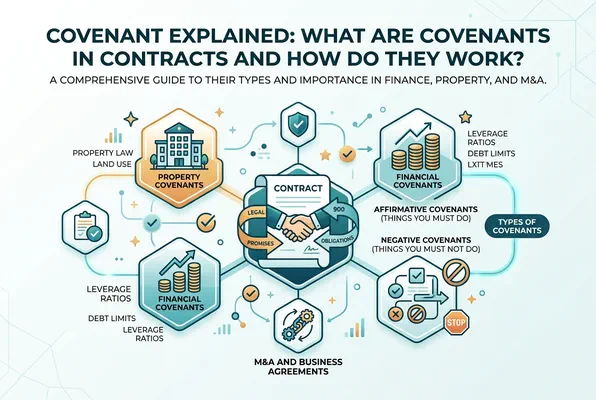
Covenants generally fall into two broad categories: affirmative covenants and negative covenants. Within these categories, there are more specific types, including financial covenants and non-financial covenants.
Affirmative Covenants
Affirmative covenants (also called positive covenants) require the borrower to take specific actions. These are things the borrower must do to remain in compliance with the loan agreement. Common examples include:
- Maintaining proper business insurance
- Providing regular financial statements to the lender
- Paying taxes on time
- Maintaining business licenses and legal compliance
- Keeping collateral assets in good condition
Negative Covenants
Negative covenants (also called restrictive covenants) limit what a borrower can do without lender approval. These restrictions are designed to prevent actions that could increase risk for the lender. Examples include:
- Restrictions on taking on additional debt
- Limitations on paying dividends to shareholders
- Restrictions on selling major assets
- Limits on mergers or acquisitions
- Prohibitions on changing the nature of the business
Property Covenants and Property Law
Covenants can also play an important role in property law. A deed property covenant may impose obligations or restrictions on how a property can be used, developed, or transferred. Some property covenants are designed to run with the land, meaning that the obligation may remain connected to the property rather than only to the original parties. Depending on the applicable law, a successor, purchaser, or transferee may therefore become subject to the covenant. Common examples include restrictions on development, requirements to maintain a shared driveway, or obligations affecting the use of land. These types of property covenants are an important part of conveyancing and can affect property rights long after the original agreement was created.
Financial Covenants
Financial covenants are a specific subset of covenants tied directly to measurable financial metrics. Lenders use these to track the ongoing financial health of a borrower. Some of the most common financial covenants include:
- Debt-to-equity ratio: Ensures the borrower doesn’t take on excessive debt relative to equity.
- Interest coverage ratio: Confirms the borrower generates enough earnings to cover interest payments.
- Current ratio: Measures short-term liquidity to ensure the borrower can meet immediate obligations.
- Minimum net worth requirements: Ensures the borrower maintains a certain baseline of assets over liabilities.
- Debt service coverage ratio (DSCR): Evaluates whether cash flow is sufficient to cover debt obligations.
These financial covenants are often tested quarterly or annually, and failing to meet them can trigger serious consequences.
Covenants in Loan Agreements vs. Bond Agreements
While the core concept remains the same, covenants can look slightly different depending on the type of financial instrument.
Covenants in Loan Agreements
In bank loans and credit agreements, covenants are often more detailed and strictly enforced because lenders typically have ongoing relationships with borrowers and more direct access to financial data. Loan covenants are commonly reviewed on a regular reporting schedule.
Covenants in Bond Agreements
Bond covenants are included in the bond indenture, the legal contract between the bond issuer and bondholders. Since bondholders are often more passive investors without direct oversight capabilities, bond covenants tend to be more standardized and sometimes less restrictive than bank loan covenants.
Covenants in Contracts Beyond Financing
The concept of covenants is not limited to loans and bonds. Covenants in contracts can appear in many commercial agreements and may define obligations that continue throughout the relationship between the parties involved. For example, a lease may contain covenants requiring a tenant to maintain the property, comply with applicable rules, or refrain from making certain changes without consent. In a business transaction, the agreement may also include covenants requiring a party to disclose information, preserve particular assets, or take certain actions before closing. These provisions help translate the parties’ expectations into clearly defined contractual obligations.
What Happens If a Covenant Is Breached?
A covenant breach, also called a covenant violation or technical default, occurs when a borrower fails to meet one or more of the agreed-upon conditions. This doesn’t necessarily mean the borrower has missed a payment; it simply means they’ve violated one of the terms of the agreement.
Common consequences of a covenant breach include:
- Technical default declaration: The lender formally notes that the borrower is in default, even if payments are current.
- Demand for immediate repayment: In severe cases, lenders can call the entire loan due immediately.
- Increased interest rates: Lenders may impose penalty rates as compensation for increased risk.
- Additional collateral requirements: Borrowers may be asked to pledge more assets as security.
- Covenant waivers or amendments: Often, lenders and borrowers negotiate a waiver, giving the borrower time to fix the issue without triggering harsher penalties.
This is why many businesses work closely with financial advisors or use financial planning tools to monitor covenant compliance proactively.
Breach of a Covenant and Legal Remedies
If a party fails to comply with a covenant, the available remedy depends on the agreement, the type of covenant, and the applicable law. A breach may give the other party a contractual claim for damages, while some circumstances may allow for specific performance or another equitable remedy. Whether a breach also constitutes a broader breach of contract depends on the wording of the agreement and the legal framework governing it. In property law, enforcement can raise additional questions about privity, successors, and whether a covenant runs with the land. Because the consequences can be serious, parties should carefully review the covenant before entering into a binding agreement.
Why Covenants Matter for Borrowers Too
While covenants are primarily designed to protect lenders, they can also benefit borrowers. Here’s how:
- Lower interest rates: Agreeing to stricter covenants can sometimes result in more favorable borrowing terms.
- Financial discipline: Covenants encourage borrowers to maintain healthy financial practices.
- Trust building: Meeting covenant requirements consistently can strengthen the borrower-lender relationship, making future borrowing easier.
- Early warning system: Covenants can help borrowers recognize financial trouble before it becomes a crisis.
How to Manage and Stay Compliant with Covenants
For businesses, staying on top of covenant requirements is critical to avoiding costly breaches. Here are some best practices:
- Track financial ratios regularly, not just at reporting deadlines.
- Build in buffers when negotiating covenant thresholds to allow room for fluctuations.
- Communicate proactively with lenders if you foresee a potential covenant issue.
- Use financial management tools to automate tracking of key covenant metrics.
- Review agreements carefully before signing to fully understand all obligations.
Many companies now rely on digital financial platforms to simplify covenant tracking, reduce the risk of accidental breaches, and maintain stronger lender relationships.
Covenants in M&A Transactions
Covenants are also important in mergers and acquisitions (M&A), where they can govern the period between signing a transaction and closing. An acquisition agreement may require the seller to operate the business in the ordinary course, preserve important relationships, maintain manufacturing facilities, or obtain consent before taking certain actions. Other provisions may restrict the incurrence of additional debt or changes to the company’s assets during this period. The purpose is to preserve the condition of the business while the transaction is subject to the agreed terms and conditions. Similar obligations can also appear in investment agreements and other commercial transactions where one party needs protection while waiting for a transaction to be completed.
Final Thoughts
So, what are covenants? At their core, they are the rules of the game in debt financing, conditions that protect lenders while also encouraging borrowers to maintain financial discipline. Whether you’re dealing with affirmative covenants, negative covenants, or specific financial covenants, understanding these terms is essential for anyone involved in loans, bonds, or corporate finance.
By understanding how covenants work, what triggers a breach, and how to stay compliant, both borrowers and lenders can build stronger, more transparent financial relationships, reducing risk and creating a foundation for long-term financial success.

Written by
Dominik KonoldFounder
Dominik is the founder of Finflexia and an expert in treasury accounting, financial instrument valuation and IFRS compliance. Since 2016, he's been a certified Professional Risk Manager (PRMIA) and also lectures for the Association of Public Banks and the Academy of International Accounting. He built Finflexia to help treasury teams automate complex accounting workflows.
Related Posts
Understanding Comprehensive Income and Accumulated Other Comprehensive Income (AOCI)
This article explains comprehensive income, OCI, and AOCI, covering their components, accounting standards, financial statement presentation, tax effects, and importance for investors and businesses.
What Is an Interest Rate Swap?
This guide explains interest rate swaps, including how they work, their types, valuation, benefits, risks, and role in managing interest rate risk.

What Is an FX Swap? Understanding Foreign Exchange Swaps
This article explains what an FX swap is, how it works, and how it is used to manage foreign currency, liquidity, and financial risks.
Ready to simplify your treasury accounting?
See how Finflexia helps you manage financial instruments with ease. Book a demo to learn more.
Book a Demo