Treasury Management: Complete Guide + TMS Explained
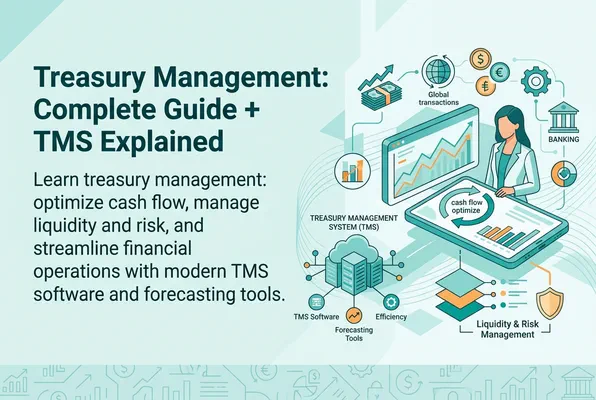

Whether you run a fast-scaling startup or a multinational corporation, one question is always relevant: how do you keep money working efficiently while protecting the business from financial risk? The answer lies in effective treasury management, and in this guide, you will learn exactly what it means, how it works, and how modern tools like a treasury management system can transform your financial operations.
What Is Treasury Management?
Treasury management is the process of overseeing an organization’s financial assets, including cash, investments, and debt, to support business objectives, maintain liquidity, and manage risk. It encompasses everything from daily cash flow monitoring to long-term capital management and banking relationships, forming a comprehensive financial management function.
Treasury management encompasses a broad scope of activities: collections, disbursements, short- and long-term financing, investment management, and regulatory compliance. Unlike pure accounting or FP&A, the treasury function sits at the center of the financial supply chain, connecting accounts receivable, accounts payable, and external banking partners.
A dedicated treasurer or treasury management team is typically responsible for these activities, operating under the CFO or VP of Finance in most organizations.
How Treasury Management Works
Core Functions of the Treasury Function
Effective treasury management relies on five interconnected pillars:
1. Cash Management: Cash management is treasury’s most visible responsibility. Treasury professionals use cash flow forecasting to plan liquidity needs, ensuring the organization can meet current and future financial obligations on time while optimizing the financial management function. This includes managing bank accounts, optimizing cash reserves, and investing excess funds.
2. Risk Management: The treasury function plays a central role in identifying, measuring, and mitigating financial risk. This includes liquidity risk, market risk, and credit risk: the inability to meet payment obligations, exposure to interest rate and currency fluctuations, and potential losses arising from counterparty default.
To manage risk effectively, treasury teams use hedging strategies, FX instruments, and scenario analysis to protect the business.
3. Debt and Equity Financing: Treasury manages access to medium and long-term financing, whether through bank credit lines, bond issuance, or equity to fund asset expansion and strategic initiatives while maintaining financial flexibility.
4. Banking Relationships: Managing relationships with banking partners, credit agencies, and financial institutions is a key element of treasury management. Strong relationships improve access to credit and optimize the cost of banking services.
5. Technology and Treasury Operations are increasingly integrated, with advanced treasury and risk management applications driving improvements in efficiency and decision-making. Modern treasury operations depend on robust tools. Treasury teams are responsible for selecting and managing technology solutions that automate reporting, improve cash visibility, and achieve straight-through processing across systems, ultimately enhancing the organization’s treasury capabilities.
Treasury Management vs. Cash Management
The terms treasury management and cash management are frequently used interchangeably, but they are distinct disciplines. Cash management focuses on daily liquidity: collections, disbursements, and short-term borrowing. Treasury management goes further, incorporating capital management, long-term financing, working capital optimization, and enterprise-wide risk management to create a complex treasury landscape.
Both disciplines share the same ultimate goal: maximize liquidity, minimize costs, and manage risk within the organization’s strategic framework.
What Is a Treasury Management System (TMS)?
A treasury management system (TMS) is specialized software that centralizes and automates treasury operations. Rather than relying on spreadsheets and manual processes, a TMS gives finance teams real-time visibility into cash positions, automates bank account reconciliation, enables accurate cash flow forecasting, and supports risk management workflows.
Key Benefits of Implementing a TMS
- Real-time cash visibility across all bank accounts and entities
- Automated forecasting is a key component of modern treasury management solutions that improve accuracy and efficiency to anticipate liquidity needs and avoid shortfalls
- Streamlined payments are essential for effective financial management and can significantly enhance the organization’s treasury operations via ACH, wire transfers, and international trade workflows, organizations can streamline their treasury operations and enhance financial management.
- Improved risk management through integrated FX exposure monitoring
- Regulatory compliance is a critical aspect of treasury and risk management that organizations must navigate to ensure effective financial management
- Scalability is crucial for organizations looking to enhance their enterprise treasury and risk management capabilities
Organizations that implement a TMS typically see faster decision-making, reduced manual errors, and measurable improvements in working capital efficiency, further strengthening their financial management.
How Does a Treasury Management System Work?
A TMS integrates with your banking partners, ERP, and accounting systems to pull in real-time financial data. It then consolidates that data into dashboards that help treasury professionals forecast cash needs, monitor liquidity, manage bank accounts, and flag financial risk, all from a single platform, enhancing the organization’s treasury capabilities.
Platforms like Finflexia are designed to deliver these management capabilities in an accessible, modern interface, making treasury management practical even for growing businesses that don’t yet have a large treasury department.
Treasury Management in Banking
In banks, the treasury function is more integral than in corporates. A bank’s treasury manages the institution’s assets and liabilities, ensuring that funds raised through deposits and wholesale debt are deployed effectively across lending and investment activities.
Key responsibilities of a bank’s treasury team include: Managing the asset liability management (ALM) desk to mitigate interest rate mismatches, operating foreign exchange and money market desks, monitoring Basel III regulatory capital ratios and Supporting clients through treasury management services such as ACH processing, fraud prevention, and information reporting
Smaller banks are increasingly expanding their treasury management offerings as technology makes these services more accessible and treasury professionals become more widely available.
Key Challenges in Corporate Treasury Management
Modern treasurers face a range of complex, evolving challenges:
- Cash flow unpredictability across business units and geographies
- Currency risk from international trade and cross-border operations
- Fraud exposure in an increasingly digital banking environment
- Compliance burdens from evolving regulatory requirements
- Technology fragmentation across disconnected banking and ERP systems
Addressing these challenges requires a combination of strong treasury expertise, disciplined processes, and the right treasury technology. Organizations that automate their treasury operations consistently outperform those relying on manual workflows.
Organizational Structure of the Treasury Department
The treasury department’s structure depends on the size and complexity of the business. Larger organizations typically use centralized treasury models to streamline operations, reduce costs, and manage risk more effectively. Smaller or more decentralized organizations may distribute treasury responsibilities across regional teams, impacting the overall financial management function.
Some multinationals operate shared service centers (SSCs) or in-house banks to consolidate treasury management services internally, reducing reliance on external banking services and optimizing liquidity across legal entities.
Why Treasury Management Matters for Your Business
Effective treasury management is not just a back-office function, it is a strategic enabler. By ensuring your organization always has the liquidity it needs, by helping you mitigate financial risk before it becomes a crisis, and by giving your finance teams the data to make informed decisions with confidence, treasury management directly supports business growth.
Whether you are looking to optimize cash flow, streamline your banking operations, or build a more resilient financial strategy, investing in the right treasury management approach and the right TMS is one of the most impactful decisions a finance leader can make.
Ready to transform your treasury operations? Explore how Finflexia can help you build a smarter, more efficient treasury function today.

Written by
Dominik KonoldFounder
Dominik is the founder of Finflexia and an expert in treasury accounting, financial instrument valuation and IFRS compliance. Since 2016, he's been a certified Professional Risk Manager (PRMIA) and also lectures for the Association of Public Banks and the Academy of International Accounting. He built Finflexia to help treasury teams automate complex accounting workflows.
Related Posts
Treasury Management System: Complete TMS Guide 2026
Treasury management system (TMS) guide: features, benefits, cash flow, risk management, ERP vs TMS, and how to choose the best treasury software.
Treasury Management Software: The Complete Guide to Smarter, Faster Treasury Operations
Discover how treasury management software streamlines cash flow, liquidity, and risk. Compare top platforms and find the best solution for your business.
Ready to simplify your treasury accounting?
See how Finflexia helps you manage financial instruments with ease. Book a demo to learn more.
Book a Demo