Treasury Management System: Complete TMS Guide 2026
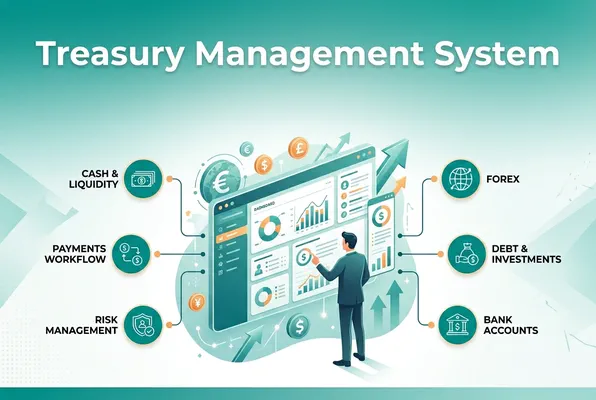

Managing corporate finances in today’s environment demands more than spreadsheets and manual bank reconciliations. As businesses expand globally, operate across multiple banks, and face increasingly complex financial risk landscapes, the need for a dedicated treasury management software provides a solution.
This guide explains what a TMS is, how it works, what core features to look for in treasury systems, and how to choose the best treasury management solution for your organization’s enterprise treasury needs.
What Is a Treasury Management System?
A treasury management system (TMS) is a enterprise-grade software designed to centralize and automate a company’s treasury operations, empowering the treasurer with advanced tools. It handles everything from daily cash management and liquidity monitoring to FX transactions, debt management, payment processing, and financial risk mitigation.
Unlike generic accounting software, a TMS is purpose-built for the treasurer’s office, offering specialized features that enhance wealth management. It connects directly to banking networks, integrates with ERP systems, and delivers real-time visibility into the organization’s global cash position, giving treasury teams the data they need to make confident, informed decisions.
Modern TMS platforms have evolved far beyond their original role as bank connectivity tools. Today’s solutions offer intelligent automation, AI-powered cash flow forecasting, and sophisticated risk management capabilities that transform treasury from a back-office function into a strategic business driver.
How Does a Treasury Management System Work?
At its core, a TMS works by pulling financial data from multiple banks and internal systems into a single, unified platform. Here’s a simplified overview of the enterprise treasury workflow:
- Data aggregation is a key feature that software helps to enhance in treasury management. The TMS connects to banking networks via SWIFT, BAI2, or API integrations, collecting transaction data, bank statements, and balance information in real time from various data sources.
- Cash positioning reconciles incoming data against forecasts and internal records to produce an accurate, up-to-date cash position across all entities and accounts.
- Workflow automation: Payments, approvals, FX transactions, and reporting are automated through predefined workflows, reducing manual intervention and streamlining treasury management activities.
- Risk monitoring: The system continuously tracks financial risk exposures such as FX rate movements, interest rate changes, and counterparty risks, leveraging advanced risk management tools.
- Reporting & audit: Dashboards and automated reports give stakeholders visibility into treasury operations, while a full audit trail supports compliance requirements.
This connected workflow allows treasury teams to operate proactively rather than reactively, enhancing their overall management activities.
Core Features of a Modern TMS
Cash and Liquidity Management
Cash management is the foundation of any TMS. The system aggregates bank data to provide real-time cash positions across all accounts and geographies, enhancing treasury intelligence. It supports liquidity management by consolidating cash pooling, intercompany funding, and in-house banking structures into a single system. Cash flow forecasting capabilities allow treasury teams to project future liquidity needs with accuracy, incorporating data from accounts payable, accounts receivable, and other internal sources.
Payments and Workflow Management
A TMS streamlines payment processes by connecting to multiple banks and managing payment origination through centralized workflow controls. It supports multilateral netting for intercompany transactions, automates approval workflows, and ensures payments meet compliance standards, which are critical for treasury functions. Some organizations use their TMS as a full payment hub, routing all corporate payments through a single system for greater control and visibility.
FX and Financial Risk Management
For companies operating in multiple currencies, FX management is critical. A TMS provides modules for spot and forward FX transactions, non-deliverable forwards, and options. It tracks FX exposures, delivers mark-to-market valuations, and supports hedge effectiveness testing. This directly reduces financial risk by ensuring currency exposures are identified, managed, and reported consistently.
Debt and Investment Management
Most TMS platforms include tools to manage short- and long-term debt obligations, letters of credit, and investment portfolios. These features help treasury teams track borrowings, optimize investment returns, and maintain accurate debt management schedules, all within the same platform.
Bank Account Management
Effective bank account management requires secure oversight of account details, signatory authorities, and fee structures. Leading treasury platforms now include electronic bank account management (eBAM) capabilities and approval workflows to ensure governance over account changes, crucial for effective management of financial resources.
Reconciliation and General Ledger Integration
One of the most time-consuming manual processes in treasury is reconciliation. A TMS automates bank-to-book reconciliation by matching imported bank transactions against general ledger entries using configurable rules. It also enables automatic posting of treasury transactions to the ERP, utilizing treasury intelligence to reduce errors and accelerate month-end close.
Reporting, Dashboards, and Audit Trail
A TMS delivers automated, tailored reporting across cash positions, payments, risk exposures, forecasts, and investments. Dashboards consolidate key metrics for executives and treasury teams alike, while a complete wealth management strategy is integrated into the platform. Audit trail supports internal controls and regulatory compliance.
TMS vs. ERP: Understanding the Difference
A common question among finance teams is whether their existing ERP system, such as SAP S/4HANA, can replace a dedicated treasury solution like Kyriba for integrated treasury and risk management. The short answer: it depends on your complexity.
ERP systems offer treasury modules that handle basic cash and payment functions, and they excel at general ledger integration. However, for organizations with complex treasury operations, multiple banking relationships, active FX hedging, global liquidity structures, or sophisticated risk management needs, a standalone TMS typically offers greater depth, flexibility, and real-time connectivity than ERP treasury modules alone.
Many enterprises adopt a hybrid approach: using their ERP for core accounting and a dedicated treasury management solution for advanced treasury workflows. A cloud-based treasury management system like Kyriba can enhance your core treasury functions. Treasury solutions can often be layered on top of existing financial systems without a full replacement, enabling teams to gain the benefits of specialized software while preserving their ERP investment.
Benefits of Implementing a TMS
The benefits of a TMS extend well beyond automation. Organizations that implement modern management systems report improvements across several dimensions:
- Real-time visibility into cash positions is essential for effective treasury and risk management
- Significant reduction in manual treasury workflows and the errors they introduce
- Stronger management of financial processes leads to improved efficiency in treasury operations.
- Faster, more accurate cash flow forecasting that supports better strategic decisions
- Improved compliance posture through automated audit trails and approval workflows is a key benefit of modern treasury systems.
- Greater connectivity between treasury, accounting, accounts payable, and accounts receivable teams
- Freed-up capacity for treasury teams to focus on strategic initiatives rather than administrative tasks is essential for effective spend management and overall enterprise treasury success.
For growing businesses, a TMS also provides the scalability needed to handle increasing transaction volumes, additional banking relationships, and new geographic entities without proportionally increasing headcount.
Choosing the Right Treasury Management System
Selecting the right TMS is a significant decision that will shape your treasury capabilities for years. Here are the key factors to evaluate:
Define Your Requirements First
Start by mapping your current treasury operations and pain points. Do you need better treasury systems for managing treasury operations? Cash visibility, more robust FX risk management, or streamlined payment processes are vital for optimizing treasury functions. Understanding your specific needs will help you filter the market efficiently and avoid paying for features you won’t use in your TMS selection.
Evaluate Total Cost of Ownership
TMS costs include initial implementation (software, integration, training), ongoing licensing fees, and variable transaction costs. Cloud-based treasury management system options generally have lower upfront costs but may carry higher per-transaction fees at scale. On-premise or installed solutions typically involve higher initial investment but lower ongoing licensing.
Assess Integration Capabilities
A TMS that cannot connect seamlessly to your existing banking networks and ERP system will create more problems than it solves. Prioritize platforms with strong connectivity to your banking partners and proven integrations with financial systems like SAP or other ERP solutions already in use.
Consider Deployment Speed and Usability
Implementation timelines for treasury solutions vary widely, from 90 days for modern cloud-native platforms to 18–24 months for complex enterprise deployments. Faster time-to-value is increasingly important as businesses need to respond quickly to changing liquidity conditions. Equally important is the user experience: a TMS that treasury teams actually want to use drives adoption and maximizes ROI.
Vendor Support and Scalability
Evaluate the vendor’s customer support model, implementation methodology, and product roadmap. The best treasury management software Providers offer dedicated support for treasury-specific issues and a clear path to expanded capabilities as your organization grows, ensuring effective management of financial resources.
The Future of Treasury Management Systems
The treasury platform landscape is evolving rapidly with new innovations in risk management tools. AI-powered effective cash forecasting is a key component of a successful treasury management system designed for modern organizations. Intelligent automation and real-time connectivity are no longer differentiators, they are becoming table stakes. Leading platforms now apply machine learning to improve forecast accuracy, detect payment anomalies, and automate reconciliation exceptions automatically, enhancing treasury intelligence.
For corporate treasury teams, this means the gap between organizations using modern, cloud-based treasury management systems and those relying on existing systems or legacy systems will only widen. Investing in the right treasury management system today is not just about solving today’s operational challenges, it is about building the financial infrastructure to compete effectively tomorrow.
At Finflexia , we help finance and treasury teams streamline operations, gain real-time visibility into their cash positions, and make smarter decisions with modern, intuitive financial management tools. Whether you are evaluating your first TMS or looking to replace a legacy solution, our platform is designed to grow with your business.

Written by
Dominik KonoldFounder
Dominik is the founder of Finflexia and an expert in treasury accounting, financial instrument valuation and IFRS compliance. Since 2016, he's been a certified Professional Risk Manager (PRMIA) and also lectures for the Association of Public Banks and the Academy of International Accounting. He built Finflexia to help treasury teams automate complex accounting workflows.
Ready to simplify your treasury accounting?
See how Finflexia helps you manage financial instruments with ease. Book a demo to learn more.
Book a Demo