Portfolio Hedge: How to Hedge Your Portfolio Effectively
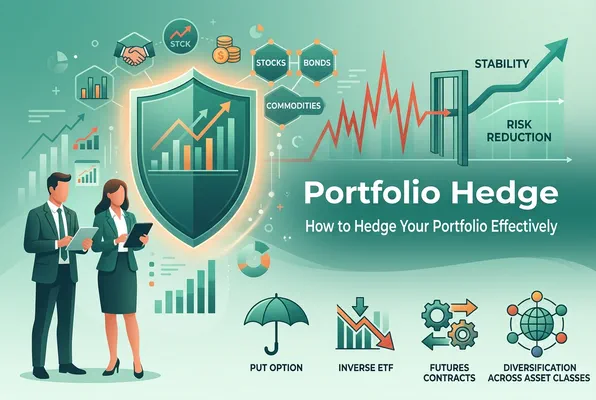

Market swings can turn a solid year of gains into a stressful scramble to limit losses. That’s where a portfolio hedge comes in. Whether you’re a retail investor with a handful of stock positions or someone managing a diversified equity portfolio, understanding how to hedge your portfolio is one of the most important skills in modern investing.
This guide breaks down what a portfolio hedge is, the most common hedging strategies, and how to decide whether hedging makes sense for your investment objectives.
What Is a Portfolio Hedge?
A portfolio hedge is a strategy used to offset potential losses in your stock portfolio by taking a position that tends to move in the opposite direction of your existing holdings. The goal isn’t necessarily to generate profit, it’s to reduce risk and limit the damage from a market downturn.
Think of hedging as insurance for your investments. You pay a small cost upfront (like an option premium or a management fee) in exchange for protection against a price decline. If the market falls, your hedge gains value and cushions the blow to your overall investment.
Many investors confuse “hedge” with “hedge fund,” but they’re different concepts. A hedge fund is an investment fund managed by professional fund managers who use advanced risk strategies, leverage, and derivatives to pursue returns for clients, often charging a management fee and taking a cut of profits. Hedging your own portfolio is simpler, it’s a trading strategy anyone can apply to protect their investments.
Why Investors Use Hedging Strategies
There are several reasons investors use hedging strategies, including:
- Protecting gains: If your stock portfolio has appreciated significantly, hedging locks in some of those gains without forcing you to sell.
- Managing volatility: When VIX spikes or market conditions turn uncertain, a hedge can reduce the emotional and financial impact of sharp swings.
- Reducing concentration risk: If a large portion of your portfolio is tied to one sector or stock, hedging helps diversify your risk exposure.
- Maintaining market exposure: Unlike selling your stock positions outright, hedging lets you stay invested while limiting downside risk.
Ultimately, the right approach depends on your risk tolerance and investment objectives. Some investors hedge constantly as part of their trading strategy, while others only hedge during periods of heightened uncertainty.
Common Hedging Methods
There are several types of hedging investors can use, each with different costs, complexity, and risk exposure.
1. Put Options
A put option gives you the right to sell a stock at a specific strike price before expiration. If the stock price falls below that strike price, your put option increases in value, offsetting losses in your equity portfolio. This is one of the most widely used option strategies because it provides defined risk, you only lose the premium paid if the market doesn’t decline.
For example, if you own 100 shares of a stock trading at $150 and buy a put with a $140 strike price, you’re protected against a price decline below $140, minus the cost of the option.
Using Options to Protect Individual Investments
Investors who want to protect a particular holding without selling their shares may consider using options as part of a risk management strategy. A put option can provide the right to sell an asset at a predetermined strike price, while a call option gives the holder the right to buy an asset at a specified price. For example, an investor who expects short-term market volatility but wants to retain a long-term stock position may purchase a put option to hedge against market risk. The effectiveness of this approach depends on factors such as the option premium, expiration date, and current market price of the underlying asset. Although options can help minimize the risk of certain losses, they do not eliminate every source of risk, and their cost can reduce overall investment profits.
2. Inverse ETFs
Inverse ETFs are designed to move in the opposite direction of a benchmark index. If the broad market declines, an inverse ETF should rise, helping offset losses elsewhere in your portfolio. These are popular because they’re easy to buy and sell like any other ETF, without needing an options trading account.
However, inverse ETFs come with risks and costs, they often use derivatives internally and can experience “decay” over time due to daily rebalancing, making them better suited for short-term hedges than long-term holdings.
3. Futures Contracts
Futures allow investors to lock in a price for a stock index, commodity, or oil futures contract, hedging against future price movements. Institutional investors and fund managers frequently use futures and options together to hedge large equity portfolios efficiently.
4. Diversification Across Asset Classes
While not a direct hedge, diversifying into stocks and bonds, cash equivalents, or commodities can reduce your overall portfolio risk. Bonds, in particular, often move differently than equities during market shifts, providing a natural buffer. Many investors ask, “how much diversification is too much?”, the answer depends on your risk tolerance, but over-diversifying can dilute returns just as much as under-hedging can increase risk.
How Asset Allocation Influences Portfolio Hedging
Effective asset allocation is an important part of managing a portfolio’s overall exposure to market risk. Investors who hold different types of investments, such as stocks, bonds, commodities, and mutual funds, may find that their assets respond differently to changing market conditions. Before choosing a hedge, it is useful to evaluate how each investment contributes to the portfolio’s overall risk profile. For example, an investor with a concentrated position in a specific investment may choose to hedge that exposure, while someone with a broadly diversified portfolio might focus on adjusting their allocation instead. Combining thoughtful asset allocation with targeted hedging risk strategies can help protect your portfolio without unnecessarily limiting its potential returns.
5. Short Selling
Some advanced investors short individual stocks or sectors they believe will decline, effectively hedging their long stock positions. Shorting carries significant risk of loss if the market moves against you, so it’s generally reserved for experienced traders.
How to Hedge Your Portfolio: A Step-by-Step Approach
- Assess your risk exposure: Identify which stock positions or sectors represent the largest risk if market conditions shift.
- Define your investment objectives: Are you protecting short-term gains, or hedging against a long-term downturn?
- Choose your hedging method: Decide between put options, inverse ETFs, futures, or diversification based on cost, complexity, and your risk tolerance.
- Calculate the hedge ratio: Determine how much of your portfolio you want to hedge, full protection or partial coverage.
- Monitor and adjust: Market conditions change, so revisit your hedge regularly and adjust as your portfolio or outlook evolves.
Adjusting Your Hedging Strategy as Markets Change
A portfolio hedge should be reviewed regularly because changing market conditions can alter both the level of protection and its cost. Investors should monitor the relationship between their underlying holdings and their hedging positions, paying attention to how market movements affect potential profits or losses. If an investment increases significantly in value, the investor may want to sell part of the position, adjust the hedge, or rebalance the portfolio through additional purchases and sales. These decisions should reflect the investor’s financial goals, time horizon, and tolerance for risk. When a strategy involves complex derivatives, consulting an investment advisor can help clarify the trade-offs involved. However, general information about hedging is not personalized investment advice, and no strategy can guarantee protection against losses.
How to Hedge a Portfolio With ETFs vs. Options
Many investors debate whether ETFs or options are the better way to hedge. ETFs, especially inverse ETFs, are simpler to use and don’t require understanding of strike prices or expiration dates, you just buy or sell like a regular stock. Options, on the other hand, offer more precision and can be cheaper for targeted hedges, but require more knowledge of options trading.
If you’re newer to hedging, starting with inverse ETFs or broad-market put options may be more approachable than complex multi-leg option strategies.
Is a Portfolio Hedge Worth It?
The cost of hedging, whether it’s an option premium, management fee, or the drag of holding cash equivalents, means hedging isn’t free. For buy-and-hold investors with a long time horizon and high risk tolerance, frequent hedging may not be worth it. But for those nearing retirement, managing concentrated positions, or navigating uncertain market trends, hedging can meaningfully reduce risk of loss.
Using fundamental analysis alongside current market data can help you decide when hedging makes sense versus when to simply ride out volatility.
Final Thoughts
A portfolio hedge is a powerful tool to manage risk, protect gains, and navigate uncertain market conditions without abandoning your long-term investment strategy. Whether you choose put options, inverse ETFs, futures, or simple diversification, the key is aligning your hedge with your risk tolerance and investment objectives. Done thoughtfully, hedging can help you stay invested with confidence, no matter what the market throws your way.

Written by
Dominik KonoldFounder
Dominik is the founder of Finflexia and an expert in treasury accounting, financial instrument valuation and IFRS compliance. Since 2016, he's been a certified Professional Risk Manager (PRMIA) and also lectures for the Association of Public Banks and the Academy of International Accounting. He built Finflexia to help treasury teams automate complex accounting workflows.
Related Posts
What Is an Interest Rate Swap?
This guide explains interest rate swaps, including how they work, their types, valuation, benefits, risks, and role in managing interest rate risk.
Understanding Comprehensive Income and Accumulated Other Comprehensive Income (AOCI)
This article explains comprehensive income, OCI, and AOCI, covering their components, accounting standards, financial statement presentation, tax effects, and importance for investors and businesses.
Hedge Ratio: Complete Guide to Risk Management
This guide explains the hedge ratio, how it is calculated, and how it is used to manage risk effectively across futures, options, currencies, commodities, and investment portfolios.
Ready to simplify your treasury accounting?
See how Finflexia helps you manage financial instruments with ease. Book a demo to learn more.
Book a Demo