IFRS 9 Financial Instruments: Complete Guide
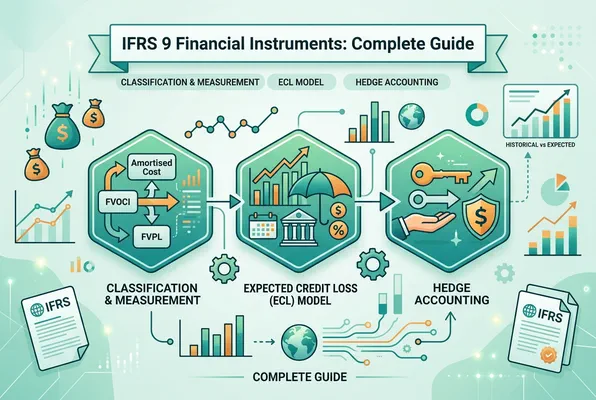

IFRS 9 is one of the most significant accounting standards ever issued by the International Accounting Standards Board (IASB). Replacing the long-criticised IAS 39, it fundamentally transformed how entities classify financial assets, measure credit risk, and apply hedge accounting. Whether you are a financial controller, risk manager, auditor, or investor trying to interpret financial statements, understanding IFRS 9 is essential to navigating modern financial reporting.
This guide walks through every major dimension of the standard, from its historical background and core classification logic to the intricacies of the expected credit loss model and hedge accounting reforms.
Background and History of IFRS 9
Why IAS 39 Was Replaced
IAS 39 Financial Instruments: Recognition and Measurement served as the predecessor standard for decades, but it attracted sustained criticism for several reasons:
- Its classification rules were complex, rule-based, and difficult to apply consistently
- Its incurred loss model for impairment was seen as “too little, too late” during the 2008–2009 global financial crisis
- Its hedge accounting requirements were overly restrictive and poorly aligned with how treasury and risk management teams actually hedged exposures
Regulators, standard-setters, and the G20 all called for a simpler, more forward-looking approach. The IASB responded by developing IFRS 9 in phases over several years.
Development Timeline
| Phase | Topic | Year Finalised |
|---|---|---|
| Phase 1 | Classification and Measurement | 2009/2010 (revised 2014) |
| Phase 2 | Impairment (ECL Model) | 2014 |
| Phase 3 | Hedge Accounting | 2013 |
| Final Standard | Complete IFRS 9 | July 2014 |
The complete version of IFRS 9 was issued in July 2014 and became mandatory for annual reporting periods beginning on or after 1 January 2018.
IFRS 9 Financial Instruments: Amendments to IFRS 9 and Measurement of Financial Instruments
IFRS 9 financial instruments establish comprehensive accounting requirements for financial instruments, including classification of financial assets, measurement of financial instruments, and recognition rules under the requirements of IFRS 9. The standard applies to financial assets within the scope of IFRS and sets out how entities must apply accounting for financial instruments in different measurement categories. In the case of a financial asset, entities must assess whether it meets the classification criteria under IFRS 9 is based principles and determine the appropriate accounting treatment under accounting requirements of IFRS 9. Although IFRS 9 replaces earlier models, amended IFRS 9 and limited amendments IFRS 9 ‘financial instruments’ continue to refine classification and recognition rules.
Scope of IFRS 9
IFRS 9 applies to all financial instruments except those specifically excluded, such as:
- Interests in subsidiaries, associates, and joint ventures (covered by IFRS 10, IAS 27, IAS 28)
- Leases (covered by IFRS 16)
- Insurance contracts (covered by IFRS 17, with limited interaction)
- Equity instruments issued by the entity itself
The standard covers both financial assets and financial liabilities, as well as contracts to buy or sell non-financial items that can be settled net in cash (treated as derivatives).
Classification and Measurement of Financial Assets
One of the most fundamental changes introduced by IFRS 9 was a simplified, principles-based classification model. Instead of four categories under IAS 39, IFRS 9 provides three primary measurement categories.
The Two-Step Classification Test
Classification of a financial asset under IFRS 9 depends on two criteria assessed at initial recognition:
- The Business Model Test – How does the entity manage its financial assets to generate cash flows?
- The Contractual Cash Flow Characteristics (SPPI) Test – Do the contractual terms give rise on specified dates to cash flows that are solely payments of principal and interest (SPPI) on the principal amount outstanding?
Both tests must be passed for a financial asset to qualify for amortised cost or FVOCI measurement.
The Three Measurement Categories
1. Amortised Cost
A financial asset is measured at amortised cost if: - The objective of the business model is to hold assets to collect contractual cash flows, and - The contractual cash flows are solely payments of principal and interest (SPPI)
Typical examples include trade receivables, held-to-maturity bonds, and standard bank loans. The asset is carried on the balance sheet at amortised cost using the effective interest rate (EIR) method, and subject to the impairment requirements.
2. Fair Value Through Other Comprehensive Income (FVOCI)
FVOCI – Debt Instruments
Debt instruments are measured at FVOCI if: - The business model involves both collecting contractual cash flows and selling financial assets, and - The SPPI test is passed
Changes in fair value are recognised in Other Comprehensive Income (OCI) and reclassified to profit or loss upon derecognition.
FVOCI – Equity Instruments (Irrevocable Election)
For equity instruments not held for trading, entities may irrevocably elect at initial recognition to present fair value changes in OCI. Crucially, gains and losses are never recycled to profit or loss — not even on disposal. Only dividends are recognised in profit or loss (unless they represent a return of investment).
3. Fair Value Through Profit or Loss (FVTPL)
All other financial assets are measured at FVTPL. This is the default category and applies to: - Assets that fail the SPPI test (e.g., convertible notes with complex features) - Assets held for trading - Assets where the business model is to manage on a fair value basis
There is also a fair value option: entities may irrevocably designate a financial asset at FVTPL if doing so eliminates or significantly reduces an accounting mismatch.
Summary: Classification Decision Tree
Is the financial asset an equity instrument?
├── YES → FVTPL (default) or FVOCI (irrevocable election)
└── NO (debt instrument)
    ├── Does it pass the SPPI test?
    │   └── NO → FVTPL
    └── YES → Apply Business Model Test
        ├── Hold to collect → Amortised Cost
        ├── Hold to collect AND sell → FVOCI
        └── Other → FVTPL
Classification and Measurement of Financial Liabilities
IFRS 9 largely retained the IAS 39 approach for financial liabilities, with one important change:
Own Credit Risk Treatment
Under IAS 39, changes in the fair value of a financial liability designated at FVTPL due to the entity’s own credit risk were recognised entirely in profit or loss — creating a counterintuitive result where entities recorded gains when their own credit quality deteriorated.
Under IFRS 9, for liabilities designated at FVTPL under the fair value option, changes in fair value attributable to own credit risk are presented in OCI rather than profit or loss. This amount is not reclassified to profit or loss even when the liability is derecognised.
The IFRS 9 Impairment Model: Expected Credit Losses (ECL)
The ECL framework is arguably the most impactful and operationally complex element of IFRS 9, particularly for banks and other financial institutions.
From Incurred Loss to Expected Credit Loss
Under the old IAS 39 incurred loss model, credit losses were only recognised when there was objective evidence of impairment — a loss event had to occur. This was criticised for delaying loss recognition and understating risk during economic booms.
IFRS 9 requires entities to estimate and recognise expected credit losses at all times, reflecting: - The probability of default (PD) - The loss given default (LGD) - The exposure at default (EAD) - The time value of money
Critically, this model is forward-looking: it incorporates macroeconomic forecasts and multiple economic scenarios.
The Three-Stage Model
IFRS 9 uses a staging approach to determine the amount of ECL to recognise:
| Stage | Description | ECL Recognised |
|---|---|---|
| Stage 1 | Performing assets — no significant increase in credit risk since origination | 12-month ECL |
| Stage 2 | Underperforming assets — significant increase in credit risk since origination, but not yet credit-impaired | Lifetime ECL |
| Stage 3 | Credit-impaired assets — objective evidence of impairment | Lifetime ECL (interest revenue on net carrying amount) |
What Is “Significant Increase in Credit Risk”?
The transfer from Stage 1 to Stage 2 is one of the most judgement-intensive aspects of IFRS 9. IFRS 9 provides a rebuttable presumption that credit risk has increased significantly when contractual payments are more than 30 days past due. However, entities are expected to use forward-looking information and not rely solely on delinquency.
Factors to consider include: - Significant changes in the borrower’s operating results or financial position - Changes in external credit ratings - Deterioration in macroeconomic indicators relevant to the borrower’s industry - Changes in market-implied credit spreads
The Low Credit Risk Exemption
As a practical expedient, an entity may assume that the credit risk on a financial instrument has not increased significantly since initial recognition if the instrument has low credit risk at the reporting date. Investment-grade rated instruments (BBB- or above) commonly qualify.
Simplified Approach for Trade Receivables and Lease Receivables
For trade receivables without a significant financing component, IFRS 9 requires entities to always measure the loss allowance at an amount equal to lifetime ECL (no staging required).
Entities can use a provision matrix based on historical loss rates, adjusted for current and forward-looking information. This practical expedient makes the ECL model more manageable for non-financial corporates.
Measuring ECL: The Core Formula
ECL is calculated as:
ECL = PD × LGD × EAD × Discount Factor
Where: - PD = Probability of Default over the relevant period - LGD = Loss Given Default (1 minus recovery rate) - EAD = Exposure at Default (outstanding balance, including undrawn commitments)
This must be estimated on a probability-weighted basis across multiple economic scenarios.
Forward-Looking Information and Macroeconomic Scenarios
A defining feature of the IFRS 9 ECL model is the requirement to incorporate forward-looking macroeconomic information. This means ECL provisions must change with:
- GDP forecasts
- Unemployment projections
- Interest rate expectations
- Property price indices (for mortgage portfolios)
In practice, banks typically use three macroeconomic scenarios (base, upside, downside) weighted by probability, and average the resulting ECL estimates.
Hedge Accounting Under IFRS 9
Overview of Changes from IAS 39
IFRS 9 introduced a reformed hedge accounting model designed to align accounting more closely with risk management activities. The core objective remains the same — to reduce income statement volatility from hedging — but the rules are significantly more flexible.
Key improvements include: - Expanded range of eligible hedged items and hedging instruments - Replacement of the 80–125% effectiveness test with a more principles-based approach - Enhanced disclosures about risk management strategy
Types of Hedging Relationships
IFRS 9 recognises three types of hedging relationships:
1. Fair Value Hedge
Used to hedge exposure to changes in the fair value of a recognised asset, liability, or firm commitment. Changes in fair value of both the hedging instrument and the hedged item are recognised in profit or loss, largely offsetting each other.
Example: Hedging the fair value of a fixed-rate bond using an interest rate swap.
2. Cash Flow Hedge
Used to hedge exposure to variability in cash flows attributable to a particular risk. The effective portion of gains/losses on the hedging instrument is recognised in OCI (the “cash flow hedge reserve”) and reclassified to profit or loss when the hedged item affects profit or loss.
Example: Hedging variable-rate debt using a pay-fixed, receive-floating interest rate swap.
3. Hedge of a Net Investment in a Foreign Operation
Used to hedge the foreign currency risk of a net investment in a foreign subsidiary. Similar to a cash flow hedge in accounting terms — the effective portion is recognised in OCI.
Qualifying Criteria for Hedge Accounting
For a hedging relationship to qualify under IFRS 9:
- There must be an economic relationship between the hedged item and the hedging instrument
- The effect of credit risk must not dominate the value changes
- The hedge ratio must be the same as that used for risk management purposes
Gone is the rigid 80–125% effectiveness range. Instead, entities must demonstrate the hedge is expected to be effective on a qualitative or quantitative basis, consistent with their actual risk management approach.
Rebalancing
A notable new concept in IFRS 9 is rebalancing: if the hedge ratio used for accounting purposes no longer matches the entity’s actual risk management hedge ratio, the entity adjusts the designation of the hedging relationship rather than discontinuing hedge accounting. This reduces artificial volatility and aligns better with practice.
Disclosure Requirements Under IFRS 9
IFRS 9 itself contains limited disclosure requirements, but it works in conjunction with IFRS 7 Financial Instruments: Disclosures, which was significantly enhanced to accompany the new standard.
Key disclosure areas include:
IFRS 9 and IFRS 7: Application of IFRS and Disclosure in Financial Statements
IFRS 9 and IFRS 7 together define how entities apply IFRS accounting to financial instruments and how disclosure in financial statements must be presented. IFRS 7 and IAS 1 interact with IFRS 18 presentation and disclosure, ensuring consistent presentation and disclosure in financial reporting. The application of IFRS requires entities to provide disclosure in financial statements that complement the measurement requirements for financial assets and financial liability not at fair value classifications. Although IFRS 9 focuses on accounting for financial instruments, IFRS 7 ensures that users receive transparent information about expected loss impairment model outcomes, derecognition of financial assets, and embedded derivatives.
Quantitative and Qualitative ECL Disclosures
Entities must disclose: - Reconciliation of opening to closing loss allowance by stage - Gross carrying amount by stage and credit quality - Write-offs and recoveries during the period - Inputs, assumptions, and estimation techniques used in ECL models - Sensitivity of ECL to changes in macroeconomic assumptions
Classification and Measurement Disclosures
- Breakdown of financial assets and liabilities by measurement category
- Explanation of business model assessments
- Fair value hierarchy (Level 1, 2, or 3) for instruments measured at fair value
Hedge Accounting Disclosures
- Description of each hedging relationship
- How the entity’s risk management strategy relates to hedge accounting
- Nominal amounts and fair values of hedging instruments
- Sources of hedge ineffectiveness
IFRS 9 for Different Industries
Banking and Financial Institutions
Banks are the most significantly affected entities. The ECL model requires substantial investment in data infrastructure, credit models, and IT systems. Many large banks reported significant day-one increases in loan loss provisions on transition to IFRS 9.
The Basel Committee on Banking Supervision issued guidance on how supervisory authorities should assess banks’ IFRS 9 implementation, emphasising sound model governance and validation.
Corporates and Non-Financial Entities
For most corporates, the primary impact of IFRS 9 is on trade receivables and intercompany loans. The simplified approach and provision matrix make the ECL model more manageable. Corporates with significant treasury operations may also be impacted by the classification of investments and use of hedge accounting.
Investment Funds
Investment funds typically hold financial assets measured at FVTPL, so the classification changes under IFRS 9 often have limited practical impact. However, the ECL model may still apply to bonds and other debt instruments held at amortised cost or FVOCI.
Insurance Companies
Insurers apply IFRS 9 in conjunction with IFRS 17 Insurance Contracts. A temporary exemption was available under IFRS 4 for entities whose activities are predominantly connected to insurance, but this expired for most entities from 1 January 2023.
Transition to IFRS 9
Transition Date and Approach
IFRS 9 became effective for annual reporting periods beginning on or after 1 January 2018. Entities generally applied the standard using a modified retrospective approach — adjusting opening retained earnings at the transition date without restating prior periods.
Key transition decisions included: - Reclassification of financial assets into the new categories - Remeasurement of financial assets and liabilities as required - Initial recognition of ECL allowances, with the day-one impact taken to retained earnings
Interaction With Other Standards
IFRS 9 interacts with several other standards:
- IFRS 7: Enhanced disclosure requirements
- IFRS 13: Fair value measurement guidance for FVTPL instruments
- IFRS 16: Lease receivables may be in scope of the ECL impairment model
- IAS 1: Presentation of OCI items (recycling vs. non-recycling)
- IAS 32: Definition of financial assets, liabilities, and equity instruments
Common Challenges and Practical Considerations
Judgement in ECL Modelling
The ECL model involves significant management judgement, particularly around: - Determining what constitutes a significant increase in credit risk - Selecting and weighting macroeconomic scenarios - Estimating LGD, particularly for collateralised instruments - Incorporating forward-looking information reliably
Auditors and regulators scrutinise ECL assumptions closely, especially during periods of economic uncertainty.
Data Requirements
Banks and larger entities often needed to build or enhance data warehouses and credit risk systems to support IFRS 9 compliance. Historical loss data, borrower-level information, and macroeconomic data feeds must all be integrated.
Pro-cyclicality Concerns
A significant concern with the ECL model is pro-cyclicality: during economic downturns, ECL provisions rise sharply, reducing capital ratios and potentially restricting credit supply. This was evident during the COVID-19 pandemic, when regulators issued guidance encouraging entities not to mechanically apply ECL models without careful consideration of government support measures.
Business Model Assessment Challenges
Determining the appropriate business model for a portfolio of financial assets requires careful analysis of how the portfolio is managed, what information management uses to evaluate performance, and how transactions (sales) relate to the business model objective.
IFRS 9 vs. US GAAP CECL Model
For globally active entities and analysts comparing IFRS and US GAAP financial statements, it is important to understand that the US equivalent — ASC 326 (CECL) — shares the forward-looking philosophy but differs in key ways:
| Feature | IFRS 9 ECL | US GAAP CECL |
|---|---|---|
| Staging | 3-stage model (12-month vs. lifetime) | Lifetime ECL from day one |
| Scope | Financial assets at amortised cost and FVOCI | Financial assets at amortised cost |
| Equity instruments | FVTPL/FVOCI (no ECL) | Not in scope |
| Practical expedients | More flexibility | Collateral-dependent practical expedient |
CECL is generally considered more conservative on initial recognition as it requires lifetime losses immediately, whereas IFRS 9 starts with only 12-month ECL for Stage 1 assets.
Key Takeaways for Finance Professionals
IFRS 9 represents a paradigm shift in financial instruments accounting. Here are the most important points to remember:
- Classification is principles-based: driven by business model and SPPI test, not instrument type alone
- ECL is forward-looking: incorporate macroeconomic forecasts and scenario analysis
- Staging drives the size of provisions: the move from Stage 1 to Stage 2 is critical and requires vigilance
- Hedge accounting is more accessible: but proper documentation and effectiveness assessment remain essential
- Disclosures are extensive: investors and analysts rely heavily on IFRS 7 disclosures to understand credit risk exposure
- Judgement matters: IFRS 9 requires more management judgement than IAS 39, elevating the importance of governance and audit oversight
Whether you are implementing IFRS 9 for the first time, refining your ECL models, or interpreting financial statements that apply the standard, a thorough understanding of its principles and mechanics is indispensable in today’s financial reporting environment.

Written by
Dominik KonoldFounder
Dominik is the founder of Finflexia and an expert in treasury accounting, financial instrument valuation and IFRS compliance. Since 2016, he's been a certified Professional Risk Manager (PRMIA) and also lectures for the Association of Public Banks and the Academy of International Accounting. He built Finflexia to help treasury teams automate complex accounting workflows.
Related Posts
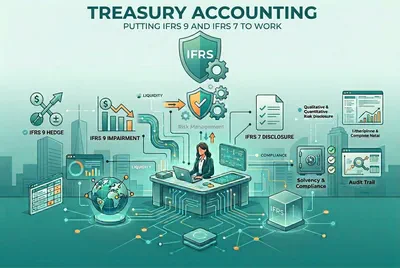
Treasury Accounting: The Complete Guide for Finance Professionals
Treasury accounting governs how companies manage cash, record financial instruments, and control risk exposures. This guide covers everything from daily cash positioning and debt accounting to hedge accounting under IFRS 9 and foreign exchange management — helping finance professionals build stronger, more resilient treasury functions.
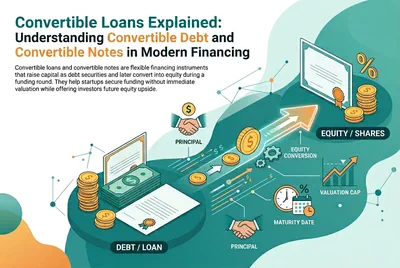
Convertible Loans Explained: Understanding Convertible Debt and Convertible Notes in Modern Financing
Convertible loans and convertible notes are flexible financing instruments that raise capital as debt securities and later convert into equity during a funding round. They help startups secure funding without immediate valuation while offering investors future equity upside.
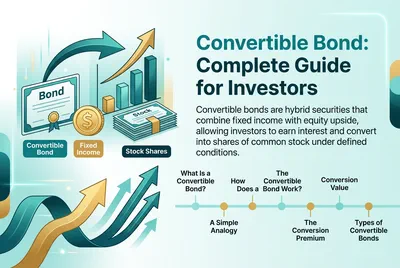
Convertible Bond: Complete Guide for Investors
Convertible bonds are hybrid securities that combine fixed income with equity upside, allowing investors to earn interest and convert into shares of common stock under defined conditions.
Ready to simplify your treasury accounting?
See how Finflexia helps you manage financial instruments with ease. Book a demo to learn more.
Book a Demo