IFRS 9 vs. IAS 39: Key Differences Explained
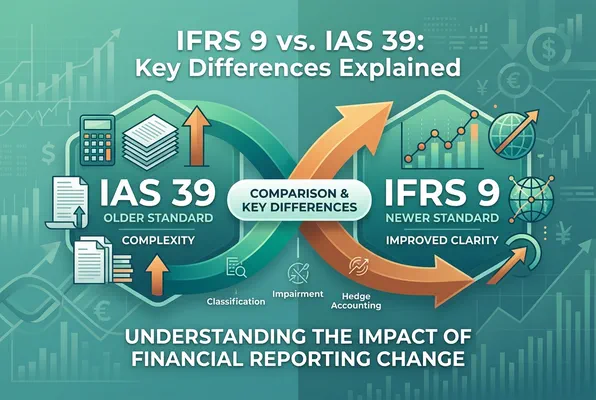

Financial reporting standards shape how banks, insurers, and corporates account for loans, investments, and derivatives. Few transitions have had as significant an impact on financial statements as the shift from IAS 39 to IFRS 9. Understanding IFRS 9 vs. IAS 39 is essential for finance professionals, auditors, and business leaders who need to interpret financial statements accurately or manage compliance during transition periods.
This article breaks down the core differences between the two standards, explains why the change happened, and highlights practical implications for classification, impairment, and hedge accounting.
What Is IAS 39?
IAS 39, Financial Instruments: Recognition and Measurement, was the original standard issued by the International Accounting Standards Board (IASB) for accounting for financial instruments. It governed how entities recognized, measured, and derecognized financial assets and liabilities.
While IAS 39 served as the backbone of financial instrument accounting for over a decade, it was widely criticized for being overly complex, rules-heavy, and slow to reflect emerging credit risks, a weakness that became glaringly apparent during the 2008 global financial crisis.
Key Features of IAS 39
- Multiple classification categories: Financial assets were classified into four categories: Held-to-maturity, loans and receivables, available-for-sale, and fair value through profit or loss (FVTPL).
- Incurred loss model: Impairment losses were only recognized when there was objective evidence of a loss event that had already occurred.
- Complex hedge accounting rules: Strict quantitative effectiveness testing (the 80–125% rule) made it difficult for many economically sound hedges to qualify for hedge accounting.
What Is IFRS 9?
IFRS 9, Financial Instruments, was introduced by the IASB to address the shortcomings of IAS 39. Developed in phases and fully effective for annual periods beginning on or after January 1, 2018, IFRS 9 introduced a more principles-based, forward-looking framework.
Effective Dates and Subsequent Amendments
The effective date of IFRS 9 was a key milestone in the transition from IAS 39. IFRS 9 became mandatory for annual periods beginning on or after 1 January 2018, although its requirements have subsequently been affected by amendments and annual improvements. References to 9 and IFRS amendments to IFRS 9, as well as the improvements to IFRS standards 2018–2020, are relevant when reviewing the development of the standard over time. Organizations therefore need to consider the version of the requirements applicable to the reporting period rather than relying solely on the original transition provisions.
Key Features of IFRS 9
- Simplified classification: Financial assets are classified based on the entity’s business model and the contractual cash flow characteristics of the asset (SPPI test, solely payments of principal and interest).
- Expected credit loss (ECL) model: Impairment is recognized earlier, based on expected losses rather than waiting for a triggering event.
- Improved hedge accounting: Aligns accounting treatment more closely with actual risk management activities, expanding the range of eligible hedged items and instruments.
IFRS 9 vs. IAS 39: Core Differences
1. Classification and Measurement
Under IAS 39, financial assets were classified into four categories, each with distinct measurement rules. This often led to inconsistent application and significant judgment calls, particularly around the “available-for-sale” category.
IFRS 9 simplifies this into three primary measurement categories:
- Amortized cost
- Fair value through other comprehensive income (FVOCI)
- Fair value through profit or loss (FVTPL)
Classification under IFRS 9 depends on two tests:
- Business model test – Is the asset held to collect contractual cash flows, to sell, or both?
- SPPI test – Are the cash flows solely payments of principal and interest?
This dual-test approach reduces classification volatility and better reflects how entities actually manage their financial assets.
Financial Liabilities Under IFRS 9
While much of the discussion around IFRS 9 focuses on financial assets, the standard also establishes important requirements for financial liabilities. Under the measurement of financial instruments framework, most financial liabilities are initially recognized at fair value and are subsequently measured either at amortized cost or at fair value through profit or loss, depending on their classification. This distinction is particularly relevant when an entity enters into complex financing arrangements, derivatives, or other contracts that create a financial asset or financial liability.
Equity Instruments and Debt Instruments
The treatment of equity instruments and debt instruments is another important consideration when applying IFRS 9. Debt instruments are assessed primarily by considering their contractual cash flows and the business model in which they are managed. For equity investments, IFRS 9 generally requires fair value measurement, although entities may make an irrevocable election to present certain changes in fair value in other comprehensive income. These requirements affect both the measurement of financial assets and the presentation of changes in fair value in the financial statements.
Fair Value Measurement and Financial Position
The application of IFRS 9 also interacts closely with IFRS 13 fair value measurement, particularly when financial instruments are measured at fair value. Entities need reliable valuation inputs and appropriate valuation techniques to determine the fair value of instruments that are not actively traded. The resulting amounts can have a direct impact on the statement of financial position, profit or loss, and other comprehensive income. Understanding these interactions is therefore important when assessing the overall financial position of an entity.
2. Impairment: Incurred Loss vs. Expected Credit Loss
This is arguably the most significant change in the IFRS 9 vs. IAS 39 comparison.
- IAS 39 (Incurred Loss Model): Losses were recognized only after a triggering event, such as default or significant financial difficulty of the borrower. Critics argued this created a “too little, too late” problem, especially during economic downturns.
- IFRS 9 (Expected Credit Loss Model): Entities must recognize expected losses from the moment a financial asset is originated or acquired, using a three-stage approach:
- Stage 1: 12-month expected credit losses (performing assets)
- Stage 2: Lifetime expected credit losses (significant increase in credit risk)
- Stage 3: Lifetime expected credit losses (credit-impaired assets)
This forward-looking model requires entities to incorporate historical data, current conditions, and reasonable forecasts, a significant shift in both methodology and data requirements.
3. Hedge Accounting
IAS 39’s hedge accounting model was often described as mechanical and disconnected from real risk management practices. The strict 80–125% effectiveness range excluded many legitimate hedging relationships from qualifying for hedge accounting treatment.
IFRS 9 introduces a more flexible, principles-based model that:
- Aligns hedge accounting with an entity’s risk management objectives
- Removes the rigid effectiveness testing threshold
- Expands eligible hedged items, including certain non-financial risk components
- Simplifies documentation and rebalancing requirements
Note: Entities can currently choose to continue applying IAS 39’s hedge accounting requirements instead of IFRS 9’s, particularly for macro hedging strategies, since the IASB’s project on dynamic risk management is still ongoing.
4. Derecognition Rules
Interestingly, IFRS 9 largely retained the derecognition principles from IAS 39 without substantial modification. This means that determining whether a financial asset should be removed from the balance sheet still relies on assessing the transfer of risks and rewards, along with control.
Why the Transition Matters
The shift from IAS 39 to IFRS 9 wasn’t just a technical accounting update, it fundamentally changed how financial institutions manage risk disclosure, provisioning, and capital planning.
Impact on Financial Institutions
Banks and lenders experienced the most significant impact, since the ECL model requires substantial changes to:
- Credit risk modeling and data infrastructure
- Loan loss provisioning processes
- Capital adequacy calculations
- Financial statement volatility, as provisions can increase rapidly when economic conditions deteriorate
Impact on Corporates and Investors
Non-financial companies with investments, trade receivables, or intercompany loans also feel the effects, particularly regarding:
- Earlier recognition of impairment on trade receivables
- Simplified approaches like the provision matrix for trade receivables under IFRS 9
- Enhanced disclosure requirements around credit risk exposure
IFRS 9 and Other Financial Reporting Standards
IFRS 9 does not operate in isolation. Depending on the transaction, entities may also need to consider IFRS 7, IFRS 10, IFRS 15, IFRS 17, IAS 19, and IFRS 4. IFRS 7 provides disclosure requirements for financial instruments, while other standards can determine whether a particular transaction falls within or outside the scope of IFRS 9. As a result, IFRS 9 and IFRS 7 are particularly closely connected: IFRS 9 determines many recognition and measurement outcomes, while IFRS 7 requires entities to explain the resulting risks and financial effects.
Practical Challenges in Adopting IFRS 9
Transitioning from IAS 39 to IFRS 9 introduced several operational challenges:
- Data requirements: The ECL model demands historical, current, and forward-looking data, often requiring new systems and models.
- Judgment and estimation: Determining “significant increase in credit risk” for staging purposes involves considerable judgment.
- System and process changes: Many organizations needed to overhaul their risk and finance systems to support new calculations.
- Cross-functional collaboration: Risk, finance, and IT teams had to work closely together, a shift from the more siloed approach common under IAS 39.
Modern financial planning and reporting platforms, like Finflexia, help organizations manage this complexity by centralizing data, automating ECL calculations, and streamlining compliance workflows across finance and risk teams.
Applying IFRS 9 in Practice
The practical application of IFRS 9 requires organizations to translate accounting requirements into consistent policies, processes, and controls. In particular, entities need to determine when to apply IFRS, how to document judgments, and how to demonstrate compliance with the requirements of IFRS 9. Although IFRS 9 allows some accounting choices and practical approaches, these decisions need to be applied consistently and supported by appropriate documentation. This is especially important when determining the measurement requirements for financial assets, assessing derecognition of financial assets, or evaluating whether an instrument remains within the scope of IAS 39 and IFRS 9.
IFRS 9 vs. IAS 39: Summary Comparison Table
| Aspect | IAS 39 | IFRS 9 |
|---|---|---|
| Classification | Four categories, rules-based | Three categories, principles-based (business model + SPPI) |
| Impairment Model | Incurred loss | Expected credit loss (ECL) |
| Loss Recognition Timing | After a triggering event | From initial recognition (forward-looking) |
| Hedge Accounting | Rigid, 80–125% effectiveness test | Flexible, aligned with risk management |
| Derecognition | Risk and rewards / control-based | Largely unchanged from IAS 39 |
| Complexity | High, with multiple exceptions | Simplified, though ECL adds new complexity |
Final Thoughts
The debate around IFRS 9 vs. IAS 39 ultimately comes down to a shift from a reactive, rules-based accounting model to a proactive, principles-based framework designed to reflect economic reality more accurately. While IFRS 9 introduced welcome improvements, particularly the forward-looking expected credit loss model and more flexible hedge accounting, it also brought new complexities in data, modeling, and judgment.
For finance teams navigating this transition or managing ongoing compliance, understanding both standards remains essential, not only for historical comparisons but also for ensuring robust, transparent financial reporting going forward.

Written by
Dominik KonoldFounder
Dominik is the founder of Finflexia and an expert in treasury accounting, financial instrument valuation and IFRS compliance. Since 2016, he's been a certified Professional Risk Manager (PRMIA) and also lectures for the Association of Public Banks and the Academy of International Accounting. He built Finflexia to help treasury teams automate complex accounting workflows.
Related Posts
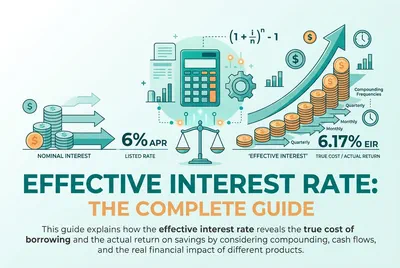
Effective Interest Rate: The Complete Guide
This guide explains how the effective interest rate reveals the true cost of borrowing and the actual return on savings by considering compounding, cash flows, and the real financial impact of different products.

Hypothetical Derivative Method Explained
To better understand the practical application of hedge accounting, the following sections examine key concepts related to hedge effectiveness, hypothetical derivatives, and cash flow hedges.
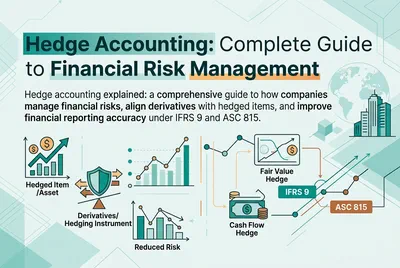
Hedge Accounting: Complete Guide to Financial Risk Management
Hedge accounting explained: a comprehensive guide to how companies manage financial risks, align derivatives with hedged items, and improve financial reporting accuracy under IFRS 9 and ASC 815.
Ready to simplify your treasury accounting?
See how Finflexia helps you manage financial instruments with ease. Book a demo to learn more.
Book a Demo