IFRS 13 Fair Value Measurement: Understanding Fair Values and the Fair Value Hierarchy
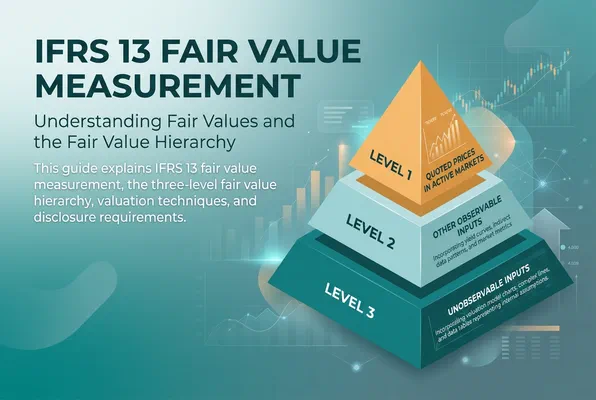

Fair value is one of the most judgement-heavy concepts in financial reporting, and the IFRS 13 fair value hierarchy is the framework that keeps that judgement disciplined. Whether you are valuing listed equities, a private company investment, an investment property or a complex derivative, the hierarchy tells you how much confidence users of your financial statements can place in the number you report.
This guide explains how the IFRS 13 fair value hierarchy works, what each level means, how to classify measurements correctly, which valuation techniques apply, and what you must disclose. Practical examples are included throughout so you can apply the standard with confidence.
What Is IFRS 13 and Why Does the Fair Value Hierarchy Matter?
IFRS 13 Fair Value Measurement was issued by the IASB in 2011 and became effective for annual periods beginning on or after 1 January 2013. It does not tell you when to measure something at fair value. That is the job of other standards such as IFRS 9, IAS 40, IAS 16 or IFRS 3. Instead, IFRS 13 defines fair value, sets out a single framework for measuring it, and prescribes the related disclosures.
Scope and Application of IFRS 13
The scope of IFRS 13 extends beyond the initial recognition of assets and liabilities and establishes a consistent framework for measuring fair value across different areas of financial reporting. The standard was developed by the International Accounting Standards Board (IASB) to improve consistency and comparability within IFRS Accounting Standards. IFRS 13 applies when another standard requires or permits fair value measurement or disclosures about fair value measurements. However, IFRS 13 does not specify which assets or liabilities must be measured at fair value, nor does it determine when fair value changes must be recognised in profit or loss or other comprehensive income. Instead, it provides the principles governing measurement and disclosure, ensuring that entities apply a consistent approach regardless of the underlying transaction or financial instrument.
The IFRS 13 Definition of Fair Value
IFRS 13 defines fair value as:
The price that would be received to sell an asset or paid to transfer a liability in an orderly transaction between market participants at the measurement date.
Several features of this definition are important:
- It is an exit price. Fair value reflects what you would receive for selling an asset or pay to transfer a liability, not what you paid to acquire it.
- It is market-based, not entity-specific. The assumptions are those that market participants would use, even if your entity would act differently.
- It assumes an orderly transaction. Distressed or forced sales do not represent fair value unless the market itself is characterised by such transactions.
- It is measured at a specific date. Fair value is a snapshot at the measurement date, not an average over time.
Market Participants and the Assumptions Underlying Fair Value
An important aspect of fair value measurement is the perspective from which the valuation is performed. As defined by IFRS 13, fair value is the price that would be received to sell an asset or paid to transfer a liability in an orderly transaction. Fair value measurement assumes that market participants act independently, have sufficient knowledge of the relevant market conditions and are willing to enter into the transaction. Consequently, an entity must consider the assumptions that market participants would use when determining an appropriate price for the asset or liability being measured. These assumptions may include expectations regarding future economic developments, market risks, financing conditions and the availability of alternative investment opportunities. The objective is not to establish the value that a particular entity assigns to an asset, but to determine the market-based price that would be appropriate under current conditions.
Why a Hierarchy Is Needed
Not all fair value measurements are equally reliable. A share price quoted on a major exchange is far more objective than a value derived from a discounted cash flow model built on management forecasts. The IFRS 13 fair value hierarchy exists to:
- Prioritise observable market data over internal assumptions
- Increase consistency and comparability between entities
- Help users of financial statements understand the uncertainty embedded in reported fair values
- Drive proportionate disclosure, with more extensive requirements for less observable measurements
The Three Levels of the IFRS 13 Fair Value Hierarchy
The hierarchy categorises the inputs to valuation techniques, not the techniques themselves. Inputs are the assumptions market participants would use when pricing an asset or liability. They are divided into three levels, with the highest priority given to Level 1 and the lowest to Level 3.
| Level | Type of Input | Observability | Typical Examples |
|---|---|---|---|
| Level 1 | Quoted prices in active markets for identical assets or liabilities | Directly observable | Listed shares, exchange-traded funds, government bonds in liquid markets |
| Level 2 | Inputs other than Level 1 prices that are observable for the asset or liability | Indirectly observable | Interest rate swaps, corporate bonds in less active markets, foreign currency forwards |
| Level 3 | Unobservable inputs | Not observable | Private equity stakes, certain investment properties, complex structured products |
Level 1 Inputs: Quoted Prices in Active Markets
Level 1 inputs are quoted prices (unadjusted) in active markets for identical assets or liabilities that the entity can access at the measurement date. This is the most reliable evidence of fair value and, where available, must be used without adjustment except in limited circumstances.
An active market is one in which transactions for the asset or liability take place with sufficient frequency and volume to provide pricing information on an ongoing basis.
Further Guidance on Level 1 Inputs and Observable Market Evidence
The distinction between Level 1 and other hierarchy inputs is particularly important when determining whether a quoted price can be used directly. Level 1 inputs are unadjusted quoted prices in active markets for items identical to the asset or liability being measured, provided that the entity can access the relevant market at the measurement date. In other words, inputs are unadjusted quoted prices when they are taken directly from an active market without modifications to reflect entity-specific circumstances. Level 1 inputs are directly observable and provide the strongest evidence of fair value. By contrast, Level 2 inputs may include information that is directly or indirectly observable, such as market interest rates, observable credit spreads or prices for comparable instruments. If a quoted price in an active market is available and the relevant instrument is included within Level 1, an entity should generally use that price rather than replace it with an internally developed estimate.
Key points about Level 1:
- The price must be for an identical instrument, not a similar one.
- The entity must have access to the market at the measurement date.
- Adjustments are generally prohibited. The exceptions are narrow, for example when a quoted price is not representative of fair value at the measurement date because a significant event occurred after market close, or when fair value is measured using a quoted price for a similar item.
- Blockage factors are prohibited. If you hold a very large block of shares, you cannot apply a discount because selling the entire block would depress the price. Fair value is the quoted price multiplied by the number of units held (the “P × Q” principle).
Example: A company holds 100,000 shares in a listed multinational that trade actively on a major stock exchange. The closing price on the reporting date is €42.50. The fair value is €4,250,000, classified as Level 1.
Level 2 Inputs: Observable Inputs Other Than Quoted Prices
Level 2 inputs are inputs other than quoted prices included in Level 1 that are observable for the asset or liability, either directly or indirectly. They typically arise when no active market exists for the identical item, but market data can be used to derive a value.
Common Level 2 inputs include:
- Quoted prices for similar assets or liabilities in active markets
- Quoted prices for identical or similar assets or liabilities in markets that are not active
- Observable inputs such as interest rates and yield curves, implied volatilities and credit spreads
- Market-corroborated inputs, which are derived principally from or corroborated by observable market data through correlation
Adjustments at Level 2 are common and permitted. For example, you may need to adjust for differences in the condition or location of an asset, the volume or level of activity in the market, or the extent to which inputs relate to comparable items. If a Level 2 adjustment is significant and based on unobservable inputs, the measurement may fall into Level 3 instead.
Example: A company holds a plain-vanilla interest rate swap. There is no quoted price for this exact contract, but the fair value can be derived by discounting expected future cash flows using an observable swap yield curve. Because all significant inputs are observable, the measurement is classified as Level 2.
Level 3 Inputs: Unobservable Inputs
Level 3 inputs are unobservable inputs for the asset or liability. They are used to the extent that relevant observable inputs are not available, which means situations where there is little or no market activity for the item at the measurement date.
Even when using unobservable inputs, the objective remains the same: to estimate an exit price from the perspective of a market participant. Therefore, Level 3 inputs should reflect the assumptions that market participants would use, including assumptions about risk. An entity may start with its own data, but it must adjust that data if reasonably available information indicates that market participants would use different assumptions.
Examples of Level 3 inputs:
- Long-term cash flow forecasts for a private company
- Discount rates built up using entity-specific risk premiums
- Prepayment rates and default rates for illiquid loan portfolios
- Terminal growth rates in a discounted cash flow model
- Illiquidity or control premiums derived from internal analysis
Example: A venture investor holds a minority stake in an early-stage private company with no recent funding round. Fair value is estimated using a discounted cash flow model that relies on management’s revenue projections and a discount rate that includes a significant company-specific risk premium. The measurement is Level 3.
How to Classify a Fair Value Measurement Within the Hierarchy
A frequent source of confusion is that the hierarchy applies to inputs, yet disclosures are made for the measurement as a whole. IFRS 13 resolves this with the “lowest level input” rule.
The Lowest Level Input Rule
A fair value measurement is categorised in its entirety in the same level of the hierarchy as the lowest level input that is significant to the entire measurement. Assessing significance requires judgement and consideration of factors specific to the asset or liability.
Example: A valuation uses ten inputs. Nine are Level 2 (observable yield curves, spreads and exchange rates), but one, a credit adjustment based on internal credit assessments, is Level 3 and has a significant effect on the result. The entire measurement is classified as Level 3.
Practical Steps for Classification
- Identify the unit of account. Determine what is being measured, such as a single share, a portfolio or a cash-generating unit.
- Select the valuation technique. Choose market, income or cost approaches that are appropriate and for which sufficient data is available.
- List all inputs. Document each input used and its source.
- Classify each input. Decide whether each is Level 1, 2 or 3.
- Assess significance. Evaluate which unobservable inputs, if any, are significant to the overall measurement, using sensitivity analysis where helpful.
- Assign the level. Apply the lowest level input that is significant.
- Document the judgement. Retain evidence that supports the classification for audit purposes.
Handling Adjustments and Calibration
Adjustments to observable data can change the level. A broker quote that is an indicative, non-binding price may be Level 2 or Level 3 depending on how it was derived and whether it can be corroborated. If you use a pricing service, you still need to understand the inputs and the methodology to support classification. Simply relying on a third-party number does not exempt you from the hierarchy analysis.
Valuation Techniques Under IFRS 13
IFRS 13 requires entities to use valuation techniques appropriate in the circumstances and for which sufficient data is available, maximising the use of relevant observable inputs and minimising the use of unobservable inputs. Three broad approaches are recognised.
Market Approach
The market approach uses prices and other relevant information generated by market transactions involving identical or comparable assets, liabilities or groups of assets and liabilities. Common applications include:
- Quoted market prices
- Multiples derived from comparable companies or transactions (such as EV/EBITDA or price-to-earnings)
- Matrix pricing for debt securities
Income Approach
The income approach converts future amounts, such as cash flows or earnings, to a single discounted present value. Examples include:
- Discounted cash flow (DCF) models
- Option pricing models such as Black-Scholes or binomial models
- The multi-period excess earnings method used for intangible assets in business combinations
Cost Approach
The cost approach reflects the amount that would be required currently to replace the service capacity of an asset, often called current replacement cost. It is frequently used for specialised property, plant and equipment where no market evidence exists.
Single Versus Multiple Techniques
In some cases, a single technique is appropriate, such as a quoted price for an identical asset. In others, multiple techniques are warranted, for example when valuing a business using both a DCF and market multiples. When multiple techniques are used, the results should be evaluated considering the reasonableness of the range of values indicated. The fair value is the point within that range that is most representative in the circumstances.
Special Considerations in Applying the Fair Value Hierarchy
Inactive Markets and Significant Declines in Activity
When the volume or level of activity for an asset or liability has significantly decreased, quoted prices may no longer be representative. IFRS 13 requires entities to evaluate whether transactions are orderly and to consider whether an adjustment to the quoted price or a change in valuation technique is needed. This is where many instruments migrate from Level 1 to Level 2 or Level 3.
Highest and Best Use for Non-Financial Assets
For non-financial assets, fair value assumes the highest and best use from the perspective of market participants. This use must be physically possible, legally permissible and financially feasible. For example, land currently used as a car park may be valued as a development site if market participants would pay more for it on that basis. The valuation premise (stand-alone or in combination with other assets) must also be considered.
Liabilities and Own Equity Instruments
IFRS 13 assumes that a liability is transferred to a market participant, rather than settled, and that the non-performance risk, including the entity’s own credit risk, remains unchanged. This means that fair value of a liability reflects the entity’s own credit risk. When quoted prices for the transfer of an identical liability do not exist, the entity may measure it from the perspective of a market participant that holds the identical item as an asset.
Measuring Net Open Risk Positions
IFRS 13 includes an exception allowing entities that manage financial assets and liabilities on the basis of their net market or credit risk exposure to measure fair value for the group on a net basis. This is relevant for banks and trading entities that hedge risks at portfolio level, subject to specific conditions being met.
Initial Recognition and Transaction Price
At initial recognition, the transaction price is often equal to fair value, but not always. If fair value differs from the transaction price, for example because of related party transactions or transactions under duress, the difference may need to be recognised in profit or loss unless another IFRS requires otherwise. Entities that use a valuation technique with unobservable inputs must calibrate it so that, at initial recognition, the result equals the transaction price.
Disclosure Requirements Under the IFRS 13 Fair Value Hierarchy
Disclosures are where the hierarchy has the greatest practical impact. The more reliant a measurement is on unobservable inputs, the more extensive the required disclosures.
Disclosures for All Fair Value Measurements
For recurring and non-recurring fair value measurements, entities must disclose, among other items:
- The fair value measurement at the end of the reporting period
- The level of the hierarchy within which the measurement is categorised in its entirety
- For measurements in Levels 2 and 3, a description of the valuation technique and inputs used
- Any change in valuation technique and the reasons for the change
Additional Disclosures for Recurring Level 2 and Level 3 Measurements
- Transfers between Level 1 and Level 2, with reasons and the policy for determining when transfers occur
- For Level 2 and 3, a description of valuation techniques and inputs
Additional Disclosures for Level 3 Measurements
Level 3 measurements attract the most extensive requirements:
- Quantitative information about significant unobservable inputs (for example, ranges and weighted averages of discount rates, growth rates or volatilities)
- A reconciliation from opening to closing balances, separately showing total gains or losses in profit or loss, gains or losses in other comprehensive income, purchases, sales, issues, settlements and transfers into or out of Level 3
- Gains or losses recognised in profit or loss that relate to assets and liabilities held at the end of the period
- A description of the valuation processes, including how the entity decides its valuation policies and procedures and analyses changes between periods
- A narrative sensitivity analysis describing how a change in significant unobservable inputs could result in a significantly higher or lower fair value, including interrelationships between inputs
- For financial assets and liabilities, the effect of reasonably possible alternative assumptions on fair value
Disclosures for Items Not Measured at Fair Value
Where fair value is disclosed but not recognised, for example for investment property under the cost model or financial instruments at amortised cost, the entity must still disclose the level of the hierarchy, the valuation technique and the inputs used for Levels 2 and 3.
Sample Disclosure Table
| Asset or Liability | Fair Value | Level | Valuation Technique | Key Inputs |
|---|---|---|---|---|
| Listed equity securities | €12.4m | 1 | Quoted market price | Closing price on exchange |
| Interest rate swaps | €(1.8)m | 2 | Discounted cash flow | Swap yield curve, credit spreads |
| Unlisted equity investment | €6.7m | 3 | Discounted cash flow | Revenue growth, discount rate (12–15%) |
| Investment property | €38.0m | 3 | Income capitalisation | Rental yield, vacancy rate |
Common Challenges and Pitfalls
Over-Reliance on Third-Party Valuations
Using valuation specialists or pricing vendors does not remove management’s responsibility. Preparers must understand the inputs, test the reasonableness of outputs and assess whether the data supports the level assigned. Auditors regularly challenge classification, particularly where a vendor price is described as “observable” without evidence of actual market transactions.
Misclassifying Level 2 Versus Level 3
The boundary between Level 2 and Level 3 is where most disputes arise. Typical pressure points include:
- Illiquidity discounts applied to otherwise observable prices
- Credit valuation adjustments (CVA) and debit valuation adjustments (DVA) based on internal models
- Long-dated derivatives where the yield curve is only observable for shorter tenors
- Real estate valuations where comparable transactions are scarce
When in doubt, perform a sensitivity analysis to test whether an unobservable input is truly significant to the measurement.
Inconsistent Application Between Reporting Periods
Valuation techniques should be applied consistently. A change from one technique to another is appropriate only if it results in a measurement that is equally or more representative of fair value, such as when new market data becomes available. Such changes are accounted for as a change in accounting estimate and must be disclosed.
Weak Documentation and Governance
Level 3 valuations in particular demand robust governance. Good practice includes:
- A formal valuation policy approved by those charged with governance
- Clear segregation between valuation and trading or investment functions
- Regular back-testing against actual transaction prices
- Independent review of key assumptions
- A documented process for escalating significant judgements
IFRS 13 Fair Value Hierarchy and Other Standards
IFRS 13 interacts with many other standards, and the hierarchy applies wherever those standards require or permit fair value measurement or disclosure.
- IFRS 9 Financial Instruments: Financial assets at fair value through profit or loss or through OCI follow the IFRS 13 framework. Equity investments in unquoted companies often fall into Level 3.
- IFRS 3 Business Combinations: Acquired assets and assumed liabilities are measured at acquisition-date fair value, frequently relying on Level 3 inputs for intangible assets such as customer relationships and brands.
- IAS 40 Investment Property: Under the fair value model, and for disclosure under the cost model, investment property valuations are typically Level 3 because of property-specific adjustments.
- IAS 16 Property, Plant and Equipment: Where the revaluation model is used, fair value is determined under IFRS 13.
- IAS 36 Impairment of Assets: Fair value less costs of disposal uses IFRS 13, and the hierarchy level must be disclosed for impaired assets.
- IFRS 2 Share-based Payment, IFRS 16 Leases and IAS 2 Inventories: These are notable scope exclusions, as they have their own measurement requirements.
Practical Tips for Preparers and Finance Teams
- Map your population early. Create an inventory of all assets and liabilities measured or disclosed at fair value and tag each with a preliminary level.
- Build a classification memo. For each material Level 2 and Level 3 item, document the technique, inputs, significance assessment and conclusion.
- Automate where possible. Use data feeds and valuation tooling to source Level 1 and Level 2 inputs consistently and reduce manual error.
- Run sensitivity analyses. Quantify how changes in unobservable inputs affect fair value to support both classification and disclosure.
- Monitor market activity. Track trading volumes and bid-ask spreads for borderline instruments so that transfers between levels are identified promptly.
- Prepare disclosure templates. Standardised reconciliation and input tables for Level 3 items save time at each reporting date.
- Engage auditors early. Agreeing methodology and classification judgements before year-end avoids late-stage surprises.
Conclusion
The IFRS 13 fair value hierarchy is more than a classification exercise. It is a transparency mechanism that tells readers of financial statements how much of a reported fair value rests on market evidence and how much on management judgement. Level 1 offers quoted prices in active markets, Level 2 relies on observable inputs other than quoted prices, and Level 3 depends on unobservable inputs and therefore carries the greatest estimation uncertainty and the heaviest disclosure burden.
Applying the hierarchy well means selecting appropriate valuation techniques, maximising observable inputs, correctly applying the lowest-level-input rule, documenting judgements and preparing complete disclosures. Teams that build strong governance and repeatable processes around fair value measurement not only comply with IFRS 13 more efficiently but also produce financial statements that stakeholders can trust.
For finance professionals looking to streamline valuation workflows, financial reporting and disclosure preparation, tools like finflexia.app can help bring structure and consistency to the fair value measurement process.

Written by
Dominik KonoldFounder
Dominik is the founder of Finflexia and an expert in treasury accounting, financial instrument valuation and IFRS compliance. Since 2016, he's been a certified Professional Risk Manager (PRMIA) and also lectures for the Association of Public Banks and the Academy of International Accounting. He built Finflexia to help treasury teams automate complex accounting workflows.
Related Posts
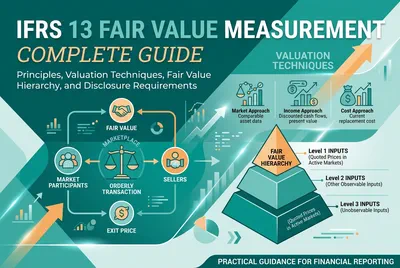
IFRS 13 Fair Value Measurement: Complete Guide
This guide provides a comprehensive overview of IFRS 13, explaining the principles of fair value measurement, valuation techniques, the fair value hierarchy, disclosure requirements, and practical guidance for applying the standard in financial reporting.

Hull-White Interest Rate Model: Calibration, Pricing and Python Implementation Explained
An in-depth overview of the Hull-White interest rate model, covering its theory, calibration, pricing methods, Python implementation and practical applications in financial markets.
IAS 39 and IFRS 9: Understanding Accounting for Financial Instruments
This article explains IAS 39 and IFRS 9, highlighting their key differences, classification and measurement requirements, and their impact on accounting for financial instruments.
Ready to simplify your treasury accounting?
See how Finflexia helps you manage financial instruments with ease. Book a demo to learn more.
Book a Demo