IAS 39 and IFRS 9: Understanding Accounting for Financial Instruments
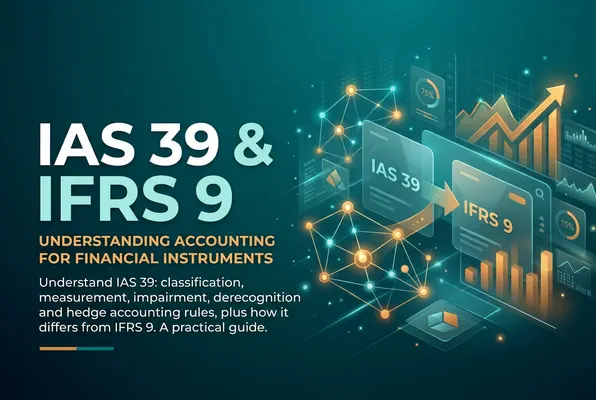

IAS 39, formally titled Financial Instruments: Recognition and Measurement, was for many years the cornerstone standard governing how companies reported financial assets, financial liabilities, and derivatives under International Financial Reporting Standards. Although it has been replaced in most respects by IFRS 9, understanding IAS 39 remains essential for finance professionals, auditors, analysts, and students. Its concepts still shape comparative financial statements, legacy contracts, hedge accounting policies, and the way many practitioners think about financial instruments today.
This guide walks through the scope, definitions, classification, measurement, impairment, derecognition, and hedge accounting requirements of IAS 39, and explains how the standard compares with its successor.
What Is IAS 39?
IAS 39 was issued by the International Accounting Standards Committee (IASC) in 1998 and later adopted and amended by the International Accounting Standards Board (IASB). It was designed to answer a deceptively simple question: when and how should an entity record a financial instrument on its balance sheet, and at what amount?
The standard established principles for:
- Recognition: when a financial asset or liability enters the statement of financial position
- Classification: which category an instrument belongs to
- Measurement: whether it is carried at fair value or amortized cost, initially and subsequently
- Impairment: when and how to recognize losses on financial assets
- Derecognition: when an instrument is removed from the balance sheet
- Hedge accounting: how to reflect risk management activities in the financial statements
IAS 39 worked alongside IAS 32 (Financial Instruments: Presentation) and IFRS 7 (Financial Instruments: Disclosures). Together, these three standards formed the complete financial instruments framework for many years.
Why IAS 39 Was Replaced
IAS 39 was widely criticized as complex, rules-based, and difficult to apply consistently. During the 2008 global financial crisis, a major criticism emerged: the incurred loss impairment model recognized credit losses too late, only after a loss event had occurred. Policymakers, including the G20, called for a more forward-looking approach. The IASB responded by developing IFRS 9, which was issued in phases and became mandatory for annual periods beginning on or after 1 January 2018.
Development of IFRS 9
The development of International Financial Reporting Standard 9 (IFRS 9 Financial Instruments) was largely driven by the 2008 financial crisis, which revealed weaknesses in the existing International Accounting Standard 39. Standard setters recognized the need for a new standard to improve accounting for financial instruments and address shortcomings in the previous measurement requirements. Following several discussions and the publication of an exposure draft, the IASB introduced IFRS 9, initially planning an effective date of 1 January 2013. However, its implementation was later postponed. The new standard replaced several IAS 39 categories, including available for sale and held to maturity, with a revised classification model based on the contractual characteristics of a financial asset or financial liability.
Scope of IAS 39
IAS 39 applied to all types of financial instruments, with certain exceptions. Financial instruments include a wide range of items, from simple trade receivables and bank loans to complex derivatives such as swaps, forwards, futures, and options.
Instruments Excluded from IAS 39
Some items fell outside the scope of the standard because they were covered by other IFRS pronouncements, including:
- Interests in subsidiaries, associates, and joint ventures (covered by IFRS 10, IAS 27, and IAS 28)
- Rights and obligations under leases (IAS 17, later IFRS 16), with some exceptions
- Employer rights and obligations under employee benefit plans (IAS 19)
- Insurance contracts (IFRS 4, later IFRS 17), with exceptions for financial guarantee contracts
- Equity instruments issued by the reporting entity (IAS 32)
- Share-based payment transactions (IFRS 2)
Contracts to Buy or Sell Non-Financial Items
Contracts to buy or sell non-financial items, such as commodities, were generally within the scope of IAS 39 if they could be settled net in cash or another financial instrument. The exception applied to contracts entered into and held for the purpose of receiving or delivering the non-financial item in line with the entity’s expected purchase, sale, or usage requirements, often referred to as the “own use” exemption.
Key Definitions Under IAS 39
A solid grasp of terminology is critical to applying the standard correctly.
Financial Instrument
A financial instrument is any contract that gives rise to a financial asset of one entity and a financial liability or equity instrument of another entity.
Derivative
A derivative under IAS 39 had three defining characteristics:
- Its value changes in response to an underlying variable such as an interest rate, exchange rate, commodity price, or credit rating
- It requires no initial net investment, or one that is smaller than would be required for other contracts with a similar response to market changes
- It is settled at a future date
Effective Interest Method
The effective interest method calculates the amortized cost of a financial asset or liability and allocates interest income or expense over the relevant period. The effective interest rate exactly discounts estimated future cash payments or receipts through the expected life of the instrument to its net carrying amount.
Amortized Cost
Amortized cost is the amount at which a financial asset or liability is measured at initial recognition, minus principal repayments, plus or minus the cumulative amortization of any difference between the initial amount and the maturity amount (using the effective interest method), and minus any reduction for impairment.
Fair Value
Fair value is the amount for which an asset could be exchanged, or a liability settled, between knowledgeable, willing parties in an arm’s-length transaction. In later years, fair value measurement guidance was consolidated into IFRS 13.
Classification of Financial Instruments Under IAS 39
One of the most recognizable features of IAS 39 is its category-based classification system. Classification determined how an instrument was measured and where gains and losses were reported.
Categories of Financial Assets
IAS 39 defined four categories of financial assets:
1. Financial Assets at Fair Value Through Profit or Loss
This category included two subgroups:
- Held for trading: instruments acquired principally to sell or repurchase in the near term, or part of a portfolio with evidence of short-term profit-taking. All derivatives (other than designated and effective hedging instruments) were classified as held for trading.
- Designated at fair value through profit or loss (the fair value option): instruments irrevocably designated at initial recognition, provided that designation eliminated an accounting mismatch, or the instrument was part of a group managed and evaluated on a fair value basis.
Fair value changes were recognized in profit or loss.
2. Held-to-Maturity Investments
Held-to-maturity investments were non-derivative financial assets with fixed or determinable payments and a fixed maturity, which the entity had the positive intention and ability to hold until maturity. They were measured at amortized cost using the effective interest method.
A notable restriction applied: if an entity sold or reclassified more than an insignificant amount of held-to-maturity investments before maturity, it was “tainted” and prohibited from using this category for two financial years. Exceptions existed for sales close to maturity, sales following isolated non-recurring events, and significant credit deterioration.
3. Loans and Receivables
Loans and receivables were non-derivative financial assets with fixed or determinable payments that were not quoted in an active market, excluding those the entity intended to sell immediately or in the near term. Trade receivables typically fell into this category. They were measured at amortized cost.
4. Available-for-Sale Financial Assets
Available-for-sale (AFS) was a residual category for non-derivative financial assets that were designated as AFS or were not classified elsewhere. Many equity investments and debt securities fell into this category. They were measured at fair value, with changes recognized in other comprehensive income (OCI) until derecognition or impairment, at which point the cumulative gain or loss was recycled to profit or loss.
Categories of Financial Liabilities
IAS 39 had two main categories for financial liabilities:
- Financial liabilities at fair value through profit or loss: including held-for-trading liabilities and those designated under the fair value option
- Other financial liabilities: measured at amortized cost using the effective interest method
Recognition and Initial Measurement
Under IAS 39, an entity recognized a financial asset or liability on its balance sheet only when it became a party to the contractual provisions of the instrument.
Initial Measurement
Financial instruments were initially measured at fair value. For instruments not classified at fair value through profit or loss, directly attributable transaction costs were added to (for assets) or deducted from (for liabilities) the initial fair value. For instruments at fair value through profit or loss, transaction costs were expensed immediately.
Regular Way Purchases and Sales
For regular way purchases or sales of financial assets, entities could choose between trade date accounting and settlement date accounting, applying the choice consistently to each category of financial asset.
Subsequent Measurement
The category of the instrument dictated the subsequent measurement basis.
| Category | Subsequent Measurement | Gains and Losses |
|---|---|---|
| Fair value through profit or loss | Fair value | Profit or loss |
| Held-to-maturity | Amortized cost | Profit or loss (interest, impairment, derecognition) |
| Loans and receivables | Amortized cost | Profit or loss |
| Available-for-sale | Fair value | OCI, recycled on derecognition or impairment |
| Other financial liabilities | Amortized cost | Profit or loss |
Equity Instruments Without a Reliable Fair Value
Investments in unquoted equity instruments whose fair value could not be reliably measured, and derivatives linked to them, were carried at cost less impairment under IAS 39.
Embedded Derivatives
An embedded derivative is a component of a hybrid contract that also includes a non-derivative host, causing some of the cash flows to vary in a manner similar to a standalone derivative. Examples include conversion options in convertible bonds or inflation-indexed rental payments.
IAS 39 required an embedded derivative to be separated from the host contract and accounted for as a standalone derivative if:
- The economic characteristics and risks of the embedded derivative were not closely related to those of the host contract
- A separate instrument with the same terms would meet the definition of a derivative
- The hybrid instrument was not measured at fair value through profit or loss
This separation requirement was one of the more demanding areas of IAS 39 in practice, requiring careful analysis of contract terms. IFRS 9 later eliminated bifurcation for financial asset hosts, assessing the whole instrument instead.
Impairment Under IAS 39
The impairment model in IAS 39 is known as the incurred loss model. An entity assessed at each reporting date whether there was objective evidence that a financial asset or group of financial assets was impaired.
Objective Evidence of Impairment
Evidence included observable data about loss events such as:
- Significant financial difficulty of the issuer or borrower
- A breach of contract, such as default or delinquency in interest or principal payments
- Granting a concession to the borrower for economic or legal reasons relating to financial difficulty
- The probability of bankruptcy or other financial reorganization
- The disappearance of an active market for the asset because of financial difficulties
- For equity instruments, a significant or prolonged decline in fair value below cost
Impairment of Assets at Amortized Cost
For loans, receivables, and held-to-maturity investments, the impairment loss was the difference between the carrying amount and the present value of estimated future cash flows discounted at the original effective interest rate. Entities first assessed individually significant assets separately, then assessed remaining assets collectively in groups with similar credit risk characteristics. Assets assessed individually and found not impaired were also included in collective assessments.
Impairment of Available-for-Sale Assets
When an AFS asset was impaired, the cumulative loss previously recognized in OCI was removed from equity and recognized in profit or loss. Reversals of impairment losses on AFS debt instruments could be recognized in profit or loss if the increase could be objectively related to an event after the impairment. Reversals on AFS equity instruments could not be recognized in profit or loss.
Criticism of the Incurred Loss Model
The incurred loss approach was criticized for delaying loss recognition until a trigger event occurred. This became known as the “too little, too late” problem during the financial crisis and was a primary motivation for the expected credit loss model introduced by IFRS 9.
Derecognition Under IAS 39
Derecognition determined when a financial asset or liability left the balance sheet. For financial assets, IAS 39 applied a mixed model that combined risks and rewards with control.
Derecognition of Financial Assets
The assessment generally followed these steps:
- Consolidate all subsidiaries, including special purpose entities, then determine whether derecognition principles apply to a part or the whole of the asset
- Determine whether the contractual rights to cash flows have expired, or have been transferred
- If transferred, evaluate whether the entity has transferred substantially all the risks and rewards of ownership
- If substantially all risks and rewards were transferred, derecognize the asset
- If substantially all risks and rewards were retained, continue to recognize the asset
- If neither transferred nor retained, assess whether control has been retained. If control was retained, the entity continued to recognize the asset to the extent of its continuing involvement
Derecognition of Financial Liabilities
A financial liability was removed from the balance sheet only when it was extinguished, meaning the obligation was discharged, cancelled, or expired. An exchange between an existing borrower and lender of debt instruments with substantially different terms was accounted for as an extinguishment of the original liability and the recognition of a new one. The “10 percent test” was commonly used to assess whether terms were substantially different.
Hedge Accounting Under IAS 39
Hedge accounting is an optional accounting treatment that aligns the timing of gains and losses on hedging instruments with those on hedged items. Without it, a derivative measured at fair value through profit or loss could create volatility that does not reflect the economic reality of the risk management strategy.
Types of Hedging Relationships
IAS 39 recognized three types of hedge:
- Fair value hedge: a hedge of the exposure to changes in fair value of a recognized asset or liability, or an unrecognized firm commitment. Gains and losses on both the hedging instrument and the hedged item (attributable to the hedged risk) were recognized in profit or loss.
- Cash flow hedge: a hedge of exposure to variability in cash flows attributable to a particular risk associated with a recognized asset or liability, or a highly probable forecast transaction. The effective portion of the hedging instrument’s gain or loss was recognized in OCI, while the ineffective portion went to profit or loss.
- Hedge of a net investment in a foreign operation: accounted for similarly to cash flow hedges, with the effective portion recognized in OCI and recycled upon disposal of the foreign operation.
Qualifying Criteria for Hedge Accounting
To apply hedge accounting, an entity had to satisfy strict conditions:
- Formal designation and documentation of the hedging relationship at inception, including the risk management objective and strategy
- The hedge was expected to be highly effective in achieving offsetting changes in fair value or cash flows
- For cash flow hedges of forecast transactions, the transaction had to be highly probable
- Effectiveness could be reliably measured
- The hedge was assessed on an ongoing basis and determined to have been highly effective throughout the reporting periods
The 80 to 125 Percent Effectiveness Test
IAS 39 used a quantitative threshold, commonly known as the 80 to 125 percent rule. A hedge was regarded as highly effective if, retrospectively, actual results of the hedge fell within a range of 80 to 125 percent offset. This bright-line rule was often criticized as arbitrary and as leading to the discontinuation of hedge accounting for economically sound hedges that fell marginally outside the range.
Portfolio Hedging and the EU Carve-Out
IAS 39 allowed fair value hedge accounting for interest rate risk on a portfolio basis, which was particularly important for banks managing core deposits and fixed-rate loan books. The European Union adopted a “carve-out” version of IAS 39 that relaxed certain hedge accounting requirements for portfolio hedges of interest rate risk, notably around demand deposits and ineffectiveness arising from underhedging. This is a useful reminder that EU-endorsed IFRS can differ slightly from the version published by the IASB.
IAS 39 vs IFRS 9: Key Differences
For anyone transitioning from legacy practices or reviewing older financial statements, comparing the two standards is invaluable.
| Area | IAS 39 | IFRS 9 |
|---|---|---|
| Asset classification | Four categories (FVTPL, HTM, loans and receivables, AFS) | Three measurement categories (amortized cost, FVOCI, FVTPL) based on business model and cash flow characteristics |
| Equity investments | AFS or FVTPL | FVTPL by default, with irrevocable election for FVOCI (no recycling) |
| Impairment | Incurred loss model | Forward-looking expected credit loss model with three stages |
| Embedded derivatives | Separated from financial and non-financial hosts | No separation for financial asset hosts; whole instrument assessed |
| Hedge accounting | Rules-based with 80 to 125 percent test | Principles-based, aligned more closely with risk management, no bright-line test |
| Own credit risk on fair-valued liabilities | Through profit or loss | Changes attributable to own credit risk go to OCI for fair value option liabilities |
| Reclassification | Limited | Required when business model changes |
Classification and Hedge Accounting under IFRS 9
Under IFRS 9, the classification of financial assets depends on the entity’s business model and whether contractual payments consist of principal and interest, including the time value of money. Depending on whether the criteria are met, financial assets may be measured at amortized cost, fair value through other comprehensive income or measured at FVTPL, with changes recognized in the P&L or income statement. Furthermore, hedge accounting is more closely aligned with the entity’s risk management objective and strategy for undertaking the hedge. To apply IFRS 9, the relationship must be formally designated and documented, including the objective and strategy for undertaking the hedge and the relevant risk exposures. The standard also changes the treatment of embedded derivatives, as entities generally no longer need to bifurcate derivatives from financial asset host contracts. These changes aim to provide a more accurate representation of financial performance and risk management activities.
The Expected Credit Loss Model in Brief
Under IFRS 9, entities recognize 12-month expected credit losses on initial recognition, move to lifetime expected credit losses when credit risk increases significantly, and apply interest on a net basis once an asset is credit-impaired. This is a fundamental departure from the incurred loss approach and typically results in earlier and larger loss allowances.
Transition Considerations
Entities that adopted IFRS 9 had to apply it retrospectively, with certain practical reliefs, and were generally not required to restate comparative figures for classification, measurement, and impairment. Disclosures around transition effects, including reconciliations from IAS 39 carrying amounts to IFRS 9 amounts, were required under IFRS 7.
Is IAS 39 Still Relevant Today?
Although IAS 39 has been replaced for most purposes, it continues to matter for several reasons.
- Hedge accounting policy choice: IFRS 9 permits entities to continue applying the hedge accounting requirements of IAS 39 instead of those of IFRS 9. Some entities, especially those with complex macro hedging programs, have chosen to stay with IAS 39 hedge accounting while the IASB’s macro hedging project remained ongoing.
- Historical analysis: Analysts comparing financial statements across periods before and after 2018 need to understand how IAS 39 categories map to IFRS 9 classifications.
- Local GAAP and legacy frameworks: Some jurisdictions and industries based their local standards on IAS 39 and updated them more slowly.
- Audit and litigation: Disputes, restatements, and reviews of historical periods rely on the standard as it applied at the time.
- Education and certification: Accounting and finance curricula and professional exams, such as those for ACCA and CFA candidates, often still reference IAS 39 concepts to build understanding of financial instrument accounting.
Practical Examples
Example 1: Available-for-Sale Equity Security
A company purchases 10,000 shares of a listed company at 20 per share and classifies them as available-for-sale. At year-end, the shares trade at 24. The company recognizes a 40,000 gain (10,000 shares × 4) in OCI and carries the investment at 240,000. If the shares later fall to 15 and the decline is considered significant or prolonged, the company must recognize the cumulative loss in profit or loss, including the amount previously deferred in OCI.
Example 2: Cash Flow Hedge of a Forecast Sale
An exporter expects to receive 1,000,000 in a foreign currency in six months and enters into a forward contract to sell that currency at a fixed rate. If the hedge is properly documented and highly effective, the effective portion of the change in fair value of the forward is recognized in OCI. When the forecast sale occurs and affects profit or loss, the amount accumulated in the cash flow hedge reserve is recycled to profit or loss, offsetting the foreign exchange effect on revenue.
Example 3: Impairment of a Loan Under the Incurred Loss Model
A bank holds a loan with a carrying amount of 500,000 to a borrower that has entered financial difficulty and missed several payments. The bank estimates future cash flows with a present value of 350,000 using the original effective interest rate. An impairment loss of 150,000 is recognized in profit or loss. Before the borrower’s difficulties became evident, no allowance would have been recorded for this specific loan under the incurred loss model beyond any collective allowance for incurred but not reported losses.
Common Challenges When Applying IAS 39
Even experienced practitioners found IAS 39 demanding. Typical pain points included:
- Complex classification rules and the tainting provisions for held-to-maturity investments
- Embedded derivative analysis, particularly for commodity-linked, foreign currency, and inflation-linked contracts
- Documentation burden for hedge accounting, where failure to document contemporaneously meant losing hedge accounting entirely
- Effectiveness testing, including regression analysis and dollar offset methods
- Fair value measurement for illiquid instruments, requiring valuation techniques and judgment
- Derecognition of securitizations and transfers, with intricate risks and rewards analyses
Best Practices for Working With Legacy IAS 39 Information
If you need to review or interpret financial statements prepared under IAS 39, consider the following approach:
- Identify the reporting period and the standard applied, since entities adopted IFRS 9 at different dates (and insurers had a deferral option until IFRS 17 took effect)
- Map the categories to their IFRS 9 equivalents to enable comparability, using transition disclosures in IFRS 7
- Read the accounting policy notes for classification choices, fair value option designations, and hedge accounting policies
- Examine impairment disclosures carefully, remembering that incurred loss allowances typically lag expected loss estimates
- Review OCI reserves, such as AFS reserves and cash flow hedge reserves, which indicate unrealized gains and losses that may later be recycled
Conclusion
IAS 39 shaped financial reporting for nearly two decades by providing a comprehensive, if complex, framework for recognizing and measuring financial instruments. Its four-category classification, incurred loss impairment model, mixed derecognition approach, and rules-based hedge accounting defined how banks, corporates, and investors reported financial assets and liabilities. While IFRS 9 has replaced most of its requirements with a more forward-looking and principles-based approach, IAS 39 continues to matter for hedge accounting elections, historical analysis, and a thorough understanding of financial instrument accounting.
Whether you are a finance professional reviewing legacy statements, a student building technical foundations, or a business owner trying to understand the reporting history behind your financial data, a firm grasp of IAS 39 helps you interpret numbers with confidence. Tools like Finflexia can support your financial reporting and analysis by making complex financial data easier to organize, track, and understand across reporting frameworks.

Written by
Dominik KonoldFounder
Dominik is the founder of Finflexia and an expert in treasury accounting, financial instrument valuation and IFRS compliance. Since 2016, he's been a certified Professional Risk Manager (PRMIA) and also lectures for the Association of Public Banks and the Academy of International Accounting. He built Finflexia to help treasury teams automate complex accounting workflows.
Related Posts
IFRS 9 vs. IAS 39: Key Differences Explained
This article explores the key differences between IAS 39 and IFRS 9, focusing on classification, impairment, hedge accounting, and the practical impact of the transition on financial reporting.
Fair Value Hedge: Accounting, Examples & Best Practices
A concise guide to fair value hedge accounting, its mechanics, requirements, and practical applications under IFRS 9 and ASC 815.

How Convertible Bonds Work: The Guide to Convertible Bonds
This guide explains how convertible bonds work, covering their key features, pricing, risks, conversion mechanisms, and the benefits they offer as hybrid securities that combine fixed-income investing with equity upside potential.
Ready to simplify your treasury accounting?
See how Finflexia helps you manage financial instruments with ease. Book a demo to learn more.
Book a Demo