How Convertible Bonds Work: The Guide to Convertible Bonds
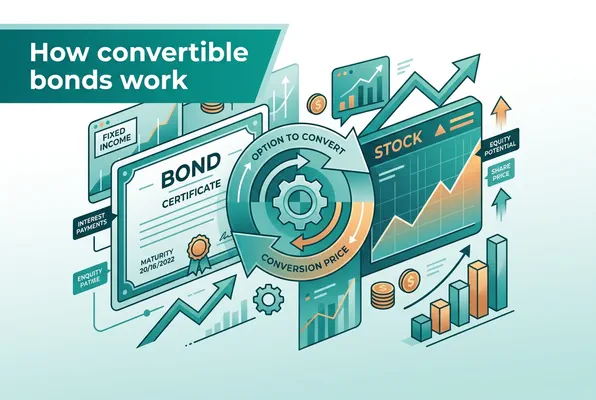

Convertible bonds occupy a fascinating middle ground in the financial markets — part debt instrument, part equity play. For investors trying to balance capital preservation with growth potential, understanding how convertible bonds work can open up a genuinely distinctive asset class. This guide walks through every critical dimension: mechanics, pricing, strategies, risks, and real-world applications.
What Is a Convertible Bond?
A convertible bond is a corporate debt security that pays periodic interest like any regular bond, but also grants the holder the right, not the obligation, to convert the bond into a specified number of the issuing company’s common shares. That embedded option is what makes convertibles unique.
Think of it as a bond with a built-in stock option. The investor enjoys the predictability of fixed income while retaining the chance to participate in equity upside if the company’s share price appreciates significantly.
Key Characteristics at a Glance
- Par value (face value): Typically $1,000 per bond
- Coupon rate: Usually lower than comparable straight (non-convertible) corporate bonds
- Maturity date: The date the issuer repays principal if no conversion has occurred
- Conversion ratio: The number of shares received per bond upon conversion
- Conversion price: The effective price per share paid when converting
- Conversion premium: The percentage by which the conversion price exceeds the current stock price at issuance
How Convertible Bonds Work: The Core Mechanics
Convertible Bonds vs. Traditional and Conventional Bonds
While convertible bonds and regular bonds share several characteristics, they differ in one important aspect: the conversion feature. Like traditional bonds, convertible bonds pay interest and have a repayment date. However, unlike conventional bonds, a bond includes a conversion right that allows investors to exchange debt for equity.
Because of this embedded option, convertible bonds typically offer lower coupon rates than plain vanilla bonds. Investors accept reduced income in exchange for the opportunity to benefit from future share price appreciation.
The Bond Component
At its foundation, a convertible bond behaves like ordinary corporate debt. The issuer pays the bondholder regular coupon interest, semi-annually in most cases, and promises to return the principal at maturity. This creates what analysts call the investment value or bond floor: the estimated price the security would trade at if the conversion feature did not exist.
The bond floor acts as a theoretical cushion against losses. Even if the company’s stock collapses, the bond should trade near its straight-bond value, assuming the issuer remains solvent.
The Equity Option Component
The other half of a convertible bond is essentially a call option on the issuer’s common stock. When the stock price rises above the conversion price, the conversion feature gains intrinsic value. Investors can convert their bonds into shares and either hold the equity or sell it at the prevailing market price.
This combination creates the famous asymmetric return profile of convertibles: - If the stock rises sharply: The investor benefits from equity-like gains - If the stock stays flat or falls modestly: The bond income and principal repayment provide protection
Conversion Ratio and Conversion Price
These two figures are set at issuance and are usually found in the bond’s indenture agreement.
Conversion ratio = Number of shares received per bond
Conversion price = Bond par value ÷ Conversion ratio
Example:
A $1,000 face-value bond with a conversion ratio of 40 has a conversion price of $25 per share ($1,000 ÷ 40 = $25).
If the company’s stock is trading at $20 at issuance, the conversion premium is 25% — meaning the stock needs to rise 25% before conversion becomes economically meaningful at face value.
Understanding the Option to Convert
The defining characteristic of convertible securities is the option to convert. This feature gives investors the right, but not the obligation, to exchange a bond for company shares. The option to convert the bond becomes valuable when the stock price rises above the conversion price.
If market conditions are favorable, an investor can convert the bond and participate in the company’s equity growth. If not, the investor may simply continue holding the bond and receive interest payments until maturity.
The Parity Value (Conversion Value)
Parity value = Current stock price × Conversion ratio
Using the example above: if the stock rises to $35, the parity value becomes $35 × 40 = $1,400. Since you paid $1,000 for the bond, converting gives you a $400 gain over par, before accounting for any coupon income already received.
The Relationship Between Conversion Price and Share Value
The conversion price is the price per share at which a convertible bond may be exchanged into stock. This figure determines how many shares per bond an investor receives.
The number of shares per bond is calculated using the principal amount divided by the conversion price. Therefore, changes in the stock price can significantly influence the value of the convertible bond and whether conversion becomes economically attractive.
The Life of a Convertible Bond: Three Stages
Understanding how convertible bonds work in practice means recognizing that the instrument behaves differently depending on where the underlying stock price sits relative to the conversion price.
1. “Busted” Convertible (Deep Out-of-the-Money)
When the stock price is far below the conversion price, the equity option has little practical value. The bond trades primarily based on its fixed-income characteristics — yield, credit quality, and interest rate sensitivity. These “busted convertibles” attract distressed debt investors and pure fixed-income players.
2. Hybrid Zone (Near the Money)
When the stock price is close to the conversion price — within roughly 20-30% above or below — the convertible exhibits its most interesting and complex behavior. Both the bond and equity components meaningfully influence the price. This is where the asymmetric payoff profile is most pronounced and where dedicated convertible bond funds typically focus their attention.
3. Equity-Like (Deep In-the-Money)
When the stock trades far above the conversion price, the conversion option has substantial intrinsic value and the bond trades very close to its parity value. At this point, the bond floor provides minimal downside protection, and the instrument behaves almost like the underlying equity. Delta (the sensitivity to stock price movements) approaches 1.
Key Terms Every Investor Should Know
Conversion Premium
The conversion premium expresses how much more expensive it is to buy shares via conversion compared to buying them directly in the market.
Conversion premium (%) = [(Conversion price − Current stock price) ÷ Current stock price] × 100
A higher premium means the stock has further to climb before conversion is profitable. Lower premiums indicate the stock is already approaching the conversion price, increasing equity-like behavior.
Call Provisions (Issuer Call)
Most convertible bonds include a call provision allowing the issuer to redeem the bonds before maturity at a specified price, typically once the stock exceeds the conversion price by a certain threshold (often 130% of the conversion price for a defined period). This is sometimes called a forced conversion because investors must choose between converting to shares or accepting the call price.
Issuers use calls to eliminate debt and force equity conversion when it suits them, which can be a disadvantage to investors holding bonds purely for income.
Put Provisions (Investor Put)
Some convertibles include a put option allowing investors to sell the bond back to the issuer at par (or a slight premium) on specific dates. This is an investor-friendly feature that provides additional downside protection beyond the bond floor, particularly during periods of rising interest rates or declining credit quality.
Dilution and Anti-Dilution Provisions
When convertible bonds convert into equity, new shares are created, diluting existing shareholders’ ownership percentages. Many convertible bond indentures include anti-dilution adjustments that modify the conversion ratio if the company splits its stock, issues dividends in shares, or undertakes certain other corporate actions, protecting convertible bondholders from being disadvantaged.
How Convertible Bonds Are Priced
Pricing a convertible bond is more complex than pricing straight debt because you are simultaneously valuing a bond and an embedded option.
Theoretical Pricing Components
- Straight bond value: Present value of future coupons and principal, discounted at the yield of comparable non-convertible bonds with similar credit risk
- Option value: The theoretical value of the right to convert, typically estimated using options pricing models such as Black-Scholes or binomial tree models
Market price ≈ Straight bond value + Option value
In practice, convertible bonds often trade at a slight premium or discount to this theoretical value based on: - Market liquidity (convertibles can be illiquid) - Supply and demand dynamics - Investor sentiment toward the issuer - Implied volatility of the underlying stock
Delta and Sensitivity Measures
Convertible bond traders use options-derived sensitivities:
- Delta: How much the convertible price changes for a $1 move in the stock price. Ranges from near 0 (busted) to near 1 (deep in-the-money).
- Gamma: The rate of change of delta; highest when the bond is near the money.
- Vega: Sensitivity to changes in implied volatility of the stock. Higher volatility increases option value, benefiting convertible holders.
- Rho: Sensitivity to interest rate changes, similar to standard bond duration.
Why Companies Issue Convertible Bonds
Lower Cost of Capital
Because investors pay for the conversion option by accepting a below-market coupon rate, companies can raise debt capital at a significantly lower interest cost. For a growth company that might otherwise pay 6-8% on straight bonds, a convertible might price at 2-4%, meaningfully reducing annual interest expenses.
Deferred Equity Dilution
Convertibles allow companies to issue what is effectively deferred equity. Dilution only occurs if and when bonds are converted, typically at a stock price higher than when the bonds were issued. Management often prefers this to an immediate equity offering at current prices.
Attractive to Growth-Stage Companies
High-growth technology and biotech companies are frequent convertible issuers. These companies often have limited current cash flows, making high fixed interest payments burdensome, yet their growth prospects attract equity-oriented investors who will accept lower coupons for conversion optionality.
Balance Sheet Flexibility
If the stock performs well and bonds convert, debt disappears from the balance sheet without requiring a cash repayment, improving leverage ratios. If the stock underperforms, the company repays principal at maturity — by which time it may have generated the cash flow to do so comfortably.
Why Investors Buy Convertible Bonds
Asymmetric Return Profile
The most cited reason is the “participate and protect” characteristic: equity-like upside with bond-like downside cushion. Research on historical convertible bond performance shows that over long periods, convertibles have delivered roughly 70-80% of equity market returns with meaningfully lower volatility, though past performance does not guarantee future results.
Portfolio Diversification
Because convertibles blend fixed-income and equity characteristics, they often have moderate correlations with both pure bond and pure equity indices. Adding convertibles to a portfolio that holds only stocks and bonds can improve the overall risk-adjusted return profile.
Yield Enhancement Over Pure Equity
For investors holding convertibles instead of the underlying shares, the coupon payments provide income that pure stock positions do not, cushioning periods of flat or modestly declining stock prices.
Inflation Protection (Relative to Straight Bonds)
Because the equity component gains value as earnings and stock prices potentially rise with inflation, convertibles generally offer better protection against inflation erosion than plain-vanilla fixed-rate bonds.
Risks of Investing in Convertible Bonds
No investment is risk-free. Understanding the drawbacks is just as important as understanding the appeal when you explore how convertible bonds work.
Credit Risk
Convertible bonds are unsecured corporate obligations in most cases. If the issuer defaults, bondholders face potential losses just as with any corporate bond, and the equity component becomes worthless. Credit analysis of the issuer is essential.
Interest Rate Risk
The bond component is exposed to rising interest rates, which reduce the present value of future cash flows. However, the equity option component provides some offset: if rates rise because the economy is strong and corporate earnings are growing, the stock price may rise, increasing the option’s value.
Equity Underperformance Risk
If the stock never rises above the conversion price, investors receive only the bond’s below-market coupon return. They would have earned more holding a comparable straight corporate bond.
Call Risk
As noted, issuers can call the bonds when the stock price rises significantly. This caps the investor’s upside in some scenarios and forces a conversion decision at the issuer’s chosen moment rather than the investor’s preferred timing.
Liquidity Risk
The convertible bond market, while global and substantial (with over $300 billion outstanding in U.S. markets alone), is far less liquid than major equity or Treasury markets. Bid-ask spreads can be wide, and large positions may be difficult to exit without moving the market.
Complexity and Mispricing Risk
The hybrid nature of convertibles makes them harder to analyze than pure bonds or stocks. Retail investors unfamiliar with options pricing may misprice these instruments or misunderstand their risk exposures, particularly near call triggers.
Types of Convertible Bonds
Convertible Preferred Securities and Alternative Structures
In addition to convertible bonds, companies may issue convertible preferred stock or other forms of convertible preferred securities. These instruments share many similarities with convertibles because investors can exchange them for common shares under predefined conditions.
While both structures provide conversion rights, convertible preferred securities often have different dividend and voting characteristics. Invest
Vanilla Convertibles
Standard convertible bonds with straightforward conversion rights, a fixed coupon, and a defined maturity date. The most common structure.
Mandatory Convertibles
These must convert into equity at maturity — the investor has no choice. In exchange, mandatory convertibles typically offer higher coupons than vanilla convertibles. Common structures include PERCS (Preferred Equity Redemption Cumulative Stock) and DECS (Debt Exchangeable for Common Stock). The trade-off is that downside protection is limited relative to optional convertibles.
Contingent Convertibles (CoCos)
Primarily issued by European banks, CoCo bonds convert into equity (or are written down) automatically when the issuer’s capital ratio falls below a regulatory trigger level. They are designed to absorb losses during financial distress, shifting risk from taxpayers to bondholders. CoCos carry higher yields but also significantly higher risk.
Zero-Coupon Convertibles (LYONs)
Issued at a deep discount to face value with no coupon payments, these bonds convert into equity or are redeemed at par at maturity. The return comes from price appreciation toward par rather than periodic income. Merrill Lynch pioneered these as Liquid Yield Option Notes (LYONs) in the 1980s.
Exchangeable Bonds
Similar to convertibles, but the bonds exchange into shares of a different company rather than the issuer itself. For example, a holding company might issue bonds exchangeable into shares of a subsidiary it owns.
Convertible Bond Strategies
Outright Long (Buy and Hold)
The simplest approach: purchase convertibles and hold them, collecting coupons while waiting for equity appreciation or holding to maturity. Appropriate for investors who believe in the issuer’s long-term growth story but want more security than pure equity provides.
Convertible Arbitrage
A popular hedge fund strategy that involves: 1. Going long the convertible bond 2. Short selling the underlying equity in proportion to the bond’s delta
The goal is to isolate and profit from mispricing between the convertible and its theoretical fair value, while remaining largely market-neutral. Changes in implied volatility, credit spreads, and gamma generate returns in this strategy. It requires sophisticated risk management and is not suitable for retail investors.
Balanced or Hybrid Allocation
Some investors include convertible bonds as a distinct allocation within a broader portfolio — neither full equity nor full fixed income — targeting the specific risk-return profile that sits between the two asset classes.
Convertible Bonds vs. Other Hybrid Securities
| Feature | Convertible Bond | Preferred Stock | High-Yield Bond |
|---|---|---|---|
| Fixed income component | Yes | Yes (dividends) | Yes |
| Equity upside potential | Yes | Limited | Minimal |
| Priority in bankruptcy | Senior to equity | Senior to common | Often senior |
| Tax treatment of income | Interest (taxable) | Dividends | Interest (taxable) |
| Conversion feature | Yes | Sometimes | No |
| Typical coupon | Low | Moderate | High |
How to Invest in Convertible Bonds
Direct Bond Purchase
Institutional investors and high-net-worth individuals can purchase individual convertible bonds through broker-dealers. Minimum denominations are typically $1,000, but realistic minimum trade sizes are much larger ($100,000+) due to liquidity constraints.
Convertible Bond Mutual Funds and ETFs
For most individual investors, the most accessible route is through dedicated convertible bond funds or exchange-traded funds. These vehicles provide: - Professional management and security selection - Diversification across many issuers - Daily liquidity at market prices (for ETFs) - Lower minimum investments
Notable ETF examples in the U.S. market include funds tracking the ICE BofA U.S. Convertibles Index, though investors should always review expense ratios and underlying holdings before investing.
Inclusion Within Multi-Asset Funds
Some balanced or multi-asset funds include convertible bonds as part of a broader allocation without separately labeling them. Reading the fund’s prospectus and holdings will reveal whether this is the case.
Evaluating a Convertible Bond: A Practical Framework
When analyzing a specific convertible bond, consider the following questions:
- Credit quality: What is the issuer’s credit rating? Can they service the debt and repay principal?
- Conversion premium: How far does the stock need to rise for conversion to be profitable? Is that realistic?
- Bond floor: What yield does the straight bond component offer? Is it competitive with similar-rated corporate bonds?
- Time to maturity: How long do you have for the equity thesis to play out?
- Call provisions: When can the issuer force conversion? Does this limit your upside?
- Liquidity: How actively does this bond trade? What are typical bid-ask spreads?
- Volatility: How volatile is the underlying stock? Higher volatility increases option value.
- Industry and growth prospects: Does the company have a credible path to the stock price appreciation needed for conversion to matter?
Tax Considerations for Convertible Bonds
Tax treatment varies by jurisdiction and specific security structure, but general principles in the U.S. include:
- Coupon interest is taxed as ordinary income in the year received
- Capital gains on sale of the bond or converted shares may qualify for long-term rates if held long enough
- Original Issue Discount (OID): For zero-coupon convertibles, the accretion of discount is typically treated as phantom income taxable annually, even without cash payment
- Conversion itself is generally not a taxable event — the cost basis of the bond carries over to the received shares
Always consult a qualified tax professional regarding your specific situation.
The Global Convertible Bond Market
Convertible bonds are a global asset class with significant issuance across North America, Europe, and Asia-Pacific. Key facts:
- United States historically dominates issuance, with technology, healthcare, and consumer discretionary sectors leading
- Japan has a large convertible market driven by its corporate capital structure preferences
- Europe sees significant issuance from industrials, financials, and real estate companies
- Emerging markets increasingly use convertibles as a capital-raising tool, though credit risk tends to be higher
Global convertible issuance often surges during periods of equity market optimism and company growth financing needs, and contracts during downturns when investor risk appetite falls.
Common Misconceptions About Convertible Bonds
“Convertibles always outperform in bull markets”
Not necessarily. In very strong equity bull markets, pure stocks will typically outperform convertibles because the bond floor limits participation when stocks are already trading far above conversion prices and call provisions cap further upside.
“The conversion option has no cost”
The option is paid for through the lower coupon rate. Investors accept below-market interest income in exchange for equity upside — there is a real economic cost to the optionality.
“Convertibles are always safer than stocks”
While convertibles generally offer more downside protection than the underlying equity, they are not risk-free. A company default eliminates both the coupon stream and the principal, and the equity option value. Distressed convertibles can lose substantial value.
“Any investor can easily value a convertible”
The pricing complexity — involving credit analysis, options modeling, volatility forecasting, and interest rate sensitivity — makes convertibles among the more challenging instruments to independently value accurately. This complexity is one reason why many retail investors access the asset class through managed funds.
Advantages and Disadvantages of Convertible Bonds
Although convertible bonds provide upside participation, investors should also understand the disadvantages of convertible investing. The lower coupon rate compared with traditional debt represents an opportunity cost if the stock underperforms.
In addition, there may be additional risk for convertible bond holders related to credit quality, liquidity, and forced conversion. Understanding the overall risk for convertible bond investors is essential before allocating capital to this asset class.
Conclusion
Understanding how convertible bonds work reveals why they have endured as a distinct and valued corner of the capital markets for over a century. For issuers, they offer a cost-efficient capital-raising tool that defers equity dilution. For investors, they provide a structurally asymmetric instrument — one that genuinely attempts to deliver the best of both the bond and equity worlds, even if the trade-offs are real and the complexity is meaningful.
Whether you are a growth-oriented equity investor seeking some downside protection, a fixed-income investor looking for upside participation, or a portfolio manager seeking diversification, convertible bonds deserve a place in your analytical toolkit. As with any investment, thorough due diligence, an understanding of the embedded costs and risks, and a clear view of your own investment objectives are essential before committing capital.
If you want to model convertible bond scenarios, compare investment options, or track your portfolio’s hybrid security exposure, tools like Finflexia can help you bring structure and clarity to complex investment decisions.

Written by
Dominik KonoldFounder
Dominik is the founder of Finflexia and an expert in treasury accounting, financial instrument valuation and IFRS compliance. Since 2016, he's been a certified Professional Risk Manager (PRMIA) and also lectures for the Association of Public Banks and the Academy of International Accounting. He built Finflexia to help treasury teams automate complex accounting workflows.
Related Posts
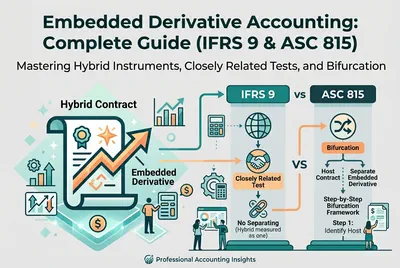
Embedded Derivative Accounting: Complete Guide (IFRS 9 & ASC 815)
This guide explains embedded derivative accounting under IFRS and ASC 815, including fair value measurement, hybrid instrument assessment, and the closely related test.
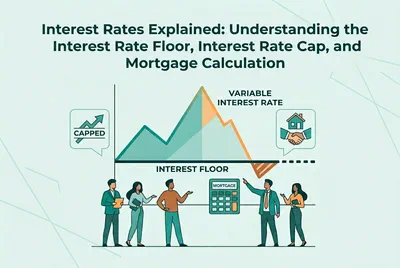
Interest Rate Floor Explained
This Guide provides an overview of interest rate caps and floors in lending, explaining how they set upper and lower limits on variable interest rates in loan contracts and protect lenders and borrowers from extreme market movements.
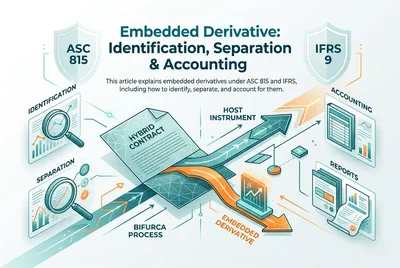
Embedded Derivative: Identification, Separation & Accounting
This article explains embedded derivatives under ASC 815 and IFRS, including how to identify, separate, and account for them. It also outlines when a derivative under ASC 815 must be bifurcated and how it impacts financial reporting.
Ready to simplify your treasury accounting?
See how Finflexia helps you manage financial instruments with ease. Book a demo to learn more.
Book a Demo