Hedge Accounting: Complete Guide to Financial Risk Management
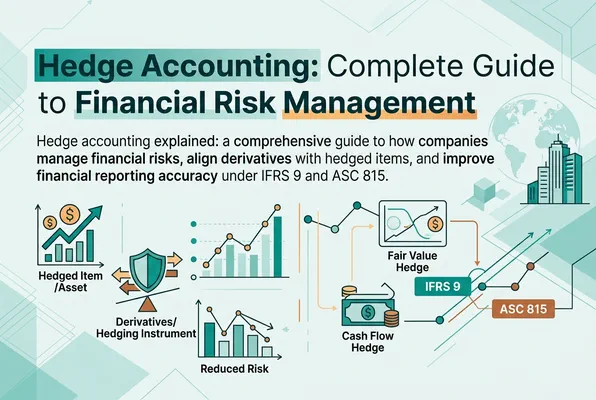

Hedge accounting is one of the most technically demanding yet strategically important practices in modern corporate finance. For treasury professionals, CFOs, and financial controllers, understanding how to correctly apply hedge accounting can mean the difference between transparent, stable financial reporting and a balance sheet riddled with artificial volatility. This guide covers everything you need to know, from the foundational concepts to practical implementation, qualification criteria, and the latest standards under IFRS 9 and ASC 815.
What Is Hedge Accounting?
Hedge accounting is a method of financial reporting that matches the gains and losses on a hedging instrument, typically a derivative such as a forward contract, option, or interest rate swap, with the gains and losses on the item being hedged. The goal is to reflect the economic reality of a company’s risk management activities rather than creating misleading fluctuations in reported earnings.
Without hedge accounting, derivatives are reported at fair value through profit or loss each reporting period. This means that even if a company is perfectly hedged from an economic standpoint, its income statement may show significant swings simply because the derivative’s value changes before the underlying exposure has been recognized. Hedge accounting corrects this mismatch.
The Core Problem Hedge Accounting Solves
Consider a company that exports goods to Europe and receives payment in euros. To protect against a weakening euro, the company enters into a forward contract to sell euros at a fixed rate. Economically, the company is protected. However, without hedge accounting:
- The forward contract is marked to market each quarter
- If the euro strengthens, the derivative shows a loss, even though the company will benefit from higher euro receipts
- Earnings appear volatile even though the underlying business is protected
Hedge accounting allows the company to defer the derivative’s gain or loss in Other Comprehensive Income (OCI) and recognize it when the hedged transaction affects profit or loss, matching the timing and creating a cleaner income statement.
Key Standards Governing Hedge Accounting
IFRS 9: Financial Instruments
The International Financial Reporting Standard 9 (IFRS 9), issued by the IASB and effective since January 1, 2018, significantly reformed hedge accounting compared to its predecessor, IAS 39. IFRS 9 introduced a more principles-based approach that better aligns hedge accounting with actual risk management practices.
Key improvements under IFRS 9 include:
- Broader eligibility for hedged items and hedging instruments
- Elimination of the 80–125% bright-line effectiveness test in favor of a qualitative, principles-based approach
- Ability to hedge risk components of non-financial items (e.g., the oil component of jet fuel)
- Dynamic risk management facilitated through improved portfolio hedging options
- Reduced discontinuation requirements, allowing rebalancing instead of termination
ASC 815: Derivatives and Hedging (US GAAP)
In the United States, hedge accounting is governed by ASC 815, issued by the Financial Accounting Standards Board (FASB). Compared to IFRS 9, ASC 815 is more prescriptive and rules-based. Recent updates (particularly ASU 2017-12 and ASU 2022-01) have modernized ASC 815 to make it more practical for corporate hedgers.
Notable features of ASC 815 include:
- Last-of-layer method (now the portfolio layer method) for fair value hedges of prepayable assets
- Benchmark interest rate hedging with designated rates such as SOFR following the LIBOR transition
- Qualitative assessment of effectiveness permitted in certain circumstances
- Expanded ability to use the shortcut method for interest rate swaps
The Three Types of Hedge Accounting Relationships
Understanding the three types of hedge relationships is fundamental to applying hedge accounting correctly. Each type has specific accounting treatment, qualifying criteria, and disclosure requirements.
1. Fair Value Hedge
A fair value hedge protects against changes in the fair value of a recognized asset, liability, or an unrecognized firm commitment attributable to a particular risk. Both the hedging instrument and the hedged item are measured at fair value through profit or loss, so gains and losses on each offset each other in the income statement.
Common examples: - Hedging fixed-rate debt using an interest rate swap (pay floating, receive fixed) - Hedging inventory fair value against commodity price changes - Hedging a firm purchase commitment in a foreign currency
Accounting treatment: The carrying amount of the hedged item is adjusted for the change in fair value attributable to the hedged risk. These adjustments, along with the gain or loss on the hedging instrument, are recognized in profit or loss in the same period.
2. Cash Flow Hedge
A cash flow hedge protects against variability in future cash flows that is attributable to a specific risk and could affect profit or loss. This is the most commonly used hedging type for corporate treasury departments.
Common examples: - Hedging variable-rate debt to lock in interest payments - Hedging forecasted foreign currency sales or purchases - Hedging commodity purchases for future production
Accounting treatment: The effective portion of gains and losses on the hedging instrument is recognized in OCI and accumulated in a cash flow hedge reserve. The ineffective portion is recognized immediately in profit or loss. When the hedged item affects profit or loss, the amounts accumulated in OCI are reclassified to profit or loss.
3. Net Investment Hedge
A net investment hedge protects against the foreign currency risk of a company’s equity stake in a foreign subsidiary. This type is particularly relevant for multinational corporations with significant overseas operations.
Common examples: - Using foreign currency borrowings to hedge a net investment in a European subsidiary - Using cross-currency interest rate swaps to hedge dollar-denominated investments in foreign entities
Accounting treatment: The effective portion of gains and losses on the hedging instrument is recognized in OCI within the foreign currency translation reserve. The ineffective portion is recognized in profit or loss. Accumulated amounts remain in OCI until the foreign operation is disposed of or partially disposed of.
Qualifying Criteria for Hedge Accounting
Not every hedging strategy qualifies for hedge accounting treatment. Both IFRS 9 and ASC 815 impose specific criteria that must be met at the inception of the hedge and throughout its life.
Formal Documentation Requirements
At hedge inception, the company must prepare formal documentation that includes:
- Identification of the hedging instrument (e.g., specific derivative contract)
- Description of the hedged item or transaction
- Nature of the risk being hedged
- Hedge effectiveness assessment method and how it will be measured
- Risk management objective and strategy for undertaking the hedge
This documentation is not optional, it is a hard prerequisite. Many companies have failed hedge accounting qualification solely because documentation was incomplete or prepared after the fact.
Hedge Effectiveness Requirements
Under IFRS 9, a hedging relationship qualifies for hedge accounting if it meets all of the following:
- Economic relationship: There is an economic relationship between the hedging instrument and the hedged item, meaning they move in opposite directions in response to the same risk
- Credit risk does not dominate: The effect of credit risk does not override the value changes resulting from the economic relationship
- Hedge ratio: The hedge ratio of the hedging relationship is the same as that resulting from the quantity of the hedged item the entity actually hedges
Under ASC 815, companies must perform both prospective and retrospective effectiveness testing, demonstrating that the hedge is “highly effective”, generally interpreted as falling within the 80–125% range.
Eligible Hedging Instruments
Under both standards, the most common hedging instruments include:
- Forward contracts (FX forwards, commodity forwards)
- Futures contracts (exchange-traded commodity or financial futures)
- Interest rate swaps and cross-currency swaps
- Options (purchased options are generally eligible; written options face restrictions)
- Collars (combination of bought and sold options)
Non-derivative instruments can also be designated as hedging instruments under IFRS 9, specifically for foreign currency risk, allowing companies to designate FX-denominated borrowings as hedges of net investments in foreign operations.
Eligible Hedged Items
The hedged item must be reliably measurable and must expose the entity to a risk that affects profit or loss (or OCI for equity instruments at FVOCI). Eligible hedged items include:
- Recognized assets and liabilities
- Firm commitments
- Highly probable forecast transactions
- Net investments in foreign operations
- Risk components of the above (under IFRS 9)
Accounting for Derivatives and Recognition of Gains and Losses
Accounting for derivatives is one of the most complex areas within financial reporting because derivative instruments are generally measured at fair value and can create significant movements in profit and loss without appropriate hedge accounting treatment. A derivative instrument that is not designated as a hedge is typically recognized through earnings, meaning changes in fair value may directly affect the income statement during each reporting period.
When a derivative is properly designated as a hedge, the timing of the recognition of gains and losses can be aligned with the financial impact of the underlying exposure. For example, a company may use a derivative to manage the risk associated with a future purchase, forecast transaction, or existing obligation. Without hedge accounting, the derivative valuation may create volatility in P&L even when the overall economic position of the company remains protected.
A hedge relationship involving a recognized asset or liability requires careful documentation and ongoing monitoring to demonstrate that the derivative offsets the relevant risk. Companies must identify the specific risk associated with P&L, determine the exposure being managed, and ensure that the accounting treatment reflects the actual financial strategy.
Hedge Accounting Work: Effectiveness Assessment, Strategies, and Technology
Successful hedge accounting work depends on continuous monitoring, accurate documentation, and reliable systems that support both accounting and operational processes. The assessment of hedge effectiveness is a critical component because companies must demonstrate that the relationship between the hedging instrument and the hedged item remains valid throughout the life of the hedge.
For a hedge relationship to continue receiving hedge accounting treatment, the relationship must maintain an economic connection between the derivative and the underlying exposure. This includes evaluating whether movements in the hedging instrument continue to offset the exposure to variability caused by market changes such as foreign exchange rates, interest rates, or commodity prices.
Modern hedge accounting strategies increasingly rely on technology to improve accuracy and efficiency. Advanced accounting software and treasury platforms help companies manage complex accounting and reporting requirements, automate calculations, maintain hedge documentation, and support compliance across multiple jurisdictions. These systems are especially valuable for multinational organizations managing exposures in different currencies, including risks related to changes in their functional currency.
By combining appropriate hedge accounting models, robust documentation processes, and technology-supported controls, companies can ensure that their financial reporting reflects the true economic purpose of their hedging activities.
Hedge Effectiveness Testing
Prospective Effectiveness Assessment
Before designating a hedge, companies must demonstrate that the hedging relationship is expected to be effective over its life. This prospective assessment can be qualitative when conditions strongly suggest the hedge will be effective — for example, when a forward contract perfectly mirrors the hedged forecasted transaction in terms of notional, currency, and maturity.
In other cases, quantitative methods are required:
- Dollar offset method: Compares the change in fair value of the hedging instrument to the change in fair value of the hedged item
- Regression analysis: Uses statistical regression to demonstrate the relationship between the hedging instrument and the hedged item
- Hypothetical derivative method: Compares the actual derivative to a perfectly effective “hypothetical” derivative
Retrospective Effectiveness Assessment
Under IFRS 9, ongoing retrospective testing is less prescriptive than under IAS 39. The standard requires companies to assess whether the hedge relationship continues to meet the qualifying criteria and to identify and account for any ineffectiveness. However, it does not require a separate numerical retrospective test.
Under ASC 815, retrospective testing is typically performed each quarter using the same method designated at inception.
Rebalancing the Hedge Ratio
One of the most practical improvements introduced by IFRS 9 is the concept of rebalancing. If the hedge ratio changes due to market conditions, companies can adjust the hedge relationship, by increasing or decreasing the quantity of the hedging instrument or hedged item, without fully discontinuing and redesignating the hedge. This saves significant administrative effort and avoids gaps in hedge accounting coverage.
Hedge Accounting for Common Risk Types
Foreign Currency Risk
Foreign currency (FX) risk is the most common reason companies use hedge accounting. Multinational corporations face FX exposure on:
- Transaction risk: Expected foreign currency receipts or payments
- Translation risk: Foreign currency-denominated assets and liabilities on the balance sheet
- Economic risk: Long-term impact of exchange rate changes on competitive position
FX forwards and options are typically used to hedge transaction risk as cash flow hedges, while net investment hedges address translation risk.
Interest Rate Risk
Interest rate risk arises from floating-rate debt obligations or fixed-rate instruments whose fair value fluctuates with rates. Companies commonly use interest rate swaps to:
- Convert floating-rate debt to fixed-rate (cash flow hedge)
- Convert fixed-rate debt to floating-rate (fair value hedge)
Following the global transition away from LIBOR, companies now primarily designate SOFR (in the US), SONIA (in the UK), or EURIBOR (in the eurozone) as benchmark rates in interest rate hedge relationships.
Commodity Price Risk
Manufacturing companies, energy producers, and airlines face significant commodity price risk. Hedge accounting can be applied to:
- Jet fuel purchases (airlines hedging crude oil or kerosene)
- Raw material purchases (manufacturers hedging copper, aluminum, or steel)
- Energy costs (companies hedging natural gas or electricity prices)
Under IFRS 9, it is possible to hedge just the commodity price component of a purchase price (e.g., the crude oil component of jet fuel cost), making hedge accounting more practical for industries where the hedged item’s price is composed of multiple components.
Credit Risk
While less common, hedge accounting can also be applied to credit risk using credit default swaps (CDS). This is more complex and subject to specific eligibility requirements under both IFRS 9 and ASC 815.
Step-by-Step: Implementing Hedge Accounting
Step 1: Identify and Assess the Risk Exposure
Before designating any hedge, the treasury or finance team must clearly identify:
- The nature of the risk (FX, interest rate, commodity)
- The specific exposure (asset, liability, forecast transaction)
- The financial impact on the income statement or OCI
Step 2: Design the Hedging Strategy
Select an appropriate hedging instrument that economically offsets the identified exposure. Consider factors such as:
- Notional amount and hedge ratio
- Maturity alignment with the hedged item
- Cost of the hedging instrument (e.g., option premiums)
- Counterparty credit risk
Step 3: Prepare Hedge Documentation
Create formal hedge documentation at or before the date of hedge designation. This must include all required elements as outlined above. Many companies use standardized templates to ensure completeness and consistency.
Step 4: Perform Prospective Effectiveness Testing
Demonstrate, using qualitative or quantitative methods, that the hedging relationship is expected to be effective. Document the method and the results.
Step 5: Record the Hedge in Accounting Systems
Designate the hedge in your ERP or treasury management system (TMS). Ensure the system is configured to:
- Track OCI separately for cash flow and net investment hedges
- Calculate and record the effective and ineffective portions
- Generate required journal entries and disclosures
Step 6: Perform Ongoing Assessment and Testing
At each reporting date:
- Assess whether the hedge continues to qualify
- Measure and record hedge ineffectiveness
- Rebalance if necessary
- Reclassify amounts from OCI to profit or loss when the hedged item affects earnings
Step 7: Maintain Disclosure Requirements
Both IFRS 7 and ASC 815 require extensive disclosures about hedging activities, including:
- The entity’s risk management strategy
- The effect of hedging on the financial position and performance
- Quantitative information about hedging instruments and hedged items
- Reconciliation of OCI components related to hedges
Common Challenges and Pitfalls
Incomplete or Late Documentation
One of the most frequent causes of hedge accounting failure is inadequate documentation. Hedge documentation cannot be prepared retroactively, it must exist at the time of designation. Companies should invest in robust processes and templates to ensure documentation is always complete and timely.
Over-Hedging and Hedge Ratio Errors
Designating a hedge ratio that does not reflect the actual economic relationship can result in significant ineffectiveness or loss of qualification. Companies should carefully calibrate hedge ratios and monitor them throughout the hedge’s life.
Forecasted Transactions That Fail to Occur
For cash flow hedges of forecasted transactions, the transaction must be “highly probable.” If a forecasted transaction no longer meets this threshold, hedge accounting must be discontinued, and any gain or loss in OCI must be immediately reclassified to profit or loss. This can result in unexpected earnings impacts.
System Limitations
Many mid-sized companies struggle to apply hedge accounting correctly because their accounting or ERP systems lack the functionality to automate hedge accounting entries, OCI tracking, and effectiveness testing. Investing in a purpose-built treasury management system or specialized software can significantly reduce operational risk.
The LIBOR Transition
The phase-out of LIBOR created significant challenges for companies with existing interest rate hedge relationships. IFRS 9 Phase 1 and Phase 2 amendments, as well as ASC 848 (Reference Rate Reform), provided temporary relief and practical expedients to help companies modify their hedging relationships without losing hedge accounting qualification.
Hedge Accounting Disclosures
Both IFRS 7 (Financial Instruments: Disclosures) and ASC 815 require comprehensive disclosure of hedge accounting activities. These disclosures are designed to help financial statement users understand the nature and extent of a company’s hedging activities and their financial impact.
Required Qualitative Disclosures
- Description of each type of hedge used
- Description of hedging instruments
- Description of items being hedged
- Risk management strategy and how hedges fit within it
Required Quantitative Disclosures
- Notional amounts of hedging instruments
- Fair values of hedging instruments
- Breakdown of OCI movements related to hedges
- Amounts reclassified from OCI to profit or loss
- Sources of hedge ineffectiveness
- Maturity profile of hedging instruments
How Technology Is Transforming Hedge Accounting
Modern treasury and finance technology has dramatically changed how companies implement and manage hedge accounting. Cloud-based platforms and specialized treasury management systems now offer:
- Automated designation workflows that enforce documentation standards
- Real-time effectiveness testing using market data feeds
- Automated journal entry generation for OCI and profit or loss
- Dashboard-level visibility into hedge positions and effectiveness
- Disclosure report generation aligned with IFRS 7 and ASC 815 requirements
Platforms like Finflexia are designed to support finance teams in managing the complexity of hedge accounting without the manual effort and risk of errors that come with spreadsheet-based approaches. As regulatory requirements grow more complex and transaction volumes increase, technology becomes an essential enabler of effective hedge accounting governance.
AI and Machine Learning in Hedge Management
Emerging applications of artificial intelligence in treasury management are beginning to assist with:
- Predictive modeling of hedge effectiveness
- Automated identification of eligible hedged items
- Scenario analysis for hedge ratio optimization
- Anomaly detection in effectiveness test results
These capabilities are not yet mainstream, but forward-thinking finance teams are exploring them to gain a competitive edge in risk management efficiency.
Best Practices for Hedge Accounting Programs
Developing a mature hedge accounting program requires both technical expertise and strong governance. Consider the following best practices:
Establish a Clear Hedging Policy
A formal hedging policy, approved by the board or audit committee, should define:
- Which risks are eligible for hedging
- Approved hedging instruments
- Maximum hedge ratios and tenor limits
- Governance and approval authorities
Invest in Training
Hedge accounting is technically complex and changes frequently. Treasury and accounting teams should receive regular training on both the accounting standards and the practical application of hedging strategies.
Perform Regular Audits of Hedging Relationships
Conduct periodic internal reviews to ensure all hedge relationships are properly documented, tested, and reported. Engage external auditors early when dealing with complex or novel hedging strategies.
Align Treasury and Accounting Teams
Effective hedge accounting requires close collaboration between treasury (who manages the hedging instruments) and accounting (who applies the accounting treatment). Misalignment between these teams is a common source of errors and audit findings.
Evaluate the Cost-Benefit of Hedge Accounting
Not every hedging strategy justifies the administrative burden of hedge accounting. For some exposures, the cost of maintaining the documentation and testing may outweigh the benefit of reducing earnings volatility. Conduct a periodic review of all hedging relationships to assess their continued suitability.
The Strategic Importance of Hedge Accounting
Beyond the technical accounting mechanics, hedge accounting plays a critical strategic role in how companies communicate their financial performance to investors, lenders, and regulators.
Companies that effectively apply hedge accounting can:
- Smooth earnings volatility, making financial results more predictable and easier to communicate to stakeholders
- Reduce cost of capital, as lenders and investors generally view stable earnings more favorably
- Demonstrate risk management maturity, which can positively influence credit ratings and investor confidence
- Protect cash flows, enabling more reliable business planning and capital allocation decisions
In an environment of elevated interest rate volatility, geopolitical currency risks, and commodity price swings, the ability to accurately and efficiently apply hedge accounting is more valuable than ever.
Summary
Hedge accounting is a powerful but complex tool that allows companies to align the accounting treatment of hedging instruments with the economic reality of their risk management activities. Whether protecting against foreign currency fluctuations, interest rate changes, or commodity price volatility, hedge accounting enables companies to present financial statements that reflect their true risk-adjusted performance.
Key takeaways:
- Hedge accounting eliminates artificial earnings volatility by matching gains and losses on hedging instruments with those on hedged items
- The three types — fair value hedges, cash flow hedges, and net investment hedges — each have distinct accounting treatment and qualifying criteria
- Formal documentation is a non-negotiable prerequisite; it must be prepared at hedge inception
- IFRS 9 and ASC 815 are the two primary standards, each with different approaches to effectiveness testing and eligible items
- Technology platforms are increasingly essential for managing the operational complexity of hedge accounting programs
- A well-designed hedging policy, strong governance, and trained staff are the foundations of a successful hedge accounting program
Whether you are implementing hedge accounting for the first time or looking to optimize an existing program, a structured approach grounded in the applicable standards, combined with the right technology, will position your organization for both accounting compliance and strategic financial resilience.

Written by
Dominik KonoldFounder
Dominik is the founder of Finflexia and an expert in treasury accounting, financial instrument valuation and IFRS compliance. Since 2016, he's been a certified Professional Risk Manager (PRMIA) and also lectures for the Association of Public Banks and the Academy of International Accounting. He built Finflexia to help treasury teams automate complex accounting workflows.
Related Posts
How Convertible Bonds Work: The Guide to Convertible Bonds
This guide explains how convertible bonds work, covering their key features, pricing, risks, conversion mechanisms, and the benefits they offer as hybrid securities that combine fixed-income investing with equity upside potential.
What Is a Convertible Bond? How a Convertible Security Works
This guide explains what convertible bonds are, how they work, and their key features, benefits, and risks for companies and investors.
Interest Rate Floor Explained
This Guide provides an overview of interest rate caps and floors in lending, explaining how they set upper and lower limits on variable interest rates in loan contracts and protect lenders and borrowers from extreme market movements.
Ready to simplify your treasury accounting?
See how Finflexia helps you manage financial instruments with ease. Book a demo to learn more.
Book a Demo