Fair Value Hedge: Accounting, Examples & Best Practices
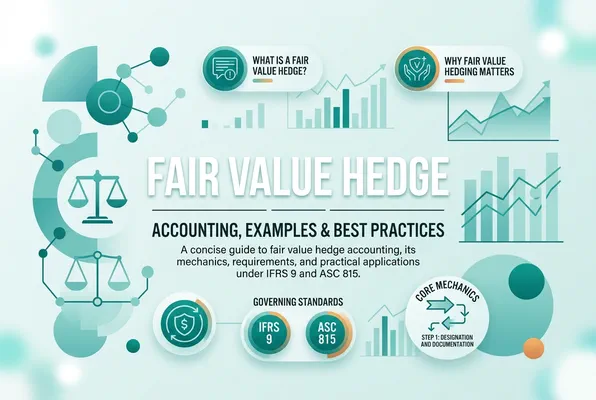

Fair value hedge accounting sits at the intersection of financial risk management and financial reporting. For treasury professionals, CFOs, and finance teams, mastering how a fair value hedge works is essential, not only to protect the balance sheet from adverse market movements but also to present financial statements that accurately reflect an entity’s risk management activities. This guide walks you through everything you need to know: the mechanics, the standards, qualifying criteria, real-world examples, and common pitfalls to avoid.
What Is a Fair Value Hedge?
A fair value hedge is a hedging relationship in which a derivative (or, in limited cases, a non-derivative financial instrument) is designated to offset the risk of changes in the fair value of a recognized asset, a recognized liability, or an unrecognized firm commitment, or a specific component of any of these items, that is attributable to a particular risk and could affect reported profit or loss.
In plain terms: if your company holds a fixed-rate bond or has issued fixed-rate debt, its fair value fluctuates as market interest rates move. A fair value hedge uses a hedging instrument, most commonly an interest rate swap, to neutralize that fluctuation on the balance sheet and in the income statement.
Why Fair Value Hedging Matters
Without hedge accounting, a company using derivatives to manage financial risk would recognize all derivative gains and losses immediately in profit or loss, while the offsetting changes in value of the hedged item might not be recognized at all (or might flow through other comprehensive income). This accounting mismatch can create artificial volatility in reported earnings that does not reflect the economic reality of the entity’s risk management strategy.
Fair value hedge accounting resolves this by allowing entities to also adjust the carrying amount of the hedged item for fair value changes attributable to the hedged risk, creating an offset in the income statement.
Debt’s Fair Value and Market Value Exposure
For companies with fixed-rate debt, movements in interest rates can significantly affect the debt’s fair value even when the contractual cash payments remain unchanged. When market interest rates rise, the market value of existing fixed-rate debt generally declines because newly issued debt offers more attractive returns. Conversely, when rates fall, the liability’s fair market value can increase. This distinction is particularly relevant when assessing the value of assets or liabilities that are exposed to market movements. A company may therefore use fair value hedges when it wants to manage changes in the fair value of assets or liabilities arising from a clearly identifiable market risk. The objective is not to change the contractual cash flows associated with the debt, but to manage the accounting impact of changes in the value of the underlying exposure.
Governing Standards: IFRS 9 and ASC 815
Fair value hedge accounting is governed by two major frameworks, depending on the jurisdiction and reporting standards of the entity:
IFRS 9 (International Financial Reporting Standards)
IFRS 9 Financial Instruments, issued by the IASB, replaced IAS 39 and introduced a more principles-based approach to hedge accounting. Under IFRS 9, the hedge accounting model is intended to align more closely with an entity’s actual risk management activities. Key features include:
- A qualitative-leaning effectiveness assessment (replacing the strict 80–125% bright-line test of IAS 39)
- Expanded eligibility of hedged items and hedging instruments
- Explicit recognition that hedge accounting should reflect risk management objectives
- Required disclosure of risk management strategy and hedge effectiveness
ASC 815 (US GAAP)
ASC 815 Derivatives and Hedging is the US GAAP equivalent, issued by the FASB. While broadly similar in concept to IFRS 9, ASC 815 has its own specific rules, including:
- The “shortcut method” and “critical terms match” method for assuming perfect effectiveness (under specific conditions)
- The “last-of-layer” method (now called the “portfolio layer method”) for hedging a portion of a closed portfolio of fixed-rate assets
- Specific requirements around benchmark interest rates (e.g., SOFR in the US)
- More prescriptive documentation and designation requirements
While IFRS 9 and ASC 815 share the same conceptual foundation, finance teams operating under both standards must pay close attention to the specific rules applicable to their reporting framework.
How Fair Value Hedge Accounting Works: The Core Mechanics
Understanding the accounting mechanics is critical. Here is how a fair value hedge operates step by step:
Step 1: Designation and Documentation
At hedge inception, the entity must formally designate and document:
- The hedging relationship
- The risk management objective and strategy
- The hedged item and the specific risk being hedged
- The hedging instrument
- How effectiveness will be assessed (prospectively and retrospectively)
This documentation is not a formality, it is a prerequisite for applying hedge accounting. Inadequate documentation is one of the most common reasons hedge accounting designations fail regulatory or audit scrutiny.
Step 2: Ongoing Effectiveness Assessment
For the hedge to qualify (and continue to qualify) for hedge accounting, it must meet effectiveness criteria:
- Economic relationship: There must be an economic relationship between the hedged item and the hedging instrument, meaning their values move in opposite directions in response to the hedged risk.
- Credit risk does not dominate: Changes in credit risk should not overshadow the economic relationship.
- Hedge ratio: The ratio of the quantity of hedging instrument to the hedged item must reflect the actual quantities used in the economic hedge.
Under IFRS 9, the rigid 80–125% quantitative threshold of IAS 39 no longer applies, though entities may still use quantitative methods as part of their effectiveness assessment. Under ASC 815, specific quantitative tests and methods remain important.
Step 3: Recognizing Gains and Losses
This is where the accounting offset is created:
- Hedging instrument: The entire change in fair value of the derivative is recognized in profit or loss.
- Hedged item: An offsetting fair value adjustment (a “basis adjustment”) is made to the carrying amount of the hedged item, also recognized in profit or loss for the portion attributable to the hedged risk.
Because both adjustments flow through the income statement in the same period, they offset each other. Any residual, the portion where the offset is not perfect, represents hedge ineffectiveness and is also recognized in profit or loss.
The Basis Adjustment Explained
The basis adjustment is a concept unique to fair value hedge accounting. It represents the cumulative fair value changes of the hedged item attributable to the hedged risk that have been recognized. This adjustment modifies the carrying amount of the hedged item on the balance sheet.
For example, if a company designated a fixed-rate bond as a hedged item and benchmark interest rates fall (increasing the bond’s fair value), a positive basis adjustment is added to the bond’s carrying amount. Simultaneously, the interest rate swap used as the hedging instrument will have decreased in value, recording a loss in profit or loss. The gain on the bond’s basis adjustment offsets that loss.
When the hedge is discontinued or the hedged item is derecognized, the accumulated basis adjustment is amortized to profit or loss over the remaining life of the item (if it still exists), or recognized immediately (if the item has been derecognized).
Foreign Exchange Rates and Fair Value Protection
Fair value exposures can also arise from movements in foreign exchange rates. Consider an entity holding a foreign-currency-denominated asset whose value changes when exchange rates move. If the value declining exchange rates creates a material economic exposure, the entity may designate an appropriate hedging instrument, such as a forward contract, to manage the foreign-currency risk. Depending on the applicable accounting standards and the characteristics of the underlying item, changes in fair value may be attributable to the foreign exchange component of the exposure. In such circumstances, the fair value hedge gains and losses on the hedging instrument can be assessed against the changes in fair value attributable to the designated foreign currency risk. This approach can help ensure that financial reporting reflects the economic relationship between the exposure and the instrument used to protect it.
Qualifying Criteria for a Fair Value Hedge
Not every derivative or risk management arrangement qualifies for fair value hedge accounting. Both IFRS 9 and ASC 815 impose specific qualifying criteria.
Eligible Hedged Items
A hedged item in a fair value hedge can be:
- A recognized financial asset or liability (e.g., a fixed-rate loan, a bond investment, or fixed-rate debt)
- An unrecognized firm commitment (e.g., a signed purchase contract at a fixed price in a foreign currency)
- A component of any of the above (e.g., only the benchmark interest rate component of a fixed-rate bond’s total fair value exposure)
- A group of items that collectively share similar risk characteristics
Non-financial items can be hedged in their entirety or only for foreign currency risk (under IFRS 9). Under ASC 815, non-financial items can also be hedged for certain specific risks.
Eligible Hedging Instruments
Hedging instruments in a fair value hedge are typically:
- Derivatives measured at fair value through profit or loss (interest rate swaps, currency forwards, options, cross-currency swaps)
- Under IFRS 9 (and limited cases under ASC 815), certain non-derivative financial instruments measured at fair value through profit or loss can be used to hedge foreign currency risk
A derivative must be with an external counterparty to the reporting entity (intra-group derivatives do not qualify in consolidated financial statements, though they may qualify in separate/individual entity financial statements).
Formal Designation Requirements
The hedge relationship must be:
- Formally designated at inception (not retroactively)
- Documented with specificity as outlined above
- Expected to be highly effective in achieving offsetting fair value changes
Practical Example: Hedging Fixed-Rate Debt with an Interest Rate Swap
The most classic and widely encountered fair value hedge is the use of an interest rate swap to convert fixed-rate debt into floating-rate debt.
The Scenario
Imagine a manufacturing company, let us call it Meridian AG, that issued a €10 million fixed-rate bond at a coupon rate of 4% with a five-year maturity. Meridian AG’s treasury team believes that interest rates may decline, which would increase the fair value of the bond liability on its balance sheet (and potentially require it to repurchase the debt at a premium if it ever wants to refinance). To hedge this exposure, they enter into an interest rate swap:
- Pay: 6-month EURIBOR (floating)
- Receive: 4% fixed (matching the bond coupon)
- Notional: €10 million
- Term: 5 years (matching the bond maturity)
This pay-floating, receive-fixed swap is designated as the hedging instrument in a fair value hedge of the fixed-rate bond (the hedged item), with the benchmark interest rate (EURIBOR) as the hedged risk.
The Accounting
At inception: No journal entries are required for the hedge designation itself. The bond is carried at amortized cost (before the basis adjustment), and the swap has a fair value of zero (assuming it is entered at market rates).
Period 1 – Interest rates fall by 50 basis points:
- The fair value of the interest rate swap decreases (a loss), as the fixed rate the company receives is now less valuable relative to the floating rate it pays. Suppose the swap fair value moves from €0 to -€200,000. This €200,000 loss is recognized in profit or loss.
- Simultaneously, the fair value of the fixed-rate bond increases because investors now demand lower yields. The basis adjustment to the bond’s carrying amount increases by €200,000, and this gain is also recognized in profit or loss.
- Net effect on profit or loss: €0 (assuming perfect effectiveness)
- Balance sheet: Bond carrying amount increases by €200,000 (basis adjustment)
Period 2 – Rates partially reverse (rise by 20 basis points):
- The swap partially recovers in value (a gain of €80,000 recognized in profit or loss)
- The bond’s basis adjustment decreases by €80,000 (a loss in profit or loss)
- Net effect: Again approximately €0, assuming the hedge continues to be highly effective
This offsetting treatment clearly demonstrates the economic purpose of fair value hedge accounting: eliminating the income statement volatility that would otherwise arise from marking the derivative to market while leaving the hedged item at amortized cost.
Fair Value and Cash Flow Risk in Different Market Conditions
The distinction between cash flow and fair value risk becomes especially important when market conditions change rapidly. Cash flow hedges focus on protecting against variability in cash payments, whereas fair value hedges address fluctuations in the current economic value of an existing position. The difference between cash flow and fair value exposure can be illustrated by a company holding a fixed-rate asset: its contractual cash flows attributable to interest may remain constant, while its current value may change considerably as market yields move. If an asset loses value because of rising yields, a fair value hedge can address the relevant market exposure. By contrast, when a company is primarily concerned that future forecasted cash payments will become more volatile, a cash flow hedge may be more appropriate. The choice ultimately depends on the nature of the risk the entity intends to manage.
Fair Value Hedge vs. Cash Flow Hedge: Key Differences
Many finance professionals encounter both fair value hedges and cash flow hedges. While both are types of hedge accounting under IFRS 9 and ASC 815, they serve different purposes and have different accounting treatment.
| Feature | Fair Value Hedge | Cash Flow Hedge |
|---|---|---|
| Risk hedged | Changes in fair value of an existing asset/liability or firm commitment | Variability in future cash flows |
| Typical hedged items | Fixed-rate bonds, fixed-rate debt, firm commitments | Floating-rate debt, forecast transactions |
| Common instruments | Interest rate swaps (receive-float, pay-fixed), forwards | Interest rate caps, swaps (pay-float, receive-fixed), options |
| Hedging instrument gains/losses | Recognized in profit or loss immediately | Effective portion deferred in OCI; reclassified when hedged item affects P&L |
| Hedged item adjustment | Basis adjustment to carrying amount, through profit or loss | No adjustment to the hedged item's carrying amount |
| Balance sheet impact | Carrying amount of hedged item adjusted | OCI balance accumulated |
The choice between these two hedge types depends on the nature of the risk being managed. A fixed-rate loan creates a fair value risk (its fair value changes as rates move), making a fair value hedge appropriate. A floating-rate loan creates a cash flow risk (the interest payments vary), making a cash flow hedge more appropriate.
Measuring and Reporting Hedge Ineffectiveness
Even well-designed hedges are rarely perfectly effective in every reporting period. Ineffectiveness occurs when the change in fair value of the hedging instrument does not exactly offset the change in fair value of the hedged item attributable to the hedged risk.
Common sources of ineffectiveness in a fair value hedge include:
- Credit risk differences: If the hedging instrument has a credit spread embedded in its pricing (e.g., the swap rate includes counterparty risk adjustments), it will not move identically to the benchmark rate component of the hedged item.
- Timing mismatches: If the repricing dates of the swap do not perfectly match the cash flow dates of the bond.
- Notional mismatches: If the notional of the swap differs from the carrying amount of the hedged item.
- Benchmark rate basis differences: Particularly relevant post-IBOR reform, where the transition to risk-free rates (SOFR, SONIA, €STR) may introduce temporary mismatches.
How Ineffectiveness Is Reported
Under both IFRS 9 and ASC 815, all ineffectiveness is recognized immediately in profit or loss. This is actually built into the fair value hedge mechanics automatically:
- The full change in fair value of the hedging instrument hits profit or loss.
- The change in fair value of the hedged item attributable to the hedged risk hits profit or loss via the basis adjustment.
- The difference between the two is the ineffectiveness, and since both numbers are already in profit or loss, the net amount automatically reflects it.
Under IFRS 9, there is no need for a separate “ineffectiveness calculation”, it emerges naturally from the accounting entries. Under ASC 815, specific methods (such as the shortcut method) may allow entities to assume zero ineffectiveness if stringent criteria are met, simplifying the accounting.
IBOR Reform and Its Impact on Fair Value Hedges
The global transition away from LIBOR and other interbank offered rates (IBORs) to risk-free rates (RFRs) such as SOFR, SONIA, TONA, and €STR had significant implications for existing fair value hedge designations.
Both the IASB (through amendments to IFRS 9, IAS 39, and IFRS 7 in Phase 1 and Phase 2) and the FASB (through ASU 2020-04 and subsequent updates) provided relief measures to ensure that existing hedge relationships were not disrupted solely due to IBOR reform. Key reliefs included:
- Allowing entities to assume that the IBOR-based benchmark rate is not altered during Phase 1, preserving the economic relationship criterion.
- Permitting entities to update hedge designations for the change in benchmark rate without discontinuing the hedge (Phase 2 relief).
- Allowing a practical expedient to treat certain modifications to hedging instruments and hedged items arising from IBOR reform as non-substantial modifications.
Finance teams managing legacy fair value hedges that referenced LIBOR must ensure their documentation has been updated and that any new RFR-based designations comply with the current standard requirements.
Common Mistakes in Fair Value Hedge Accounting
Even experienced treasury and accounting teams make errors when applying fair value hedge accounting. Here are the most frequent pitfalls:
1. Inadequate or Retroactive Documentation
Documentation must be completed at hedge inception, not after the fact. Many audits and regulatory reviews have rejected hedge accounting designations because documentation was prepared after the derivative was entered into, or was not sufficiently specific about the hedged risk, the hedging instrument, or the effectiveness assessment methodology.
2. Designating the Wrong Risk Component
Under IFRS 9, it is possible to designate only a component of the hedged item’s risk (e.g., only the benchmark interest rate component of a fixed-rate bond). However, the component must be separately identifiable and reliably measurable. Mis-specifying the component can lead to high levels of ineffectiveness or disqualification of the hedge.
3. Forgetting to Amortize Basis Adjustments
When a fair value hedge is discontinued (but the hedged item continues to exist), the accumulated basis adjustment must be amortized to profit or loss over the remaining life of the hedged item. Failing to do so is a common error that can result in material misstatements.
4. Neglecting Rebalancing Requirements
Under IFRS 9, if a hedge becomes less effective due to changes in the hedge ratio (but the risk management objective remains the same), the entity is required to rebalance the hedge relationship rather than discontinue it. Many preparers are unaware of this obligation or confuse it with voluntary discontinuation.
5. Applying the Wrong Standard
Entities that report under both IFRS and US GAAP (e.g., for subsidiary reporting) must be careful not to apply IFRS 9 mechanics to an ASC 815 designation or vice versa. The two standards have important differences in available simplifications, eligible hedged items, and presentation requirements.
Fair Value Hedge Disclosures
Both IFRS 7 (under IFRS) and ASC 815 (under US GAAP) require extensive disclosures about hedge accounting. For fair value hedges specifically, entities must disclose:
- The risk management strategy and how it relates to the hedge
- A description of the hedging instruments and their fair values
- The nature of the risks being hedged
- The carrying amounts of hedged items on the balance sheet (separately for assets and liabilities), including the accumulated basis adjustments
- The gains and losses recognized in profit or loss from the hedging instrument and the hedged item
- Ineffectiveness amounts recognized in profit or loss
- Information about sources of hedge ineffectiveness
Under IFRS 7, entities must also provide a maturity analysis of the hedging instruments and qualitative information about how the hedge accounting strategy relates to the documented risk management objective.
Clear, well-structured disclosures are not just a compliance requirement, they also help investors and analysts understand the true economic substance of the entity’s risk management program.
Leveraging Technology for Fair Value Hedge Management
Managing fair value hedges at scale, especially for entities with large portfolios of fixed-rate debt, loans, or investment securities, requires robust systems and processes. Modern treasury management systems (TMS) and financial risk management platforms can:
- Automate hedge designation documentation
- Run real-time fair value calculations for both hedging instruments and hedged items
- Perform prospective and retrospective effectiveness assessments
- Generate the journal entries and basis adjustment schedules automatically
- Produce IFRS 7 and ASC 815 disclosure reports
For finance teams looking to streamline their hedge accounting workflows and reduce the risk of manual error, platforms like Finflexia offer integrated solutions that bring together derivative valuation, hedge accounting automation, and financial reporting in a single environment, making it easier to stay compliant with IFRS 9 and ASC 815 while focusing on strategic risk management decisions.
Conclusion
A fair value hedge is a powerful risk management and accounting tool that allows entities to protect the carrying value of assets and liabilities from adverse fair value movements and to reflect that protection faithfully in their financial statements. By aligning the accounting treatment of the hedging instrument and the hedged item, both measured through profit or loss, fair value hedge accounting eliminates the artificial earnings volatility that would otherwise arise from economic hedging activities.
Success in fair value hedging requires a thorough understanding of the qualifying criteria under IFRS 9 or ASC 815, disciplined documentation practices, careful selection of hedging instruments such as interest rate swaps, and rigorous ongoing effectiveness monitoring. Avoiding common mistakes, from incomplete documentation to forgotten basis adjustment amortization, is equally important.
As interest rates, benchmark rate transitions, and regulatory requirements continue to evolve, staying current with developments in fair value hedge accounting is not optional for finance professionals, it is a strategic imperative.

Written by
Dominik KonoldFounder
Dominik is the founder of Finflexia and an expert in treasury accounting, financial instrument valuation and IFRS compliance. Since 2016, he's been a certified Professional Risk Manager (PRMIA) and also lectures for the Association of Public Banks and the Academy of International Accounting. He built Finflexia to help treasury teams automate complex accounting workflows.
Related Posts
Amortized Cost: Complete Guide with Examples
This guide explains what amortized cost is, how it is calculated using the effective interest method, when it is applied under IFRS and US GAAP, and how it impacts financial reporting, asset valuation, and the analysis of financial statements.
How Convertible Bonds Work: The Guide to Convertible Bonds
This guide explains how convertible bonds work, covering their key features, pricing, risks, conversion mechanisms, and the benefits they offer as hybrid securities that combine fixed-income investing with equity upside potential.
Embedded Derivative Accounting: Complete Guide (IFRS 9 & ASC 815)
This guide explains embedded derivative accounting under IFRS and ASC 815, including fair value measurement, hybrid instrument assessment, and the closely related test.
Ready to simplify your treasury accounting?
See how Finflexia helps you manage financial instruments with ease. Book a demo to learn more.
Book a Demo