Embedded Derivative: Identification, Separation & Accounting
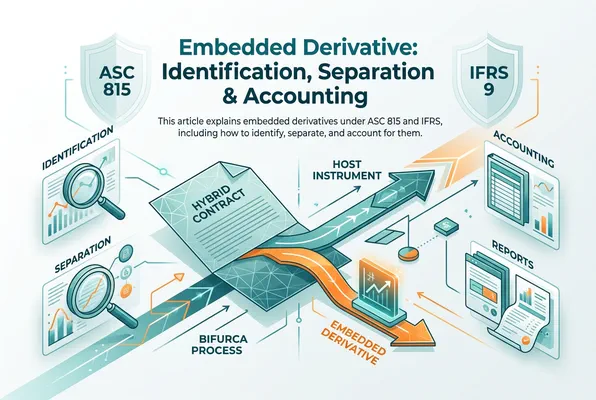

Contracts in the real world are rarely simple. A bond might let the holder convert it into shares. A supply agreement might tie prices to a commodity index. A lease might include a foreign-currency payment clause. Hidden inside each of these arrangements is something that behaves just like a derivative—even though no one signed a separate derivative contract. That component is an embedded derivative, and getting its accounting treatment right matters enormously for the accuracy of financial statements.
This guide walks through everything finance professionals need to know: the definition of an embedded derivative, the regulatory frameworks that govern it, how to identify and separate it, how to measure it at fair value, and where the common pitfalls lie.
What Is an Embedded Derivative?
An embedded derivative is a component of a hybrid (or combined) financial instrument that includes a non-derivative host contract. The embedded component modifies some or all of the cash flows that would otherwise be required by the contract in a way that resembles how a standalone derivative would behave—by referencing an interest rate, commodity price, foreign exchange rate, equity price, credit rating, or another underlying variable.
The Hybrid Contract Structure
To understand embedded derivatives, it helps to picture a hybrid contract as two layers:
- Host contract — the primary economic arrangement, such as a debt instrument, equity instrument, lease, or executory contract.
- Embedded derivative — a provision within that host whose value is sensitive to a separate underlying variable.
A classic example is a convertible bond. The host contract is the debt (fixed interest payments and principal repayment). The embedded component is the conversion option that allows the bondholder to exchange the bond for a fixed number of equity shares. The conversion option derives its value from the issuer’s share price—exactly as a standalone equity call option would.
Separate Accounting, Host Instrument and Embedded Derivatives
A host instrument is the base instrument or contract that may contain embedded features. In many arrangements, a contract contains an embedded derivative, meaning a feature is embedded in a host and changes cash flows like a standalone derivative. From the perspective of the host contract and embedded, accounting focuses on whether separate accounting is required or whether the entire structure is measured together.
The notion of an embedded derivative is used to assess whether a common embedded derivative feature meets the derivative definition. If so, it may be considered an embedded derivative and must be separated from the host contract for accounting purposes accounting for embedded derivatives. In this case, the embedded derivative should be separated and accounted for independently of the host contract and the embedded component.
Why It Matters
If embedded derivatives were simply ignored, companies could effectively hold or issue derivative positions without recognising the associated fair value changes in their financial statements. This would obscure the true risk profile of the entity and mislead investors. Accounting standards therefore require that embedded derivatives either be bifurcated (separated from the host and accounted for as standalone derivatives) or, in some cases, that the entire hybrid contract be measured at fair value through profit or loss.
Regulatory Framework: IFRS 9 and ASC 815
Two major accounting frameworks govern embedded derivative accounting: IFRS 9 (International Financial Reporting Standards, as issued by the IASB) and ASC 815 (Accounting Standards Codification Topic 815, under US GAAP). Both share the same conceptual objective but differ in certain details.
Guidance in ASC 815-15 and Embedded Derivative Bifurcation
Under guidance in ASC 815-15 and asc 815-15-25-1, an embedded derivative requiring bifurcation must be identified and split from the host when conditions are met. The standard explains when a derivative should be separated from its host and accounted for as a derivative under accounting under ASC. Once separated, it is recorded in earnings and measured independently.
The framework ensures that accounting requirements are met when a host contract and embedded feature differ in risk. In such cases, the derivative in its entirety is not part of the host and must be separately account for an embedded derivative under ASC guidance.
IFRS 9: The “Closely Related” Test
Under IFRS 9, an entity must assess whether an embedded derivative needs to be separated from its host contract. The standard replaced IAS 39’s bifurcation model with a classification-based approach for financial asset hosts, but bifurcation requirements still apply to financial liability hosts and non-financial host contracts.
The three conditions for mandatory separation under IFRS 9 (and the legacy IAS 39 rules that remain relevant for liabilities) are:
- The economic characteristics and risks of the embedded derivative are not closely related to those of the host contract.
- A separate instrument with the same terms as the embedded derivative would meet the definition of a derivative instrument.
- The hybrid (combined) instrument is not measured at fair value through profit or loss (FVTPL) as a whole.
If all three conditions are satisfied, the embedded derivative must be separated and accounted for at fair value, with changes recognised in profit or loss.
ASC 815: Bifurcation Under US GAAP
Under US GAAP, ASC 815 requires bifurcation of an embedded derivative from its host contract when:
- The hybrid instrument is not remeasured at fair value with changes reported in earnings.
- The embedded feature, if it were a standalone instrument, would be classified as a derivative under ASC 815.
- The embedded feature is not clearly and closely related to the economic characteristics and risks of the host contract.
One notable difference from IFRS is that ASC 815 provides a fair value election (the “fair value option”) under ASC 825, allowing entities to designate an entire hybrid financial instrument at fair value through earnings, thereby avoiding bifurcation.
How to Identify an Embedded Derivative
Identification is often the most challenging step. Embedded derivatives are not always labelled as such in contracts, and they can arise in unexpected places.
Step 1: Understand the Host Contract
Start by classifying the host contract. Is it:
- A debt instrument (fixed or floating rate bond, loan, note payable)?
- An equity instrument (preferred shares, convertible instruments)?
- A lease agreement?
- An insurance contract?
- A service or supply agreement (executory contract)?
The nature of the host contract is critical because the “closely related” test is applied differently depending on the host.
Step 2: Identify Provisions That Reference an Underlying Variable
Scan every clause of the contract for provisions whose value or cash flow impact depends on a variable outside the core contractual terms. Key indicators include:
- Interest rate adjustments tied to an index other than a market interest rate
- Principal adjustments linked to commodity prices or equity indices
- Currency clauses requiring payment in a currency other than the functional currency of either party or the currency in which the good or service is typically denominated
- Conversion or exchange options allowing one party to convert the instrument into another asset class
- Put or call options on the principal of a debt instrument
- Credit-linked provisions such as interest rate step-ups triggered by a credit rating downgrade
- Inflation-linked payment clauses
Step 3: Apply the “Closely Related” Test
Once a potential embedded derivative is identified, the next question is whether its economic characteristics and risks are closely related to those of the host.
Some general principles:
| Embedded Feature | Host Contract | Closely Related? |
|---|---|---|
| Interest rate cap or floor (in-the-money at inception) | Debt instrument | Potentially yes, depending on leverage |
| Equity conversion option | Debt instrument | No — not closely related |
| Foreign currency clause (functional currency of a party) | Supply contract | No — not closely related |
| Inflation-linked interest in an economy with inflation | Debt instrument | Generally yes |
| Call option on principal at par | Debt instrument | Generally yes |
| Commodity-indexed principal | Debt instrument | No — not closely related |
This table provides starting points, but each assessment is fact-specific and must consider the economic substance of the arrangement.
Multiple Embedded Derivatives and Complex Contract Features
Some contracts may contain embedded derivatives, including multiple embedded derivatives or a compound embedded derivative structure. These may include non-option embedded features, such as index-linked pricing, or option-based embedded elements like conversion rights. In some cases, the structure includes an embedded forward or swap, creating more than one embedded derivative within the same agreement.
Each feature must be assessed to determine whether it is considered an embedded derivative and whether it must be separated from the host contract. This ensures proper treatment of both the host contract and the embedded components.
Bifurcation: Separating the Embedded Derivative
When the three conditions for separation are met, the entity must bifurcate the hybrid contract—that is, separate the embedded derivative from the host and account for each component independently.
Accounting for the Host Contract After Bifurcation
After separating the embedded derivative, the host contract is accounted for according to the applicable standard for that type of instrument:
- A debt host is accounted for under IFRS 9 (amortised cost, FVOCI, or FVTPL) or ASC 310 and related guidance.
- A lease host is accounted for under IFRS 16 or ASC 842.
- A service contract host is accounted for under IFRS 15 or ASC 606.
The carrying amount allocated to the host is typically the residual amount after deducting the fair value of the embedded derivative at inception.
Accounting for the Separated Embedded Derivative
The separated embedded derivative is measured at fair value, with subsequent changes in fair value recognised in profit or loss. It cannot be designated as a hedging instrument in a cash flow hedge of its own host contract, because the exposure it creates and the hedge would be circular.
However, if the entity has other exposures, the fair value movements of the separated embedded derivative may naturally offset those, or the entity may designate a separate external derivative as a hedge.
Initial Recognition
At initial recognition of the hybrid contract:
- Determine the fair value of the embedded derivative.
- Allocate that amount to the embedded derivative component.
- Allocate the remainder to the host contract (residual approach).
This allocation affects the initial carrying amount and the subsequent effective interest rate of the debt host, which will then be amortised over the instrument’s life.
Measurement of an Embedded Derivative at Fair Value
Fair value measurement of an embedded derivative follows the general fair value hierarchy under IFRS 13 and ASC 820:
- Level 1: Quoted prices in active markets
- Level 2: Observable inputs other than Level 1 prices (e.g., implied volatilities, yield curves)
- Level 3: Unobservable inputs (e.g., internally developed models)
Common Valuation Techniques
Depending on the nature of the embedded derivative, common approaches include:
Option Pricing Models
For conversion options, call/put options on debt principal, or equity-linked features, the Black-Scholes model or a binomial lattice model is commonly used. Key inputs include:
- Current market price of the underlying asset (share price, commodity price)
- Strike price or conversion ratio
- Expected volatility
- Time to expiration
- Risk-free interest rate
- Expected dividends (for equity underlyings)
Discounted Cash Flow Models
For interest rate-linked features or inflation-indexed clauses, a discounted cash flow approach using market-observable forward curves is typically more appropriate.
Monte Carlo Simulation
For path-dependent features or complex structures with multiple underlyings, Monte Carlo simulation provides flexibility but requires careful documentation of inputs and assumptions.
Subsequent Measurement
At each reporting date, the embedded derivative is remeasured to fair value. The cumulative change from inception is recognised in profit or loss. Entities must maintain detailed records of:
- The valuation model used
- Key assumptions and inputs
- Sensitivity analysis (especially for Level 3 instruments)
- Changes in valuation technique, if any
Special Cases and Practical Considerations
Embedded Derivatives in Foreign Currency Contracts
One of the most frequently encountered embedded derivatives in corporate treasury arises in supply agreements and sales contracts denominated in a currency that is:
- Neither the functional currency of the buyer or seller, and
- Not the currency routinely used in contracts for that commodity in international trade.
For example, a German manufacturer with EUR as its functional currency enters a supply contract with a Brazilian supplier, with prices denominated in USD. Because USD is neither party’s functional currency, the foreign currency clause functions as a forward foreign exchange contract—an embedded derivative that must typically be bifurcated.
However, if the commodity is routinely traded in USD on international markets (as oil, gold, and many agricultural commodities are), the foreign currency clause may be considered closely related to the host, and bifurcation would not be required.
Convertible Bonds and Hybrid Capital Instruments
For issuers of convertible bonds, the accounting treatment depends on whether the conversion feature is classified as equity or as a liability under the applicable standard. Under IFRS, if the conversion option is settled by delivering a fixed number of shares for a fixed amount of cash (“fixed-for-fixed”), it is classified as an equity component under IAS 32, rather than as an embedded derivative. Under US GAAP, the treatment of convertible instruments was significantly amended by ASU 2020-06, which simplified bifurcation requirements for convertible debt.
Embedded Derivatives in Leases
Under IFRS 16 and ASC 842, lease contracts are scoped out of the embedded derivative bifurcation requirements for the lease component itself. However, non-lease components (such as a supply of goods at a price indexed to a commodity) may still require assessment.
Reassessment of Embedded Derivatives
Under IFRS 9 and IAS 39, an entity generally does not reassess whether an embedded derivative must be separated after initial recognition, unless there is a change in the terms of the contract that significantly modifies the cash flows. A modification that changes the nature of the host or introduces a new potential embedded component triggers a fresh assessment.
Under ASC 815, a similar principle applies, but specific guidance addresses when reassessment is required, including on reclassification of financial instruments.
Common Errors and Audit Risk Areas
Finance teams and auditors frequently encounter the following issues in embedded derivative accounting:
1. Failure to Identify the Embedded Feature
Contracts are drafted by legal teams who may not use financial terminology. A “price adjustment mechanism,” “index-linked clause,” or “conversion right” may not be described as a derivative, but its economic effect may be precisely that. Systematic contract review processes are essential.
2. Incorrect Application of the “Closely Related” Test
The closely related test requires both qualitative judgement and quantitative assessment in some cases (for example, the “double leverage” test for leveraged inverse floaters). Applying the test mechanically without understanding the economic substance leads to errors.
3. Inadequate Fair Value Documentation
Regulators and auditors scrutinise the valuation of Level 2 and Level 3 embedded derivatives closely. Insufficient documentation of assumptions, model choices, and sensitivity analysis is a recurring deficiency.
4. Ignoring Embedded Derivatives in Non-Financial Contracts
Companies often focus their embedded derivative review on financial instruments and overlook long-term supply agreements, service contracts, and operating agreements that may contain currency, commodity, or index-linked clauses.
5. Incorrect Effective Interest Rate on the Host Debt
After bifurcation, the host debt carries a residual carrying amount that is typically lower than the face value (because part of the proceeds are attributed to the embedded derivative). The effective interest rate must be recalculated based on this residual amount, which affects interest expense recognition over the instrument’s life.
How to Build a Robust Embedded Derivative Process
Organisations that issue or hold significant numbers of complex financial instruments benefit from a structured, repeatable process for embedded derivative identification and accounting.
Contract Intake and Review
Establish a process by which all new contracts above a materiality threshold are reviewed for potential embedded derivatives before execution. Involve treasury, accounting, and legal functions jointly. Using a structured checklist of trigger features (currency clauses, index linkages, conversion rights, optionality provisions) speeds up this review.
Documentation Standards
For every contract reviewed, maintain a bifurcation assessment memo that records:
- Contract description and key economic terms
- Potential embedded features identified
- Host contract classification
- Application of the closely related test with supporting rationale
- Conclusion (bifurcate or no bifurcation required)
- Valuation methodology if bifurcation is required
- Sign-off by the preparer and reviewer
Ongoing Monitoring
Embedded derivatives that have been bifurcated require quarterly or monthly fair value updates. Establish a calendar-driven process to revalue these instruments at each reporting date, update the fair value hierarchy disclosures, and prepare journal entries.
Technology and Tools
Manual spreadsheet-based processes are error-prone and difficult to audit. Platforms like finflexia.app provide dedicated workflows for embedded derivative assessment, documentation, and fair value tracking. A purpose-built tool reduces the risk of missed instruments, preserves the audit trail, and streamlines period-end close for finance teams managing large portfolios of hybrid contracts.
Disclosure Requirements
Both IFRS and US GAAP require extensive disclosures about embedded derivatives and hybrid instruments.
IFRS 7 Disclosures
Under IFRS 7 (Financial Instruments: Disclosures), entities must provide:
- The significance of embedded derivatives to the entity’s financial position and performance
- Fair value hierarchy classification and quantitative disclosures for Level 2 and Level 3 instruments
- Sensitivity analysis showing the effect of changes in key assumptions on fair value
- Information about methods and assumptions used in determining fair value
ASC 815 Disclosures
Under US GAAP, disclosures for bifurcated embedded derivatives (which are treated as derivatives) include:
- The location and fair value of derivative instruments in the balance sheet
- The location and amount of gains and losses on derivatives in the income statement
- Credit risk concentration information
- For Level 3 measurements: reconciliation of opening and closing balances, a description of valuation techniques, and significant unobservable inputs
Practical Example: Convertible Bond with an Equity Conversion Feature
Scenario
A company issues a 5-year bond with a face value of CU 10,000,000 at a coupon rate of 2%, which is below the market rate of 7% for a comparable non-convertible bond. The holder can convert the bond into 500,000 ordinary shares at any time before maturity.
Analysis
Step 1 — Identify the host and embedded component: - Host: Fixed-rate debt instrument - Embedded feature: Equity conversion option (value depends on the issuer’s share price)
Step 2 — Apply the closely related test: - An equity conversion option is clearly not closely related to a debt host. The risks of equity (variable returns, residual claim) are fundamentally different from those of debt (fixed returns, priority claim).
Step 3 — Check whether the instrument is at FVTPL: - Assume the company does not elect FVTPL for the hybrid. Bifurcation is therefore required.
Step 4 — Measure the embedded derivative: - Using an option pricing model, the fair value of the conversion option at inception is CU 1,200,000.
Step 5 — Allocate carrying amounts: - Embedded derivative (equity conversion option): CU 1,200,000 - Host debt (residual): CU 10,000,000 − CU 1,200,000 = CU 8,800,000
Step 6 — Subsequent accounting: - The host debt is carried at amortised cost using an effective interest rate calculated on the CU 8,800,000 carrying amount at inception (this will be significantly higher than the 2% coupon rate). - The conversion option is remeasured to fair value at each reporting date, with changes recognised in profit or loss.
This simplified example illustrates why bifurcation materially affects both the balance sheet and the income statement over the life of the instrument.
Conclusion
Embedded derivatives sit at the intersection of contract law, financial economics, and accounting standards. Their identification requires careful contract analysis; their separation demands sound judgement on the “closely related” test; and their measurement calls for robust fair value models backed by well-documented assumptions.
Getting embedded derivative accounting right is not merely a technical compliance exercise—it is fundamental to presenting a true and fair view of an entity’s financial risk exposures. As financial instruments grow more complex and regulators sharpen their focus on hybrid structures, companies that invest in systematic processes, strong documentation practices, and purpose-built tools like finflexia.app will be better positioned to manage this complexity with confidence.
Whether you are a treasury professional reviewing a new bond issuance, a controller assessing a supplier agreement, or an auditor evaluating a client’s hybrid instrument portfolio, the principles in this guide provide a solid foundation for navigating the embedded derivative landscape.

Written by
Dominik KonoldFounder
Dominik is the founder of Finflexia and an expert in treasury accounting, financial instrument valuation and IFRS compliance. Since 2016, he's been a certified Professional Risk Manager (PRMIA) and also lectures for the Association of Public Banks and the Academy of International Accounting. He built Finflexia to help treasury teams automate complex accounting workflows.
Related Posts
IFRS 9 Financial Instruments: Complete Guide
This Guide provides a comprehensive overview of IFRS 9, explaining its classification and measurement rules, expected credit loss model, hedge accounting requirements, and its interaction with IFRS 7 and other IFRS standards.
Treasury Accounting: The Complete Guide for Finance Professionals
Treasury accounting governs how companies manage cash, record financial instruments, and control risk exposures. This guide covers everything from daily cash positioning and debt accounting to hedge accounting under IFRS 9 and foreign exchange management — helping finance professionals build stronger, more resilient treasury functions.

Convertible Loans Explained: Understanding Convertible Debt and Convertible Notes in Modern Financing
Convertible loans and convertible notes are flexible financing instruments that raise capital as debt securities and later convert into equity during a funding round. They help startups secure funding without immediate valuation while offering investors future equity upside.
Ready to simplify your treasury accounting?
See how Finflexia helps you manage financial instruments with ease. Book a demo to learn more.
Book a Demo