Derivative Accounting: IFRS 9 & ASC 815 Complete Guide
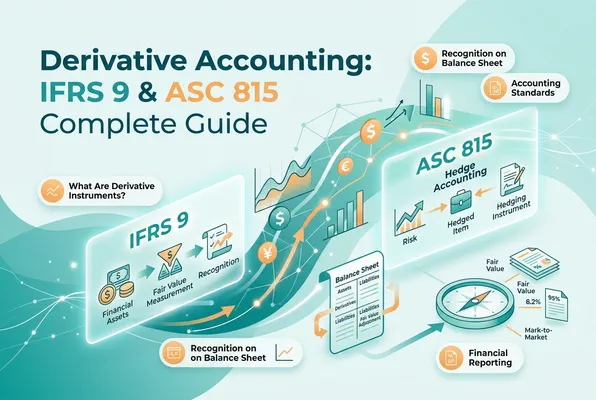

Derivative financial instruments are among the most complex and consequential elements of modern corporate finance. From multinational corporations hedging currency exposure to financial institutions managing interest rate risk, derivatives touch virtually every corner of the business world. Yet despite their prevalence, derivative accounting remains one of the most technically demanding areas of financial reporting — one where errors can distort financial statements, trigger regulatory penalties, and undermine investor confidence.
This comprehensive guide breaks down everything finance professionals, accountants, and business leaders need to know about derivative accounting — from first principles and regulatory frameworks to the nuanced mechanics of hedge accounting, fair value measurement, and embedded derivatives.
What Are Derivative Financial Instruments?
Before exploring the accounting treatment, it is essential to understand what derivatives actually are. A derivative is a financial contract whose value is derived from an underlying asset, index, rate, or variable. Common examples include:
- Forward contracts – Agreements to buy or sell an asset at a predetermined price on a future date
- Futures contracts – Standardized forward contracts traded on exchanges
- Options contracts – Rights (but not obligations) to buy or sell an asset at a set price within a defined period
- Swap agreements – Contracts to exchange cash flows based on a notional amount (e.g., interest rate swaps, currency swaps)
These instruments are used both for risk management purposes (hedging) and for speculative positions intended to generate profit from market movements.
Key Characteristics of Derivatives
Under both IFRS 9 and ASC 815, a financial instrument qualifies as a derivative if it meets three criteria:
- Its value changes in response to a change in a specified underlying asset (interest rate, exchange rate, commodity price, etc.)
- It requires little or no initial net investment compared to other contracts with similar response to market changes
- It is settled at a future date
Understanding these characteristics is the foundation of proper derivative accounting.
Core Principles of Derivative Accounting
Recognition on the Balance Sheet
One of the most fundamental rules of derivative accounting — consistent across both major accounting standards — is that all derivatives must be recognized on the balance sheet at fair value. This applies regardless of whether the derivative is held for hedging or speculative purposes.
This is a significant departure from older accounting models, where off-balance-sheet treatment was more common. Today, financial instruments such as interest rate swaps and foreign currency forwards must appear as either assets (when fair value is positive) or liabilities (when fair value is negative) on the reporting entity’s balance sheet.
Fair Value Accounting and Mark-to-Market
Fair value accounting — often called mark-to-market accounting — requires that derivatives be remeasured at their current market value at every reporting date. This means the carrying value of a derivative contract fluctuates continuously as market conditions change.
The gain or loss arising from these fair value changes flows directly to the income statement unless the entity has designated the derivative in a qualifying hedging relationship. This is a critical distinction:
- Without hedge accounting: Fair value changes hit profit or loss immediately, potentially creating significant earnings volatility
- With hedge accounting: Gains or losses may be deferred or offset against the hedged item, reducing that volatility
Mark-to-market accounting is powerful in its transparency — it reflects real economic exposure. However, it can introduce significant noise into financial statements, which is precisely why hedge accounting frameworks exist.
Accounting Standards: IFRS 9 and ASC 815
Two primary accounting standards govern derivative accounting globally: IFRS 9 (International Financial Reporting Standards) and ASC 815 (US Generally Accepted Accounting Principles).
IFRS 9: Financial Instruments
IFRS 9 replaced the older IAS 39 standard and came into effect for annual periods beginning on or after January 1, 2018. Its hedge accounting model was deliberately redesigned to be more principles-based, better reflecting how entities actually manage financial risk in practice.
Key features of IFRS 9 for derivative accounting include:
- A three-category classification for financial assets (amortized cost, fair value through other comprehensive income, fair value through profit or loss)
- A reformed hedge accounting framework that removed certain bright-line quantitative thresholds
- Recognition that hedging relationships should reflect actual risk management strategies
- Improved treatment of hedging with options contracts and forward points
Under IFRS 9, the hedge effectiveness requirement is qualitative rather than purely quantitative, making it somewhat easier for entities to qualify for and maintain hedge accounting.
ASC 815: Derivatives and Hedging
ASC 815 (formerly SFAS 133) is the US GAAP standard for derivative accounting. While it shares the same fundamental principle — all derivatives recognized at fair value — it has historically been more prescriptive in its requirements.
Under ASC 815:
- Hedge accounting requires rigorous documentation at the inception of the hedging relationship
- Effectiveness testing must be performed both prospectively and retrospectively
- The standard distinguishes clearly between fair value hedges, cash flow hedges, and net investment hedges
- Specific rules govern how notional amount is used in measuring derivative exposure
Recent updates (ASU 2017-12 and subsequent amendments) have moved ASC 815 closer to IFRS 9 by simplifying certain effectiveness testing requirements and expanding hedge accounting eligibility.
Hedge Accounting: Aligning Accounting with Risk Management
Hedge accounting is the mechanism that allows companies to reflect their risk management activities more faithfully in their financial reporting. Without it, a perfectly effective economic hedge can still create accounting volatility — because the derivative is marked to market while the hedged item may not be.
To qualify for hedge accounting under either standard, entities must:
- Formally designate the hedging relationship at inception
- Document the risk management objective, hedging strategy, and how effectiveness will be assessed
- Demonstrate that the hedging relationship is economically effective
- Ongoing assessment — the relationship must continue to meet effectiveness criteria throughout its life
Fair Value Hedge
A fair value hedge is designed to offset exposure to changes in the fair value of a recognized asset or liability, or an unrecognized firm commitment.
Example: A company holds a fixed-rate bond and enters into an interest rate swap (receiving fixed, paying floating) to convert the bond to a floating-rate exposure, protecting its fair value from interest rate movements.
Accounting treatment: - Changes in fair value of the derivative go to the income statement - Changes in fair value of the hedged item attributable to the hedged risk also go to the income statement - The two largely offset each other, reducing net earnings volatility
Cash Flow Hedge
A cash flow hedge protects against variability in future cash flows from a recognized asset or liability, or a highly probable forecasted transaction.
Example: An airline company enters into fuel forward contracts to lock in the price of jet fuel for the next 12 months, protecting against fuel price increases.
Accounting treatment: - The effective portion of gains or losses on the hedging instrument is recognized in other comprehensive income (OCI) - The ineffective portion goes to the income statement immediately - Deferred gains or losses in OCI are reclassified to profit or loss when the hedged forecasted transaction affects profit or loss
This treatment preserves earnings stability — a key reason why cash flow hedges are widely used by companies with significant commodity, interest rate, or foreign currency exposures.
Net Investment Hedge
A net investment hedge addresses the currency risk associated with a net investment in a foreign operation (e.g., a subsidiary operating in a foreign currency).
Accounting treatment: - Gains and losses on the hedging instrument are recognized in OCI (translation reserve) - These amounts are only reclassified to profit or loss when the foreign operation is disposed of
Net investment hedges are especially important for multinational corporations managing the translation risk embedded in their consolidated financial statements.
Effectiveness Testing in Derivative Accounting
For a hedging relationship to qualify (and continue to qualify) for hedge accounting, it must be effective. Both IFRS 9 and ASC 815 require effectiveness assessment, though their approaches differ.
Prospective Effectiveness Assessment
Before designating a hedge, the entity must assess whether the hedging relationship can be expected to be highly effective. Under IFRS 9, this is qualitative (does the hedge make economic sense?). Under ASC 815, this has historically required quantitative analysis.
Retrospective Effectiveness Testing
Some frameworks require looking back to confirm the hedge was effective. Under ASC 815 (before recent amendments), the hedge had to fall within an 80-125% effectiveness range. IFRS 9 eliminated the specific quantitative threshold requirement, though effectiveness must still be demonstrated.
Methods of Effectiveness Testing
Common approaches include: - Dollar offset method: Comparing the change in fair value of the hedging instrument to the change in fair value of the hedged item - Regression analysis: Statistical approach demonstrating a strong relationship between the two - Hypothetical derivative method: Comparing the derivative’s performance to a hypothetical perfectly effective hedge
Maintaining robust effectiveness testing documentation is critical for sustaining hedge accounting designation — and for surviving audit scrutiny.
Embedded Derivatives: A Special Case
Not all derivatives exist as standalone contracts. Embedded derivatives are components embedded within a hybrid financial instrument (the host contract) that modify the cash flows of that host.
When Must Embedded Derivatives Be Bifurcated?
Under both IFRS 9 and ASC 815, an embedded derivative must generally be separated (bifurcated) from the host contract and accounted for as a standalone derivative when:
- The economic characteristics and risks of the embedded derivative are not closely related to those of the host contract
- A separate instrument with the same terms would meet the definition of a derivative
- The hybrid instrument is not already measured at fair value through profit or loss
Example: A convertible bond contains an embedded conversion option (equity derivative) that modifies the bond’s cash flows. This embedded derivative would typically need to be bifurcated and accounted for separately at fair value.
IFRS 9 vs. ASC 815 on Embedded Derivatives
A notable difference: under IFRS 9, the bifurcation requirement primarily applies to financial liability host contracts and non-financial host contracts. For financial asset host contracts, the entire hybrid instrument is classified and measured as a whole.
Under ASC 815, a more detailed analysis is required across all host contract types, making the evaluation process potentially more complex.
Financial Statement Presentation and Disclosure
Proper derivative accounting extends beyond initial recognition and measurement — it requires clear and transparent presentation and disclosure in financial statements.
Balance Sheet Presentation
Derivatives are presented as: - Current assets or liabilities if they mature within 12 months (or the operating cycle) - Non-current assets or liabilities if they extend beyond 12 months
Entities typically do not offset derivative assets and liabilities on the balance sheet unless specific netting criteria are met (e.g., a master netting arrangement and intention to settle net).
Income Statement Impact
- Speculative derivatives and non-qualifying hedges: Full fair value changes recognized in profit or loss each period
- Fair value hedges: Both the derivative and hedged item adjustments appear in the income statement (largely offsetting)
- Cash flow hedges: Only the ineffective portion goes to the income statement; the effective portion stays in OCI until the hedged item affects earnings
Other Comprehensive Income
The OCI section of the income statement serves as the temporary holding area for: - Effective cash flow hedge gains and losses - Net investment hedge gains and losses - These deferred gains and losses are recycled to profit or loss when specific triggering events occur
Required Disclosures
Both IFRS 9 and ASC 815 mandate extensive disclosures, including: - The nature and extent of derivative use - Risk management objectives and strategies - Quantitative disclosures about fair value and notional amounts - Hedge effectiveness and amounts reclassified from OCI - Sensitivity analyses to key market risks
Common Challenges in Derivative Accounting
Volatility in Financial Statements
Even with hedge accounting, imperfect hedges create residual volatility. Mismatch in timing, notional amounts, or reference rates between the hedging instrument and hedged item can lead to ineffectiveness charges that affect reported earnings unpredictably.
Documentation Burden
Both IFRS 9 and ASC 815 require comprehensive upfront documentation before hedge accounting can be applied. Missing or inadequate documentation is one of the most common reasons companies fail audits and are required to de-designate hedging relationships — forcing the immediate recognition of previously deferred gains and losses.
Complexity of Valuation
Fairly valuing derivatives — especially complex instruments like exotic options or multi-leg swap agreements — requires sophisticated valuation models, market data inputs, and counterparty credit risk adjustments. Errors in valuation directly affect the reported fair value on the balance sheet and the gain or loss in the income statement.
Navigating Dual Standards
Multinational companies that report under both IFRS and US GAAP face the challenge of maintaining parallel accounting for derivatives under two different frameworks. Differences in hedge accounting eligibility, effectiveness testing, and OCI recycling rules can create meaningful divergences in reported results.
Types of derivatives
Derivative instruments are financial contracts whose value is based on an underlying asset and are typically recorded at fair value under accounting standards such as ASC 820. Common types of derivatives include forwards, options, swaps, and futures, many of which are traded on an exchange or over-the-counter. These instruments are frequently used to hedge risk exposures, and companies may choose to apply hedge accounting; otherwise, unless hedge accounting is applied, all changes in fair value are recorded directly in profit or loss. During each reporting period, the value of derivatives is remeasured, and changes in its fair value affect either earnings or OCI depending on the accounting treatment.
Contract mechanics and accounting treatment
A derivative is a contract between two parties (buyer and seller) where one party gains exposure to future price movements, often giving the holder the right to exercise the contract at a price at a future date. These instruments come with potential gains or losses because their value fluctuates throughout the life of the contract. If hedge accounting is not applied, all changes in the value are recognized immediately in profit or loss. When used correctly, derivatives help companies offset the risk, but they still require careful valuation, since their instrument whose value depends on market conditions must be continuously measured and fair value are recorded at financial close.
Best Practices for Effective Derivative Accounting
1. Establish Robust Documentation from Day One
Hedge accounting documentation must be in place at the inception of the hedging relationship — not retroactively. Invest in templates and checklists that capture: - Identification of the hedging instrument and hedged item - The nature of the risk being hedged - The entity’s risk management objective and strategy - How effectiveness will be assessed
2. Leverage Technology and Automation
Modern treasury management systems and platforms like Finflexia can automate fair value calculations, effectiveness testing, journal entries, and disclosure reporting — dramatically reducing manual error and audit risk.
3. Maintain Ongoing Effectiveness Monitoring
Hedge accounting is not a set-and-forget designation. Monitor hedging relationships continuously to detect deteriorating effectiveness early, allowing time to rebalance or redesignate before a hedge becomes non-qualifying.
4. Train Across Departments
Effective derivative accounting requires collaboration between treasury, accounting, financial reporting, and risk management teams. Ensure all stakeholders understand the accounting implications of new derivative transactions before they are executed.
5. Stay Current on Standard Updates
Both the IASB and FASB continue to refine derivative and hedge accounting guidance. Subscribe to regulatory updates and consider the impact of proposed changes on your current hedging strategies and accounting policies.
Conclusion
Derivative accounting sits at the intersection of finance, risk management, and financial reporting — and getting it right has never been more important. Whether your organization uses forward contracts to lock in commodity prices, swap agreements to manage interest rate exposure, or options contracts to protect against currency fluctuations, understanding the accounting treatment under IFRS 9 and ASC 815 is essential.
The core principle is straightforward: all derivatives are recognized at fair value on the balance sheet. What makes derivative accounting complex is the layered framework of hedge accounting designations, effectiveness testing, OCI deferral mechanics, and disclosure requirements that surround that principle.
By investing in proper documentation, leveraging purpose-built technology, and maintaining rigorous ongoing monitoring, organizations can use derivative accounting not just as a compliance exercise — but as a genuine reflection of how they manage financial risk and create long-term value.
Looking to streamline your derivative accounting workflows? Explore how Finflexia helps finance teams manage financial instruments, automate hedge accounting processes, and produce audit-ready reporting with confidence.

Written by
Dominik KonoldFounder
Dominik is the founder of Finflexia and an expert in treasury accounting, financial instrument valuation and IFRS compliance. Since 2016, he's been a certified Professional Risk Manager (PRMIA) and also lectures for the Association of Public Banks and the Academy of International Accounting. He built Finflexia to help treasury teams automate complex accounting workflows.
Related Posts

Modern Treasury Management Software for Smarter Financial Operations
Learn how treasury management software improves treasury operations by centralizing financial data, enhancing visibility, automating processes, and optimizing cash and liquidity management within a modern treasury management system.
Convertible Bond: Complete Guide for Investors
Convertible bonds are hybrid securities that combine fixed income with equity upside, allowing investors to earn interest and convert into shares of common stock under defined conditions.

Treasury Software: Best Treasury Management Systems 2026
Treasury software explained: features, benefits, and TMS tools for cash management, forecasting, payments, risk control, and ERP integration.
Ready to simplify your treasury accounting?
See how Finflexia helps you manage financial instruments with ease. Book a demo to learn more.
Book a Demo