What Is CVA? Understanding Credit Valuation Adjustment and Counterparty Risk

What Is Credit Value Adjustment?
Credit Value Adjustment (CVA) is one of the most important concepts in modern derivatives valuation and counterparty credit risk management. At its core, CVA represents the market value of counterparty credit risk embedded in a derivative contract or portfolio of derivatives. It quantifies the expected loss a firm faces if its counterparty defaults before fulfilling its contractual obligations.
Before the 2008 global financial crisis, many financial institutions valued derivatives assuming counterparties would always honor their obligations. The collapse of Lehman Brothers and the near-failure of several other major financial institutions exposed the flaw in this assumption. Since then, Credit Value Adjustment has become a standard, and in many jurisdictions, mandatory, component of derivative pricing, accounting, and regulatory capital calculations.
In essence, CVA adjusts the risk-free value of a derivative downward to reflect the probability that the counterparty may fail to make good on its payments. The higher the counterparty’s credit risk, the larger the CVA, and the lower the effective value of the trade to the institution holding it.
Why Credit Value Adjustment Matters
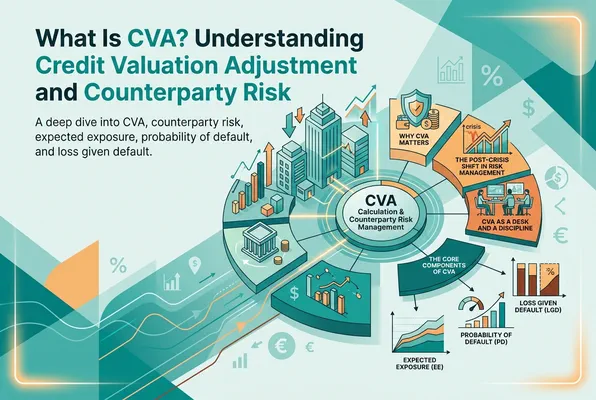
The Post-Crisis Shift in Risk Management
The 2008 financial crisis fundamentally changed how financial institutions think about counterparty risk. Losses during the crisis were not only driven by outright defaults but also by the market’s repricing of counterparty risk on outstanding derivative positions. Regulators and accounting bodies responded by requiring firms to explicitly account for this risk through CVA.
Today, CVA sits at the intersection of three critical functions within a bank or financial institution:
- Pricing: Traders incorporate CVA into the price quoted for a derivative, ensuring the institution is compensated for taking on counterparty risk.
- Accounting: Under IFRS 13 and similar fair value accounting standards, CVA must be reflected in the fair value of derivative assets.
- Regulatory Capital: Basel III introduced a specific capital charge for CVA risk, recognizing that changes in counterparty credit spreads can cause significant volatility in bank earnings.
CVA as a Desk and a Discipline
Many large banks now operate dedicated CVA desks. These teams are responsible for calculating, monitoring, and hedging counterparty credit risk across the entire derivatives book. Rather than leaving individual trading desks to manage counterparty risk in isolation, a centralized CVA desk aggregates exposures across all counterparties and manages the associated risk more efficiently, often using credit default swaps (CDS) and other credit derivatives as hedging instruments.
The Core Components of Credit Value Adjustment
To understand how Credit Value Adjustment is calculated, it helps to break the concept down into its fundamental building blocks.
Expected Exposure (EE)
Expected exposure represents the anticipated positive value of a derivative at a given point in the future, assuming the counterparty defaults at that time. Since derivative values fluctuate with market conditions, exposure is not static, it must be modeled across many possible future scenarios, typically using Monte Carlo simulation techniques.
Probability of Default (PD)
The probability of default reflects the likelihood that the counterparty will fail to meet its obligations within a given time period. This is usually derived from market-observable instruments such as credit default swap (CDS) spreads, or from internal credit ratings models when liquid CDS data isn’t available.
Loss Given Default (LGD)
Loss given default represents the portion of the exposure that would actually be lost in the event of default, after accounting for any recovery. It is typically expressed as a percentage, commonly assumed at 60% for many counterparties, implying a 40% recovery rate, though this varies by seniority, collateral, and jurisdiction.
Discount Factor
Because future exposures and default probabilities must be brought back to present value, a discount factor, usually derived from the risk-free interest rate curve, is applied to each period’s expected loss.
The Credit Value Adjustment Formula
While actual implementations vary in complexity, the general formula for Credit Value Adjustment can be expressed as:
CVA = LGD × Σ [ EE(t) × PD(t) × DF(t) ]
Where: - EE(t) = Expected exposure at time t - PD(t) = Marginal probability of default in the period around time t - DF(t) = Discount factor at time t - LGD = Loss given default
This calculation is performed across the entire life of the trade or portfolio, summing the discounted expected losses at each time interval. In practice, banks use sophisticated simulation engines that model thousands of potential future market paths to generate accurate expected exposure profiles, especially for portfolios containing interest rate swaps, foreign exchange forwards, and other long-dated derivatives.
Unilateral vs. Bilateral CVA
Unilateral CVA
Unilateral CVA considers only the risk that the counterparty defaults, assuming the institution calculating the adjustment is default-risk-free. This simplified approach was more common in earlier CVA frameworks but is now considered incomplete, since it ignores the reciprocal nature of credit risk in a bilateral contract.
Bilateral CVA and DVA
Bilateral CVA accounts for the fact that both parties to a derivative contract carry default risk. This introduces the concept of Debit Value Adjustment (DVA), the adjustment reflecting the institution’s own default risk. From an accounting standpoint, DVA increases the value of a liability because, in the event of the institution’s own default, it would not need to pay the full amount owed.
The combined bilateral adjustment is often expressed as:
Bilateral CVA = CVA − DVA
While bilateral CVA is theoretically more complete, it has been criticized because it implies that a firm’s own deteriorating credit quality generates an accounting gain, a counterintuitive and controversial outcome that has drawn scrutiny from regulators and accounting standard-setters alike.
Related Valuation Adjustments (The “xVA” Family)
Credit Value Adjustment is part of a broader family of valuation adjustments collectively known as xVA. Understanding CVA in isolation is useful, but modern derivatives desks manage a full suite of these adjustments together:
- DVA (Debit Value Adjustment): Reflects the institution’s own credit risk.
- FVA (Funding Value Adjustment): Captures the cost of funding uncollateralized derivative positions.
- MVA (Margin Value Adjustment): Reflects the cost of posting initial margin over the life of a trade.
- KVA (Capital Value Adjustment): Accounts for the cost of holding regulatory capital against a trade.
Together, these adjustments form a comprehensive picture of the total cost of a derivative transaction beyond its simple risk-free valuation.
How CVA Impacts Derivative Pricing and Hedging
Pricing Implications
When a bank prices a derivative with a counterparty that has meaningful credit risk, the CVA is subtracted from the risk-free value of the trade. This means riskier counterparties effectively pay more (in economic terms) to enter into derivative contracts, since the bank must be compensated for the additional counterparty risk it assumes.
Hedging CVA Risk
CVA is not static, it fluctuates as market variables change, including interest rates, foreign exchange rates, and, most importantly, the counterparty’s credit spread. Because of this volatility, CVA desks actively hedge their exposure using:
- Single-name CDS contracts on the counterparty, where available
- Index CDS products (such as CDX or iTraxx) when single-name protection is illiquid or unavailable
- Interest rate and FX derivatives to hedge the market risk component of expected exposure
Effective CVA hedging is challenging because it requires managing both credit risk and market risk simultaneously, and the two interact in complex, often non-linear ways, a phenomenon known as “wrong-way risk,” where exposure to a counterparty increases precisely when that counterparty’s credit quality deteriorates.
Eligibility Criteria for CVA Hedges
Not every hedge a CVA desk puts on actually reduces the cva risk capital requirement. Regulators have set out strict eligibility criteria for CVA hedges to ensure that only instruments genuinely reducing credit exposure are recognized in the calculation.
Generally, external CVA hedges are treated as eligible when they reference the specific counterparty (or an eligible index) and are transacted with a party outside the banking group. By contrast, an internal CVA hedge is ineligible for capital relief unless it is passed through to an external market participant, the logic being that a hedge booked purely between the cva desk and the opposite trading desk internally does nothing to reduce the bank’s actual exposure to the market. Where the cva desk’s internal counterparty executes an offsetting trade externally, that internal cva hedge is eligible, since the risk has genuinely left the institution.
Instruments such as ineligible external cva hedges, for example, hedges that reference a proxy name with insufficient correlation to the actual counterparty, cannot be included in the cva calculation at all. This is one reason a cva hedge involves an instrument that must meet fairly narrow criteria: single-name CDS on the counterparty itself, or index products with demonstrable basis correlation, tend to qualify, while more exotic or loosely correlated instruments generally do not.
Wrong-Way and Right-Way Risk
Wrong-way risk occurs when exposure to a counterparty increases at the same time that counterparty’s probability of default increases. A classic example is a bank entering into a derivative with an oil producer where the derivative’s value to the bank rises as oil prices fall, precisely the scenario in which the oil producer’s credit quality is likely to deteriorate.
Right-way risk is the opposite scenario: exposure decreases as the counterparty’s credit quality worsens, which actually reduces overall risk. Properly identifying and modeling wrong-way and right-way risk is a critical, if technically demanding, part of a robust Credit Value Adjustment framework.
Wrong-Way Risk as a Dependence Structure
Beyond the intuitive example of an oil producer, wrong-way risk is more formally understood as the statistical dependence between exposure and credit quality. Rather than treating credit exposure and probability of default as independent inputs, sophisticated CVA models attempt to capture how a deterioration in the credit quality of the counterparty tends to coincide with an increase in exposure, and price this dependency directly into the valuation of counterparty risk. This is one of the most difficult modeling problems in the entire xVA space, since it requires jointly simulating market risk factors and credit spreads rather than treating them as separate simulation legs.
Regulatory Treatment of CVA Under Basel III
Following the 2008 crisis, the Basel Committee on Banking Supervision introduced a dedicated capital charge for CVA risk under Basel III. Regulators recognized that a significant portion of derivative-related losses during the crisis stemmed not from actual defaults, but from mark-to-market losses due to the widening of counterparty credit spreads, in other words, CVA volatility itself.
Basel III originally introduced the Standardized CVA Risk Capital Charge and later refined this approach under the Basel III finalization (sometimes called “Basel IV”), which introduced:
- The Basic Approach (BA-CVA) for banks with less sophisticated risk infrastructure
- The Standardized Approach (SA-CVA) for banks with approved internal models and robust hedging capabilities
These frameworks require banks to hold capital specifically against the risk that CVA losses will increase due to adverse movements in counterparty credit spreads, separate from the credit risk capital charge for outright default.
Calculating CVA Capital Requirements Under SA-CVA
For institutions using the Standardized Approach, the calculation of CVA capital requirements builds on a formal risk factor framework. Each transaction is assigned a set of market risk factors that drive its exposure profile, interest rates, FX rates, and, critically, the counterparty’s credit spread itself. A bank must calculate its CVA capital requirements using sensitivities to these risk factors, similar in structure to the sensitivities-based approach used for general capital requirements for market risk.
The SA-CVA framework requires a bank to set its CVA capital requirement by aggregating sensitivities across its entire CVA portfolio, weighting them according to the credit quality of the counterparty and the correlation between the credit spread of that counterparty and other risk factors in the book. A maturity adjustment factor is also applied, though regulators cap the maturity adjustment factor to prevent excessively long-dated trades from disproportionately inflating the capital requirement.
Regulatory CVA vs. Accounting CVA
It’s worth noting that regulatory CVA may differ meaningfully from the CVA reserves for accounting purposes. Accounting CVA is calculated to reflect fair value under standards like IFRS 13, and best practice in accounting CVA generally allows for netting, collateral, and bespoke credit curves tailored to each counterparty. Regulatory CVA, by contrast, exists specifically to account for counterparty credit risk from a prudential standpoint, capital requirement for counterparty credit is calculated under prescribed methodologies (BA-CVA or SA-CVA) that are often more conservative and less flexible than what a valuation control group would use for accounting cva.
This divergence exists because the two serve different purposes: calculations of regulatory cva aim to hold sufficient assets for credit value adjustment risk against future stress, while accounting cva aims to reflect current fair value as accurately as possible. The requirement for counterparty credit risk capital, in other words, is a forward-looking, stress-oriented figure, whereas the accounting number is a point-in-time valuation. Losses arising from changing cva, whether due to credit spread widening or shifts in exposure, can therefore show up differently in a bank’s regulatory capital ratios than in its reported earnings, and cva risk must be calculated separately for each purpose even though both ultimately derive from the same underlying transactions and eligible cva hedges available for calculating cva capital.
Common Challenges in Calculating Credit Value Adjustment
Data and Model Complexity
Calculating accurate CVA requires robust market data, particularly credit spread data for counterparties that may not have liquid, traded CDS contracts. In these cases, institutions must rely on proxy spreads based on sector, region, and credit rating, introducing model risk and potential inaccuracy.
Computational Intensity
Because CVA requires simulating thousands of potential future market scenarios across a portfolio of derivatives with multiple counterparties, the computational burden can be substantial. Financial institutions invest heavily in high-performance computing infrastructure and efficient simulation algorithms to make real-time or near-real-time CVA calculation feasible.
Netting and Collateral Agreements
Many derivative counterparties operate under master netting agreements (such as ISDA agreements) and credit support annexes (CSAs) that allow for collateral posting. These arrangements significantly reduce net exposure and, therefore, CVA, but modeling their impact accurately adds another layer of complexity to the calculation.
Best Practices for Managing Credit Value Adjustment
- Centralize CVA management through a dedicated desk to ensure consistent pricing and hedging across the institution.
- Use high-quality market data for probability of default and loss given default assumptions, supplementing with proxy methods where necessary.
- Actively monitor wrong-way risk in portfolios with correlated exposure and credit risk, such as commodity producers or emerging market counterparties.
- Leverage netting and collateral agreements wherever possible to reduce gross exposure and the resulting CVA charge.
- Regularly stress-test CVA under adverse market scenarios to understand potential capital and earnings impacts during periods of credit spread volatility.
Final Thoughts
Credit Value Adjustment has evolved from a niche academic concept into one of the central pillars of modern derivatives risk management. It captures a simple but critical truth: no counterparty is entirely free of default risk, and that risk has a real, quantifiable price. From trading desks pricing new transactions to regulators setting capital requirements, CVA now touches nearly every corner of the derivatives market.
For financial institutions, mastering CVA calculation, hedging, and regulatory compliance is no longer optional, it’s a fundamental requirement for sound risk management in an interconnected financial system where counterparty defaults can and do happen.

Written by
Dominik KonoldFounder
Dominik is the founder of Finflexia and an expert in treasury accounting, financial instrument valuation and IFRS compliance. Since 2016, he's been a certified Professional Risk Manager (PRMIA) and also lectures for the Association of Public Banks and the Academy of International Accounting. He built Finflexia to help treasury teams automate complex accounting workflows.
Related Posts

Hypothetical Derivative Method Explained
To better understand the practical application of hedge accounting, the following sections examine key concepts related to hedge effectiveness, hypothetical derivatives, and cash flow hedges.

How Convertible Bonds Work: The Guide to Convertible Bonds
This guide explains how convertible bonds work, covering their key features, pricing, risks, conversion mechanisms, and the benefits they offer as hybrid securities that combine fixed-income investing with equity upside potential.
Interest Rate Floor Explained
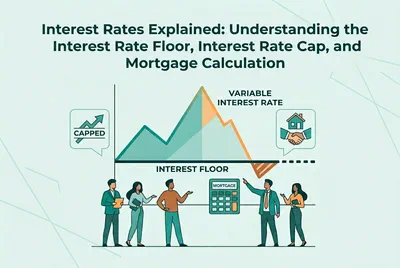
This Guide provides an overview of interest rate caps and floors in lending, explaining how they set upper and lower limits on variable interest rates in loan contracts and protect lenders and borrowers from extreme market movements.
Ready to simplify your treasury accounting?
See how Finflexia helps you manage financial instruments with ease. Book a demo to learn more.
Book a Demo