Modern Treasury Management Software for Smarter Financial Operations
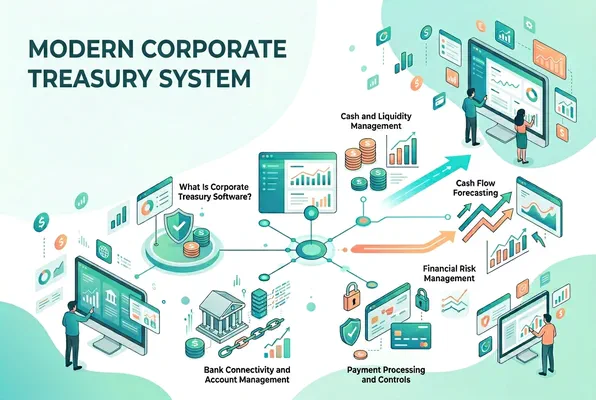

Corporate treasury functions sit at the heart of every financially healthy organization. Yet many finance teams still rely on spreadsheets, disconnected bank portals, and manual reconciliation processes that drain time, introduce errors, and obscure the true financial picture. Corporate treasury software changes all of that — bringing automation, real-time visibility, and intelligent decision-making to one of the most critical functions in any business.
This guide covers everything you need to know: what treasury software does, why it matters, which features to prioritize, and how solutions like Finflexia are redefining what modern treasury management looks like.
What Is Corporate Treasury Software?
Corporate treasury software is a dedicated financial management platform designed to centralize and automate the core activities of a treasury department. These activities include cash and liquidity management, bank account management, financial risk management, payments processing, debt and investment portfolio tracking, and cash flow forecasting.
Unlike general ERP modules or accounting platforms, treasury software is purpose-built to handle the complexity, speed, and precision that treasury operations demand. It connects directly to banks, payment networks, and financial data sources — giving treasury professionals an accurate, up-to-the-minute view of their organization’s financial position.
The Core Problem It Solves
Most treasury problems stem from the same root cause: fragmented financial data. When cash balances live in 12 different bank portals, forecasts are built in spreadsheets, and payments are approved through email chains, the treasury team operates reactively rather than strategically.
Corporate treasury software solves fragmentation by:
- Aggregating all bank account data into a single dashboard
- Automating payment workflows with approval controls
- Generating rolling cash forecasts from real operational data
- Flagging liquidity gaps and concentration risks before they become problems
- Creating a full audit trail for compliance and governance
Key Features of Corporate Treasury Software
Not all treasury platforms are equal. When evaluating solutions, focus on the functionality that will have the greatest impact on your specific treasury operations.
Cash and Liquidity Management
This is the foundation of any treasury management system (TMS). The software should provide:
- Real-time cash positioning across all bank accounts, currencies, and legal entities
- Intraday liquidity monitoring to track cash movements as they happen
- Cash pooling and sweeping functionality for inter-company balances
- Multi-currency consolidation with live exchange rate feeds
The ability to see exactly how much cash you have, where it is, and what it needs to do — all in one screen — is transformational for treasury teams previously juggling spreadsheets.
Cash Flow Forecasting
A robust corporate treasury software solution goes beyond telling you where your cash is today. It helps you predict where it will be tomorrow, next week, and next quarter.
Look for:
- Rolling short, medium, and long-term forecasts
- Variance analysis that compares actuals against forecasts over time
- Integration with ERP and AP/AR data to pull in operational cash flows automatically
- Scenario modeling for stress testing under different business conditions
Accurate forecasting is what allows treasury teams to optimize investment of surplus cash, arrange credit facilities in advance of shortfalls, and present confidence-inspiring financial plans to leadership.
Bank Connectivity and Account Management
A TMS should serve as a single point of connection to all your banking relationships. This means:
- SWIFT, SFTP, and API bank connectivity to major global banks
- Automated bank statement reconciliation (BAI2, MT940, CAMT formats)
- Bank account inventory management — tracking signatories, account details, and authorization levels
- Rationalization insights to identify redundant or underutilized accounts
Reducing the number of bank logins your team manages each day might sound minor, but it represents hours of recovered productivity every week.
Payment Processing and Controls
Manual payment processes are a leading source of fraud risk and operational errors. Corporate treasury software replaces ad-hoc payment workflows with structured, auditable processes:
- Centralized payment factory for domestic and cross-border transactions
- Multi-level approval workflows that enforce segregation of duties
- Positive pay and fraud detection controls
- SEPA, ACH, SWIFT GPI payment support
- Beneficiary verification and sanctions screening integration
For companies managing high volumes of vendor payments or inter-company settlements, automating this process significantly reduces both cost per payment and fraud exposure.
Financial Risk Management
Treasury’s risk mandate typically covers foreign exchange (FX) risk, interest rate risk, and counterparty risk. Your software should support:
- FX exposure identification and hedging workflows
- Derivative and hedge accounting support (IAS 39 / IFRS 9)
- Counterparty credit risk monitoring with exposure limits
- Interest rate risk analysis on floating-rate debt portfolios
Risk management without software often means risks go unidentified until they’ve already caused damage. A proper TMS surfaces exposures automatically and triggers the right workflows.
Debt and Investment Management
Corporate treasury software should track your full portfolio of financial instruments on both sides of the balance sheet:
- Loan facility management — tracking drawdowns, repayments, and covenant compliance
- Short-term investment tracking — money market funds, deposits, T-bills
- Interest accrual calculations and settlements
- Maturity schedules and refinancing alerts
Having a single system manage both borrowings and investments ensures you never miss a maturity date or pay unnecessary interest on an unneeded credit line.
Reporting and Analytics
Data is only valuable when it’s actionable. Leading corporate treasury software platforms offer:
- Configurable treasury dashboards for executive and operational views
- KPI tracking — DSO, DPO, cash conversion cycle
- Regulatory and audit reporting (SOX, IFRS, US GAAP alignment)
- Board-ready reporting exports
Real-time reporting replaces the end-of-day scramble to compile position reports and gives leadership the financial intelligence they need to make confident decisions.
Cash Management and Treasury Automation in Modern Financial Operations
Modern cash management is no longer possible without a powerful treasury management software or a fully integrated treasury management solution. Companies today rely on a centralized treasury solution to streamline financial processes, manage liquidity, and improve overall financial operations. By connecting multiple banks, banks and financial institutions, and internal core financial systems, organizations gain real-time visibility into cash and stronger control over global cash flow management. Solutions such as oracle cash and treasury management, sap treasury and risk management, and coupa treasury demonstrate how leading platforms support liquidity planning treasury and risk management on a global scale. A modern cloud-based treasury management system or tms solutions enable automating cash management, reducing reliance on manual treasury work, and improving workflow management across global treasury environments.
Why Spreadsheets Are No Longer Enough
It’s worth understanding why so many treasury teams still use spreadsheets — and why that approach increasingly fails as organizations grow.
Spreadsheets offer flexibility and familiarity. They require no implementation project and no software budget. For a single-entity business with one or two bank accounts and simple cash flows, they may be adequate.
But as soon as your business adds:
- Multiple legal entities or subsidiaries
- Accounts in more than one bank or currency
- Regular hedging or borrowing activity
- Inter-company lending or cash pooling
- A compliance or audit requirement
…spreadsheets become a liability. Data is manually entered, version control breaks down, formulas contain undetected errors, and there’s no audit trail. The 2012 JP Morgan “London Whale” trading loss — partially attributed to spreadsheet-based risk models — remains a cautionary tale for treasury functions of any size.
Corporate treasury software eliminates these risks by providing a single source of truth with built-in controls, automated data feeds, and full transaction history.
Choosing the Best Treasury Management Software and Platform
For cfos and finance leaders, selecting the best treasury management software is a strategic decision that impacts liquidity management, risk mitigation, and overall financial systems efficiency. The best treasury management approach is typically achieved through a platform for treasury management that unifies cash management systems, treasury workflows, and contract management in one environment. Modern tools like fusion treasury, treasury intelligence solutions, and other advanced treasury platforms are designed to automate treasury, improve treasury automation, and integrate seamlessly with erp systems and existing systems. A strong management solution helps organizations optimize liquidity, enhance banking and treasury processes, and ensure better coordination with financial institutions.
Cloud-Based vs. On-Premise Treasury Software
The deployment model you choose matters — both for your implementation timeline and your total cost of ownership.
On-Premise Treasury Systems
Traditional enterprise treasury systems were installed on company servers. They offered high customization but came with significant drawbacks:
- Long and expensive implementation projects (6–18 months)
- Large upfront licensing fees plus annual maintenance costs
- IT infrastructure requirements and ongoing support burden
- Slower release cycles and limited mobile/remote access
Cloud-Based Treasury Software
Modern SaaS treasury platforms like Finflexia are deployed entirely in the cloud. The advantages are significant:
- Faster implementation — often live within weeks
- Subscription pricing with no large capital expenditure
- Automatic updates with new features released continuously
- Bank-grade security with SOC 2, encryption, and access controls
- Accessible anywhere — remote treasury teams can operate with full capability
- Scalability — add entities, users, or bank connections as you grow
For most mid-market businesses and growing enterprises, cloud-based corporate treasury software delivers more value faster and at lower total cost than legacy on-premise alternatives.
How Corporate Treasury Software Integrates with Your Tech Stack
A treasury platform doesn’t operate in isolation. Its value multiplies when it connects to the other systems your finance team already uses.
ERP Integration
Connecting your TMS to your ERP (SAP, Oracle, NetSuite, Microsoft Dynamics) ensures that:
- Accounts payable and receivable data flows into cash forecasts automatically
- General ledger entries are created from treasury transactions without manual posting
- Inter-company balances are reconciled across entities in real time
Banking Systems
Direct bank connectivity via SWIFT, host-to-host, or open banking APIs allows:
- Automated bank statement import every morning (or intraday)
- Payment file transmission directly from the TMS
- Real-time balance confirmations
FX and Market Data Providers
Integration with Bloomberg, Refinitiv, or similar market data providers feeds live exchange rates, interest rate benchmarks, and commodity prices into the platform — enabling accurate exposure calculations and hedge valuations without manual data entry.
SSO and Identity Management
Enterprise-grade treasury software integrates with your corporate identity provider (Okta, Azure AD) for single sign-on and multi-factor authentication — maintaining security while simplifying access management.
Global Treasury Visibility, Risk Management and System Integration
A modern treasury management system designed for global finance enables companies to manage risk, improve liquidity planning treasury and risk management, and strengthen risk mitigation strategies. By consolidating data across across multiple banks, organizations achieve superior visibility into cash and more accurate forecasting for cash flow management. These systems support automating treasury, reducing dependency on manual treasury processes, and improving collaboration with financial institutions. Whether using standard treasury setups or advanced treasury intelligence solutions, companies benefit from better decision-making, stronger financial operations, and improved efficiency across all treasury workflows.
Treasury Software for Different Business Stages
Early-Stage and Scale-Up Companies
Even companies that aren’t yet “enterprise” benefit from treasury software. The key needs at this stage are:
- Cash runway visibility — knowing exactly how long current cash reserves last
- Payment controls — preventing unauthorized spending as teams grow
- Bank account consolidation — avoiding the chaos of multiple disconnected accounts
A lightweight, cloud-native corporate treasury software solution is ideal here — minimal setup, affordable pricing, and the ability to grow with you.
Mid-Market Companies
Mid-market treasury teams are often stretched thin — a small team managing growing complexity. The priority features at this stage include:
- Automated cash positioning and forecasting to reduce manual work
- Multi-entity consolidation across subsidiaries or regional offices
- FX risk management as international business grows
- Approval workflows to maintain controls without slowing operations
Enterprise and Multinational Organizations
Large enterprises need the full breadth of treasury functionality:
- Global bank connectivity across dozens of banking relationships
- In-house banking and intercompany netting
- Advanced hedge accounting with full IFRS 9 documentation
- Treasury center of excellence capabilities
- Deep ERP integration with SAP Treasury or Oracle CFIN
Measuring the ROI of Corporate Treasury Software
Investing in a treasury management system is a business case, not just a technology decision. Here’s how to quantify the return:
Direct Cost Savings
- Reduced bank fees through account rationalization and payment consolidation
- Lower FX costs through better-timed hedging and netting of exposures
- Improved investment returns on idle cash identified through better forecasting
- Reduced borrowing costs through optimized use of existing credit facilities
Productivity Gains
- Treasury staff time saved on manual data collection and reconciliation
- Faster month-end close through automated bank reconciliation
- Reduced time spent on board and management reporting
Risk Reduction Value
- Prevention of payment fraud through automated controls
- Reduced probability of liquidity crises through better forecasting
- Improved compliance posture reducing audit and regulatory risk
Many organizations report full ROI within 6–18 months of implementing corporate treasury software, with ongoing annual benefits that grow as the platform is more deeply integrated.
Choosing the Right Corporate Treasury Software
With dozens of platforms on the market — from legacy giants to modern cloud-native solutions — here’s a framework for making the right choice.
Define Your Requirements First
Before evaluating vendors, document your treasury processes, pain points, and must-have functionality. Involve the people who will actually use the system daily — not just IT or procurement.
Key questions to answer:
- How many bank accounts and banking relationships do we manage?
- In how many currencies do we operate?
- Do we need to manage FX hedging or financial instruments?
- How many legal entities require consolidated visibility?
- What ERP or accounting system must we integrate with?
- What is our budget and desired go-live timeline?
Evaluate Vendors on Fit, Not Just Features
A feature-rich platform that’s impossible to configure without a consultant is not a good fit for a lean treasury team. Prioritize:
- User experience — can your team learn the system quickly?
- Implementation support — does the vendor provide hands-on onboarding?
- Customer success — is there ongoing support beyond go-live?
- Roadmap transparency — will the product evolve with your needs?
- Security and compliance certifications — SOC 2, ISO 27001, GDPR
Consider Total Cost of Ownership
Look beyond the subscription price. Factor in:
- Implementation and professional services fees
- Integration development costs
- Training and change management
- Ongoing support and maintenance
- The cost of not having the right system (errors, fraud, missed opportunities)
Start with a Pilot or Proof of Concept
Many modern cloud platforms — including Finflexia — allow you to get started quickly with core functionality before rolling out the full platform. Starting with cash visibility and bank connectivity, then adding forecasting and risk management, reduces implementation risk and accelerates time to value.
The Future of Corporate Treasury Software
Treasury technology is evolving rapidly. The next generation of corporate treasury software will be shaped by several converging trends:
Artificial Intelligence and Machine Learning
AI is already improving cash flow forecast accuracy by learning from historical patterns and adjusting for anomalies. Future applications include:
- Intelligent anomaly detection flagging unusual payment patterns in real time
- Predictive liquidity alerts before a gap materializes
- Automated FX hedging recommendations based on exposure modeling
Real-Time Treasury
As payment rails move toward real-time settlement globally (FedNow, SEPA Instant, ISO 20022), treasury software must evolve to match. Real-time bank connectivity will become the baseline expectation, not a premium feature.
Embedded Finance and API-First Architecture
Modern treasury platforms are building open APIs that allow treasury functions to be embedded directly into ERP workflows, procurement systems, and even customer-facing applications — breaking down the walls between treasury and the rest of the business.
ESG and Sustainable Finance Tracking
As sustainable finance grows in importance, treasury teams are increasingly responsible for tracking green bond issuance, ESG-linked loan covenants, and sustainability-linked payment terms. Forward-looking treasury software will incorporate ESG data natively.
Why Finflexia Is the Modern Choice for Corporate Treasury Management
Finflexia is a modern, cloud-native corporate treasury software platform designed for the way finance teams actually work today. It combines powerful treasury functionality with the usability and speed of deployment that modern businesses demand.
Key advantages of Finflexia include:
- Real-time cash visibility across all accounts and entities from day one
- Intelligent cash flow forecasting with variance analysis built in
- Automated bank statement processing with multi-bank connectivity
- Payment workflow automation with configurable approval hierarchies
- FX exposure tracking and hedging support
- Fast implementation — go live in weeks, not months
- Intuitive interface that treasury professionals actually want to use
Whether you’re a scaling mid-market company taking treasury seriously for the first time, or an established enterprise looking to modernize a legacy TMS, Finflexia provides the functionality and flexibility to meet you where you are.
Conclusion
Corporate treasury software has moved from a luxury reserved for large multinationals to an operational necessity for any organization serious about financial performance. The combination of real-time cash visibility, automated workflows, accurate forecasting, and robust risk management delivers measurable value — in cost savings, risk reduction, and strategic insight.
The question is no longer whether to invest in treasury software, but which platform best fits your organization’s needs, scale, and ambitions.
If you’re ready to move beyond spreadsheets and fragmented bank portals — and build a treasury function that drives real business value — explore what Finflexia can do for your organization .

Written by
Dominik KonoldFounder
Dominik is the founder of Finflexia and an expert in treasury accounting, financial instrument valuation and IFRS compliance. Since 2016, he's been a certified Professional Risk Manager (PRMIA) and also lectures for the Association of Public Banks and the Academy of International Accounting. He built Finflexia to help treasury teams automate complex accounting workflows.
Related Posts
Treasury Software: Best Treasury Management Systems 2026
Treasury software explained: features, benefits, and TMS tools for cash management, forecasting, payments, risk control, and ERP integration.
Treasury Management System: Complete TMS Guide 2026
Treasury management system (TMS) guide: features, benefits, cash flow, risk management, ERP vs TMS, and how to choose the best treasury software.
Treasury Management: Complete Guide + TMS Explained
Learn treasury management: optimize cash flow, manage liquidity and risk, and streamline financial operations with modern TMS software and forecasting tools.
Ready to simplify your treasury accounting?
See how Finflexia helps you manage financial instruments with ease. Book a demo to learn more.
Book a Demo