Convertible Bond: Complete Guide for Investors
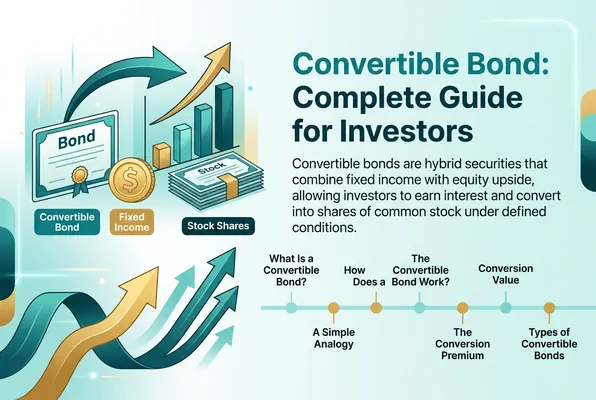

Somewhere between the predictability of fixed income and the growth potential of equities lies one of the financial markets’ most versatile instruments: the convertible bond. For investors who want the security of regular interest payments without giving up the chance to participate in a company’s stock market success, this hybrid security offers a compelling middle ground.
But convertible bonds are far more nuanced than simply “bonds that can become stock.” Their pricing, risk profile, and strategic applications make them a rich topic for both individual investors building a portfolio and finance professionals seeking to understand capital markets more deeply.
This guide unpacks everything you need to know — from the basic mechanics and types to valuation methods, risks, and investment strategies.
What Is a Convertible Bond?
A convertible bond is a type of corporate bond — and more broadly, a debt instrument — that gives the holder the right to convert the bond into a predetermined number of shares of the issuing company’s common stock. This conversion can typically happen at specific times and under specific conditions defined in the bond’s indenture.
Because it combines characteristics of both debt and equity, a convertible bond is classified as a hybrid security or hybrid instrument. It pays a fixed coupon rate like a regular bond, has a defined maturity date, and returns the face value (par value) of the bond if not converted. But unlike a standard corporate bond — sometimes called a vanilla bond — it also carries an embedded conversion option that links its value to the performance of the company’s stock.
This dual nature is precisely what makes the convertible bond so appealing: investors receive bond-like downside protection while retaining the ability to profit if the issuing company’s share price performs well.
A Simple Analogy
Think of a convertible bond as a concert ticket that also doubles as a backstage pass. You’re guaranteed the show (coupon payments and principal repayment), but if the band becomes extraordinarily popular, you can upgrade your ticket into equity ownership — joining the crowd that profits directly from the band’s success.
How Does a Convertible Bond Work?
When a company issues a convertible bond, it sets several key parameters at the time of issuance:
- Face value (par value): Usually $1,000 per bond
- Coupon rate: The annual interest rate paid to bondholders, typically lower than a comparable plain-vanilla bond
- Maturity date: The date on which the bond expires if not converted
- Conversion ratio: The number of shares the bondholder receives per bond upon conversion
- Conversion price: Derived from the face value divided by the conversion ratio
The Conversion Ratio and Conversion Price
These two figures are central to understanding how a convertible bond functions.
Conversion Ratio tells you how many shares you receive for each bond you convert. If the conversion ratio is 20, you get 20 shares for every bond.
Conversion Price is calculated as:
Conversion Price = Face Value ÷ Conversion Ratio
Using our example: $1,000 ÷ 20 = $50 per share
At issuance, this conversion price is typically set 20–30% above the current market price of the company’s stock. This premium reflects the conversion option’s value and ensures that conversion is not immediately profitable.
The Conversion Premium
The conversion premium tells you how much more the conversion price is than the current stock price:
Conversion Premium = (Conversion Price − Current Stock Price) ÷ Current Stock Price × 100%
If the stock trades at $40 and the conversion price is $50:
Conversion Premium = ($50 − $40) ÷ $40 × 100% = 25%
A higher conversion premium means the stock must rise significantly before conversion becomes worthwhile. A narrowing premium signals that the bond is approaching or exceeding its conversion value.
Conversion Value
The conversion value represents what the bond is worth if converted immediately:
Conversion Value = Conversion Ratio × Current Market Price per Share
If the conversion ratio is 20 and the stock now trades at $65:
Conversion Value = 20 × $65 = $1,300
If this conversion value exceeds the bond’s current market price, converting makes financial sense. If it’s lower, the investor is better served holding the bond for its fixed-income characteristics.
Types of Convertible Bonds
Not all convertible bonds are created equal. The convertible bond market encompasses several distinct structures, each with its own risk-reward profile.
Standard (Optional) Convertible Bonds
This is the most common form. The bondholder has the right — but not the obligation — to convert their bond into company shares at any eligible time before maturity. If the company’s share price never rises above the conversion price, the investor simply holds the bond to maturity and collects coupon payments plus the return of principal. This optionality is the core appeal of the standard convertible bond.
Mandatory Convertible Bonds
Mandatory convertible bonds require the holder to convert into shares at maturity — there is no choice. Because this eliminates the downside protection that makes a regular convertible attractive, mandatory convertible bonds typically offer a higher coupon rate to compensate. They often feature two conversion ratios:
- A minimum conversion ratio for when the stock price stays below a set threshold
- A maximum conversion ratio that applies when the stock price exceeds a higher threshold, capping the investor’s upside
Mandatory convertibles are essentially a deferred equity issuance structured with bond-like income.
Callable Convertible Bonds
Callable convertible bonds include a call provision that gives the issuing company the right to redeem the bond before maturity. Companies typically exercise this option when the stock price has risen well above the conversion price — forcing investors to either convert or accept early redemption at the call price.
While this limits the upside for investors, it’s highly beneficial for issuers: once the stock price has surged, the company can eliminate high-interest debt and replace it with equity. Callable convertible bonds balance the interests of both parties and are extremely common in real-world bond issues.
Zero-Coupon Convertible Bonds
These bonds pay no coupon at all. Instead, they are issued at a significant discount to their face value, and investors earn their return through the bond’s appreciation toward par value at maturity — or through conversion if the stock price rises sufficiently. Zero-coupon convertibles appeal to investors who prefer capital gains over periodic income and are willing to absorb more risk.
Exchangeable Bonds
Similar to convertible bonds but with a twist: the bond converts into shares of a company other than the issuer. For example, a holding company might issue exchangeable bonds that convert into shares of one of its subsidiaries or portfolio companies.
Convertible Preferred Stock
While not technically a bond, convertible preferred stock operates on the same principle: holders can convert preferred shares into common stock under defined conditions. It’s a closely related hybrid instrument that often appears alongside traditional convertible bonds in a company’s capital structure.
Convertible Bond Valuation
Valuing a convertible bond requires decomposing it into its two fundamental components: the straight bond value and the embedded option value.
Straight Bond Value
The straight bond value (also called the bond floor) represents what the bond would be worth without the conversion feature — simply the present value of all future coupon payments plus the face value at maturity, discounted at the appropriate rate for a non-convertible bond with equivalent credit risk.
This value acts as a theoretical floor: the convertible bond should rarely trade below this level, because at that point the pure fixed-income characteristics would attract buyers regardless of the equity story.
Option Value
The embedded conversion option is effectively a call option on the company’s stock. It can be valued using options pricing models, with key inputs including:
- Stock price relative to the conversion price
- Volatility (vega): Higher stock price volatility increases option value
- Time to maturity: More time means more opportunity for the stock to rise
- Interest rates (delta, gamma): These affect both the bond floor and the option value
- Credit risk of the issuer
The total convertible bond value is:
Convertible Bond Value = Straight Bond Value + Option Value
In practice, sophisticated investors use binomial tree models or Monte Carlo simulations to account for features like callability, puttability, and path-dependent conversion rights. The interaction between delta (sensitivity to stock price changes), gamma (rate of change of delta), and vega (sensitivity to volatility) makes convertible bond valuation considerably more complex than standard bond pricing.
Market Dynamics and the Bond Price
In the convertible bond market, the bond price fluctuates based on both interest rate movements (which affect the bond floor) and stock price movements (which affect the option value). When interest rates rise, the straight bond value falls. When the company’s share price surges, the option value drives the total price higher, often causing the convertible to trade more like a stock than a bond.
Why Companies Issue Convertible Bonds
From the issuer’s perspective, convertible bonds offer several strategic advantages in the context of debt financing and overall capital structure management.
Lower Borrowing Costs
Because investors are paying for the embedded conversion option — accepting lower income in exchange for equity upside — companies can issue convertible bonds at a significantly lower coupon rate than comparable vanilla bonds. This reduces the immediate cash burden of debt service.
A growth company that might have to pay 7% on a regular corporate bond may be able to issue convertible notes at 3–4%, preserving cash for business operations.
Delayed Equity Dilution
Issuing new shares immediately dilutes existing shareholders’ ownership and earnings per share (EPS). A convertible bond issue defers this dilution until conversion actually occurs — which may be years down the road, or never. This gives management time to grow the business and potentially issue shares at a much higher stock price than today’s market price.
Attracting a Broader Investor Base
Convertible bonds attract a different category of investor than either pure equity or straight debt. Fixed-income investors who cannot hold stocks may be willing to hold convertibles, while equity-oriented investors may use them as a lower-risk entry point into a company’s growth story.
Signaling Confidence
When a company issues convertible bonds with a conversion price well above the current stock price, it signals management’s confidence that the share price will rise substantially. This can be a positive signal to the broader market.
Benefits of Convertible Bonds for Investors
Upside Participation
If the company’s stock price climbs above the conversion price, investors can convert their bonds into shares and participate in the equity appreciation. This is the primary equity-like benefit of convertible bonds.
Downside Protection (Bond Floor)
If the stock underperforms and never reaches the conversion price, the investor is still holding a bond. They continue to receive coupon payments (interest payments) and recover the face value at maturity. This bond floor is what makes convertibles attractive relative to outright stock ownership in volatile markets.
Portfolio Diversification
Convertible bonds occupy a unique position in the risk spectrum — they tend to outperform regular bonds in bull markets (due to the equity upside) and outperform stocks in bear markets (due to the bond floor). This asymmetric return profile makes them a valuable diversification tool.
Convertible Bond Funds
For investors who prefer not to select individual securities, convertible bond funds pool multiple convertible bonds across companies, sectors, and maturities. These funds offer professional management, daily liquidity, and broader diversification than a single convertible bond could provide. They also lower the minimum investment threshold required to gain meaningful exposure to the convertible bond market.
Risks of Investing in Convertible Bonds
Like every financial instrument, convertible bonds come with meaningful risks that investors must understand before committing capital.
Stock Price Risk
If the company’s share price never rises above the conversion price, the conversion option expires worthless. The investor is left with a low coupon rate bond — less income than they would have earned from a regular corporate bond offering equivalent credit risk.
Credit Risk
As with any corporate bond, there is the possibility that the issuing company defaults on its debt obligations. Convertible bonds are often subordinated to senior debt, meaning in the event of bankruptcy, convertible bondholders are paid after senior creditors. This makes credit risk an important consideration, particularly for high-yield or speculative-grade issuers.
Interest Rate Risk
Rising interest rates reduce the present value of future cash flows, depressing the straight bond value component of the convertible. Although the equity option component may partially offset this, the overall bond price is still sensitive to shifts in the interest rate environment.
Call Risk
Callable convertible bonds can be redeemed early by the issuer — usually when the company’s stock price has risen significantly, which is precisely when holding the bond is most beneficial for investors. Early redemption caps the investor’s upside and forces them to reinvest at potentially less favorable terms.
Dilution Risk
When convertible bonds are converted into shares en masse, the company’s outstanding share count increases, diluting existing shareholders. While this doesn’t directly harm the converting bondholder, anti-dilution provisions are sometimes included in convertible bond agreements to protect investors from share splits or significant new stock issuances that would reduce the effective conversion value.
Complexity Risk
Convertible bonds are among the more complex instruments in the fixed-income world. Features such as mandatory conversion, callability, anti-dilution adjustments, and optionality in the conversion window can make it genuinely difficult for retail investors to assess fair value. Mispricing or misunderstanding of terms is a real risk.
Convertible Bond Arbitrage
Convertible bond arbitrage is an advanced investment strategy employed primarily by hedge funds and institutional investors. It seeks to profit from perceived mispricings between a convertible bond and the underlying stock.
How It Works
The classic structure involves:
- Buying the convertible bond — which contains the embedded equity option
- Shorting the company’s stock — to hedge out the equity risk
The arbitrageur profits when the convertible bond’s option value is mispriced relative to the equivalent standalone option on the stock. The strategy relies heavily on precise modeling of delta (how much the bond price moves for a given change in stock price), gamma (the rate of change of delta), and vega (the bond’s sensitivity to changes in volatility).
Why It Matters
Convertible bond arbitrage serves an important market function: it helps keep convertible bond prices close to their theoretical fair values. When arbitrageurs detect and exploit mispricings, their trading activity corrects the discrepancy and improves overall market efficiency.
However, the strategy is not without risk. Liquidity squeezes, sudden changes in credit conditions, or dramatic shifts in market volatility can all cause significant losses, as demonstrated during several historical market crises.
Convertible Bonds vs. Other Securities
Convertible Bonds vs. Regular Bonds
| Feature | Convertible Bond | Regular (Vanilla) Bond |
|---|---|---|
| Coupon rate | Lower | Higher |
| Equity upside | Yes | No |
| Conversion option | Yes | No |
| Complexity | High | Low |
| Typical seniority | Subordinated | Varies |
Convertible Bonds vs. Stocks
| Feature | Convertible Bond | Common Stock |
|---|---|---|
| Fixed income | Yes (coupon) | No (dividends optional) |
| Downside protection | Bond floor | None |
| Maturity date | Yes | No |
| Priority in bankruptcy | Higher | Lowest |
| Upside potential | Capped (unless converted) | Unlimited |
Convertible Bonds vs. Convertible Preferred Stock
Both are hybrid instruments with conversion features, but convertible preferred stock sits in the equity section of the balance sheet, while convertible bonds are classified as debt. Preferred stockholders generally have priority over common shareholders but rank below bondholders in a liquidation scenario.
Additional Key Concepts in Convertible Bonds
Convertible debt represents a broader category of financing where investors hold debt instruments with the option to convert into shares of common stock at a later stage. The option to convert is a defining feature of many instruments in the global convertible bond market, allowing a bond can be converted into equity depending on the underlying stock price and specific market conditions. Bond issuers often offer convertible conversion rate structures that determine the convertible ratio and ultimately how many shares of common stock investors receive upon conversion. These features of convertible bonds are particularly attractive in scenarios of price appreciation, as investors can benefit from rising equity values while still holding fixed-income protection. Convertible bonds are also commonly included in mutual funds, giving investors diversified exposure to both debt and equity upside, often referred to as a vanilla convertible when structured in its simplest form.
Tax Considerations
Interest income received from a convertible bond is generally taxed as ordinary income in most jurisdictions. The conversion of a bond into shares is typically not treated as a taxable event at the moment of conversion — but any gain realized when the subsequently held shares are eventually sold is subject to capital gains tax. Similarly, selling a convertible bond before maturity triggers capital gains or losses depending on the sale price relative to the investor’s cost basis.
Tax treatment can vary significantly across different countries and investor types. It’s always advisable to consult a qualified tax professional before making convertible bond investments.
Are Convertible Bonds Right for You?
Convertible bonds can be an excellent addition to a diversified portfolio — but they are not universally appropriate. Consider them if:
- You want fixed-income exposure with some equity participation
- You believe in the long-term growth of a specific company but want downside protection
- You are investing in a period of market uncertainty where capital preservation matters
- You want to diversify beyond pure stocks and traditional bonds
They may be less suitable if:
- You require maximum income from fixed-income holdings
- You prefer simplicity and transparency in your investments
- You need investments with predictable cash flows and minimal equity risk
For most retail investors, convertible bond funds offer the most practical and accessible path to this asset class, providing diversification, professional management, and liquidity without the complexity of evaluating individual convertible securities.
Conclusion
The convertible bond stands out as one of the most intellectually interesting instruments in the bond market — and for good reason. By blending the income stability of fixed-income debt with the growth potential of equity, it creates a unique risk-reward profile that neither asset class can replicate on its own.
For issuers, convertible bonds offer a way to raise capital through debt financing at lower coupon rates, defer equity dilution, and signal confidence in the company’s growth trajectory. For investors, they provide the bond floor of a regular bond alongside the equity upside of a stock — a combination that can deliver exceptional results in the right market conditions.
Whether you’re a portfolio manager evaluating complex structured products, a retail investor exploring fixed-income alternatives, or a corporate finance professional analyzing a company’s capital structure, understanding how convertible bonds work — from conversion ratios and conversion prices to valuation models and arbitrage strategies — is an essential competency in today’s financial landscape.

Written by
Dominik KonoldFounder
Dominik is the founder of Finflexia and an expert in treasury accounting, financial instrument valuation and IFRS compliance. Since 2016, he's been a certified Professional Risk Manager (PRMIA) and also lectures for the Association of Public Banks and the Academy of International Accounting. He built Finflexia to help treasury teams automate complex accounting workflows.
Related Posts
Treasury Software: Best Treasury Management Systems 2026
Treasury software explained: features, benefits, and TMS tools for cash management, forecasting, payments, risk control, and ERP integration.
Treasury Management: Complete Guide + TMS Explained
Learn treasury management: optimize cash flow, manage liquidity and risk, and streamline financial operations with modern TMS software and forecasting tools.
Treasury Management System: Complete TMS Guide 2026
Treasury management system (TMS) guide: features, benefits, cash flow, risk management, ERP vs TMS, and how to choose the best treasury software.
Ready to simplify your treasury accounting?
See how Finflexia helps you manage financial instruments with ease. Book a demo to learn more.
Book a Demo