Bifurcation Embedded Derivatives: Complete Guide
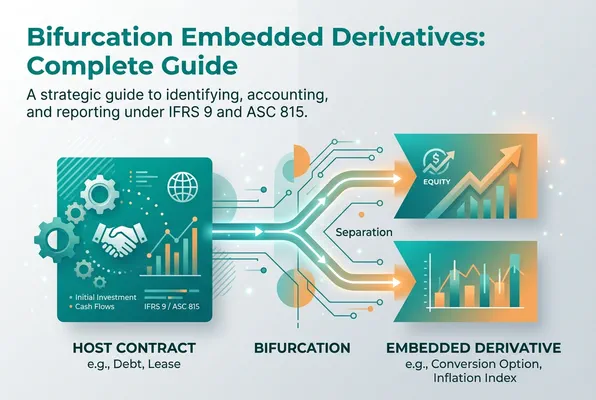

Hybrid financial instruments sit at the intersection of complexity and risk, and few accounting topics generate more debate in treasury teams and audit committees than bifurcation of embedded derivatives. Whether you are preparing financial statements under IFRS 9 or US GAAP ASC 815, understanding when and how to separate an embedded derivative from its host contract is critical for accurate reporting, hedge accounting eligibility, and regulatory compliance.
This comprehensive guide breaks down every dimension of the topic: from conceptual foundations and regulatory frameworks to step-by-step bifurcation assessments, practical examples, and common pitfalls. By the end, you will have a robust framework for tackling embedded derivative accounting with confidence.
What Is an Embedded Derivative?
An embedded derivative is a component of a hybrid (or combined) financial instrument that includes both a non-derivative host contract and a derivative element. Because the derivative is “embedded” within the host, it modifies some or all of the cash flows of the combined instrument in a manner similar to a standalone derivative.
The Host Contract Defined
The host contract is the base agreement to which the embedded component is attached. Host contracts can be:
- Financial liabilities (e.g., bonds, loans, notes payable)
- Financial assets (e.g., structured notes, convertible instruments held)
- Non-financial contracts (e.g., lease agreements, purchase contracts, service agreements)
- Insurance contracts
The nature of the host contract determines which accounting framework governs bifurcation and shapes the entire analysis.
How an Embedded Derivative Arises
An embedded derivative arises when contractual terms introduce variability tied to an underlying variable, such as an interest rate, equity price, credit spread, commodity price, or foreign exchange rate, that is not inherent to a plain-vanilla version of that contract type.
Classic examples include:
- A bond whose interest payments are indexed to a stock market index
- A supply contract with prices denominated in a foreign currency that is non-standard for both parties
- A loan with a conversion option allowing the lender to convert the outstanding balance into equity
- A callable bond where the issuer can redeem early at a fixed price unrelated to market rates
The Concept of Bifurcation
Bifurcation literally means splitting into two parts. In accounting, bifurcation of embedded derivatives refers to the process of separating the embedded derivative from the host contract and accounting for each part independently:
- The host contract is accounted for using its applicable standard (amortized cost, operating lease accounting, revenue recognition, etc.)
- The bifurcated derivative is measured at fair value through profit or loss (FVTPL) at each reporting date
This separation matters enormously because fair value measurement introduces income statement volatility that would otherwise be hidden inside a contract measured at amortized cost or historical cost.
Why Bifurcation Exists as a Concept
Without bifurcation requirements, entities could potentially structure derivative exposures inside hybrid contracts to avoid mark-to-market accounting. Bifurcation rules close this loophole by ensuring that genuine derivative risks embedded in contracts receive derivative accounting treatment, regardless of legal form.
Regulatory Framework: IFRS 9 vs. ASC 815
The two dominant frameworks governing bifurcation of embedded derivatives are IFRS 9 (International Financial Reporting Standards) and ASC 815 (US GAAP). Both share a common conceptual foundation but differ in important ways.
IFRS 9 Approach to Embedded Derivatives
IFRS 9 fundamentally changed the embedded derivative landscape compared to its predecessor, IAS 39. Under IFRS 9:
For financial asset hosts, bifurcation is no longer required. Instead, the entire hybrid financial asset is classified and measured as a whole. If the contractual cash flows of the hybrid asset fail the Solely Payments of Principal and Interest (SPPI) test, the entire instrument is measured at FVTPL , effectively capturing the derivative’s fair value effect without a mechanical bifurcation step.
For financial liability hosts, IFRS 9 retains the bifurcation requirement from IAS 39. An embedded derivative must be separated from a financial liability host if all three conditions are met:
- The economic characteristics and risks of the embedded derivative are not closely related to those of the host contract
- A separate instrument with the same terms as the embedded derivative would meet the definition of a derivative under IFRS 9
- The hybrid contract is not measured at FVTPL in its entirety
For non-financial host contracts, IFRS 9 also requires bifurcation when the same three conditions are satisfied.
The Closely Related Assessment Under IFRS 9
The “closely related” determination is frequently the most challenging part of bifurcation analysis. IFRS 9 and its accompanying guidance (as well as legacy IAS 39 guidance still referenced in practice) provide application examples, including:
- Interest rate floors and caps that are at or out of the money when issued → generally closely related to a debt host
- Equity conversion features in a debt instrument → generally not closely related
- Leveraged inflation features → not closely related
- Commodity-linked interest payments → not closely related to a debt host
- Credit-linked features referencing a third party** → not closely related
ASC 815 Approach to Embedded Derivatives (US GAAP)
Under ASC 815-15, bifurcation applies more broadly, to both financial and non-financial hosts, and to both financial assets and financial liabilities. The criteria under US GAAP require all of the following:
- The economic characteristics and risks are not clearly and closely related to the host contract
- The hybrid instrument is not re-measured at fair value with changes in fair value reported in current earnings
- A separate instrument with the same embedded terms would be a derivative under ASC 815
Key Difference: The “Clearly and Closely Related” Standard
The US GAAP standard uses the phrase “clearly and closely related,” a nuanced but important distinction from IFRS 9’s “closely related.” ASC 815 provides substantial implementation guidance under subtopic 815-15-25, with detailed examples covering interest rate-linked features, equity-linked features, credit-related features, and more.
Scope Exceptions Under ASC 815
ASC 815 also includes explicit scope exceptions that can prevent bifurcation, including:
- Contracts that qualify for the normal purchase and normal sale (NPNS) exception
- Certain insurance contracts
- Contingent consideration in a business combination
- Equity instruments (including written options on own stock meeting certain conditions)
Scope Exceptions and Special Guidance
Not every hybrid instrument falls within the bifurcation requirements. Certain contracts qualify for a scope exception in ASC, meaning the embedded feature is excluded from derivative accounting despite exhibiting derivative-like characteristics. Determining whether a contract qualifies for a scope exception in ASC requires careful consideration of the relevant implementation guidance, including ASC 480-10-S99-3A, ASC 480, and the derivative in ASC 815-10-15-83.
Entities should also determine whether an embedded ASC 815-10 analysis is required before concluding that an exception applies. A contract that contains an embedded derivative may still qualify for an exclusion if the relevant scope guidance specifically removes the arrangement from derivative accounting.
Step-by-Step Bifurcation Assessment Process
A disciplined, repeatable assessment process is essential for any finance team dealing with hybrid contracts. Here is a structured approach:
Step 1: Identify the Hybrid Contract
Review all contracts entered into or held by the entity. Flag any instrument that contains terms linked to an underlying variable (price, rate, index) that could create derivative-like cash flows. This includes reviewing:
- Debt issuances and borrowing arrangements
- Convertible instruments
- Structured investment products
- Long-term supply and purchase agreements
- Lease contracts with variable payments tied to unusual indices
- Foreign currency clauses
Step 2: Identify the Host Contract and the Potential Embedded Derivative
Once a hybrid contract is identified, decompose it conceptually:
- What is the host? What would this contract look like without the variable feature?
- What is the embedded component? What underlying variable drives the additional cash flow modification?
The identification of the host is not always straightforward. For a convertible bond, the host is typically a fixed-rate debt instrument. For a commodity-linked note, the host is typically a floating or fixed-rate debt instrument.
Step 3: Apply the Three-Condition Test
Apply the relevant three-condition test under IFRS 9 or ASC 815 as described above. Document your analysis clearly for each condition:
- Condition 1 (Closely Related): Assess whether the embedded component’s risks mirror the economic risks of the host. Reference the relevant application guidance and examples.
- Condition 2 (Standalone Derivative Definition): Would the embedded feature, if detached, meet the definition of a derivative? Typically this means checking for an underlying, notional amount, little or no net initial investment, and net settlement capability.
- Condition 3 (Not Already at FVTPL): Has the entity designated or is the hybrid instrument classified as FVTPL? If yes, bifurcation is not required.
Step 4: Determine Whether the Fair Value Option Applies
Both IFRS 9 and ASC 815 permit entities to elect the fair value option (FVO) for hybrid financial instruments in certain circumstances, measuring the entire instrument at FVTPL. Where available, the FVO eliminates the need for bifurcation and can simplify accounting significantly, though it introduces its own challenges around measurement and disclosure.
Step 5: Measure the Bifurcated Derivative at Fair Value
If bifurcation is required and the FVO is not elected, the embedded derivative must be measured at fair value at inception and at each subsequent reporting date. The fair value measurement should:
- Use observable market inputs where available (Level 1 or Level 2 under the fair value hierarchy)
- Apply appropriate valuation techniques (option pricing models, discounted cash flow models, Monte Carlo simulation) when observable inputs are not available
- Consider credit risk adjustments (CVA/DVA) where material
Step 6: Account for the Host Contract
The residual host contract is the hybrid instrument’s carrying amount less the fair value of the bifurcated embedded derivative at inception. The host is then accounted for under its applicable standard, typically amortized cost using the effective interest method for a debt host.
Step 7: Subsequent Measurement and Reassessment
After initial recognition:
- The embedded derivative continues to be measured at FVTPL, with changes recognized in profit or loss each period
- The host contract is unwound over its term using the effective interest rate established at inception
- Reassessment of bifurcation is generally not required under IFRS 9 once the initial assessment is made, unless there is a change in contract terms that significantly modifies the instrument
Applying the Bifurcation Criteria in Practice
The bifurcation criteria established by ASC 815-15-25-1 require a structured assessment that begins with identifying the contractual feature and determining whether the embedded derivative is clearly and closely related to the host contract. The evaluation of whether an embedded feature satisfies these requirements should always be documented using the relevant guidance in ASC 815-15 or ASC 825-10.
An entity should also identify potential embedded features before concluding that a hybrid instrument requires no additional analysis. Even relatively straightforward debt arrangements may include embedded features that alter expected cash flows or introduce exposure to equity, commodity, or foreign exchange risks. Whenever an embedded feature must be evaluated, management should assess whether the feature represents an embedded derivative requiring bifurcation under ASC 815-15-25-4.
Fair Value Option Versus Separate Recognition
Rather than applying bifurcation, an entity may elect the fair value option in ASC when the eligibility requirements are satisfied. The fair value option under ASC can significantly simplify accounting by eliminating the need for the separate recognition of an embedded derivative. However, this election should be evaluated carefully because all subsequent change in fair value recognized will affect the carrying amount of the entire hybrid instrument.
When the value option in ASC 815-15 or ASC 825-10 is available, entities should compare the operational complexity of bifurcation with the financial reporting consequences of measuring the complete instrument at fair value. The election must be consistent with applicable generally accepted accounting principles and documented before initial recognition.
Practical Examples of Bifurcation
Example 1: Convertible Bond (Issuer Perspective)
Scenario: A company issues a 5-year bond with a face value of $10 million, paying 3% annual interest. The bond includes a conversion feature allowing the holder to convert into 500,000 ordinary shares.
Bifurcation Analysis:
- Host contract: Fixed-rate debt liability
- Embedded component: Equity conversion option
- Closely related? No — equity risk is not closely related to a plain debt host
- Standalone derivative? Yes — the conversion option would be a derivative on the issuer’s equity
- At FVTPL? No, the bond is carried at amortized cost
Conclusion: Bifurcation required. The conversion feature is separated and measured at FVTPL (or, under IAS 32, classified as equity if certain conditions are met — a separate analysis outside pure IFRS 9 scope).
Example 2: Foreign Currency Purchase Contract
Scenario: A UK company (functional currency GBP) enters a long-term iron ore supply contract with a Brazilian supplier. The contract is denominated in US dollars, which is neither the functional currency of the buyer nor the seller, but is commonly used in iron ore trading internationally.
Bifurcation Analysis:
- Host contract: Non-financial purchase contract
- Embedded component: FX exposure in USD
- Closely related? Under IFRS 9, there is an exception for FX features in non-financial contracts when the currency is commonly used in the economic environment of the transaction (e.g., widely used commodity pricing currency). USD in commodity contracts often qualifies.
- Conclusion: Bifurcation likely not required due to the commonly used currency exemption.
If, instead, the contract were denominated in a currency with no common use in the relevant commodity market, bifurcation of an FX forward would be required.
Example 3: Callable Bond with Non-Standard Call Feature
Scenario: A company issues a 10-year bond callable at 120% of face value after year 3, regardless of market interest rates.
Bifurcation Analysis:
- Host contract: Fixed-rate debt liability
- Embedded component: Call option exercisable by the issuer
- Closely related? A call option in a debt instrument may be closely related if its exercise price approximately equals the amortized cost of the bond at exercise date. However, if the call price is significantly above or below market (a “deep in the money” or unusual premium call), it may not be closely related.
- Detailed assessment required referencing specific application guidance under IFRS 9 / IAS 39 AG30 and ASC 815-15-25
Example 4: Commodity-Indexed Note
Scenario: An entity issues a 3-year note where the interest rate is 2% plus an adjustment based on changes in crude oil prices.
Bifurcation Analysis:
- Host contract: Fixed-rate debt liability
- Embedded component: Commodity price swap or option embedded in interest payments
- Closely related? No — commodity price risk is fundamentally different from the risks of a plain debt instrument
- Conclusion: Bifurcation required; the commodity-linked component is separated and measured at FVTPL
Common Challenges and Pitfalls
Challenge 1: Identifying All Embedded Features
Complex financial instruments can contain multiple embedded derivatives — for example, a bond that is both convertible and callable. Each feature must be assessed separately, and if multiple features are interdependent (e.g., a call feature that extinguishes the conversion option), they may need to be assessed together.
Challenge 2: Determining the Host Contract Characteristics
The host contract identification drives the “closely related” assessment. Different practitioners may identify different hosts for the same instrument, leading to different bifurcation conclusions. Careful documentation and consistency with prior periods is essential.
Challenge 3: Fair Value Measurement of Illiquid Embedded Derivatives
Bifurcated derivatives embedded in private debt or structured instruments often lack observable market prices. This pushes entities into Level 3 fair value territory, requiring complex valuation models with subjective inputs. The resulting fair value estimates can be highly sensitive to assumptions and require robust governance.
Challenge 4: Effective Interest Rate Recalculation
When bifurcation occurs, the host contract’s carrying amount at inception equals the proceeds received less the initial fair value of the embedded derivative. This residual amount may differ significantly from the instrument’s face value, resulting in a non-standard effective interest rate for amortization purposes.
Challenge 5: Tracking Reassessment Triggers
While routine reassessment is not required, any modification of the hybrid contract’s terms should trigger a fresh bifurcation analysis. Finance teams need robust contract monitoring processes to catch triggering events, particularly important for loans subject to covenant renegotiations or amendments.
Challenge 6: Disclosure Requirements
Both IFRS 7 and ASC 815 require extensive disclosures about derivatives, including bifurcated embedded derivatives. These include:
- Qualitative descriptions of hedging strategies and derivative use
- Quantitative disclosures of fair values, notional amounts, and gains/losses
- Fair value hierarchy classification and valuation technique descriptions
- Sensitivity analyses for key inputs
The Fair Value Option as an Alternative to Bifurcation
Where bifurcation of embedded derivatives would be complex, costly, or operationally burdensome, both IFRS 9 and ASC 815 offer the fair value option (FVO) as a practical alternative.
FVO Under IFRS 9
Under IFRS 9, an entity may designate a hybrid financial liability as at FVTPL at initial recognition if doing so eliminates or significantly reduces an accounting mismatch, or if the hybrid contract contains one or more embedded derivatives that would otherwise require separation. This designation is irrevocable.
A key consideration: for financial liabilities designated at FVTPL, changes in fair value attributable to the entity’s own credit risk are presented in other comprehensive income (OCI) rather than profit or loss, to avoid the counterintuitive result of recognizing gains when own credit deteriorates.
FVO Under ASC 815 / ASC 825
Under US GAAP, ASC 825-10 provides the fair value option for eligible financial instruments. When an entity elects the FVO for a hybrid financial instrument, the entire instrument is measured at FVTPL each period, and bifurcation is not required. Unlike IFRS 9, US GAAP does not bifurcate fair value changes attributable to own credit into OCI by default (though other guidance may apply).
When FVO Makes Sense
The FVO is particularly attractive when:
- The bifurcated derivative is highly complex or costly to value separately
- The entity already marks the related portfolio to market for risk management purposes
- Operational simplicity outweighs the cost of income statement volatility
- The entity has strong internal fair value measurement capabilities
Hedge Accounting Implications of Bifurcated Embedded Derivatives
The interaction between bifurcation of embedded derivatives and hedge accounting deserves specific attention.
Can a Bifurcated Embedded Derivative Be a Hedging Instrument?
Under IFRS 9, a bifurcated embedded derivative can be designated as a hedging instrument, provided it meets the general qualifying criteria for hedge accounting (i.e., it is a derivative instrument measured at FVTPL). However, a bifurcated embedded derivative cannot be designated as a hedging instrument in a fair value hedge of the host contract from which it was bifurcated — this would create circular accounting.
Under ASC 815, similar logic applies. An embedded derivative that has been bifurcated is a derivative and can be designated in a hedging relationship, subject to meeting the applicable criteria including formal designation, documentation, and effectiveness requirements.
Bifurcation and the Hedged Item
Conversely, the host contract remaining after bifurcation can be designated as a hedged item in a qualifying hedging relationship. For example, the fixed-rate host of a convertible bond could be designated as the hedged item in a fair value hedge of interest rate risk.
Technology and Automation in Bifurcation Analysis
The manual identification, assessment, and measurement of embedded derivatives across large contract portfolios is operationally challenging. Modern treasury and financial risk management platforms — including purpose-built tools like FinFlexia — are increasingly supporting embedded derivative workflows through:
- Automated contract scanning and flagging of potential embedded derivative features
- Structured bifurcation assessment workflows aligned with IFRS 9 and ASC 815 criteria
- Integrated fair value measurement engines using market data feeds
- Audit trail documentation for each assessment decision
- Reporting and disclosure preparation aligned with IFRS 7 and ASC 815 requirements
As the volume and complexity of hybrid instruments in corporate and financial institution portfolios grows, technology-enabled bifurcation management is shifting from a nice-to-have to a necessity.
Summary: Key Principles for Bifurcation of Embedded Derivatives
| Dimension | IFRS 9 | ASC 815 |
|---|---|---|
| Financial asset hosts | No bifurcation; whole instrument classification | Bifurcation may apply |
| Financial liability hosts | Bifurcation if 3 conditions met | Bifurcation if 3 conditions met |
| Non-financial hosts | Bifurcation if 3 conditions met | Bifurcation if 3 conditions met |
| Key test | "Not closely related" | "Not clearly and closely related" |
| Fair value option available | Yes (irrevocable) | Yes (irrevocable) |
| Subsequent reassessment | Not required unless modification | Not required unless modification |
| Bifurcated derivative measurement | FVTPL | FVTPL |
Conclusion
Bifurcation of embedded derivatives sits at the heart of transparent, decision-useful financial reporting for entities holding or issuing hybrid instruments. The core principle, that genuine derivative risk embedded in contracts should receive derivative accounting treatment regardless of legal form, is sound and essential to comparability across financial statements.
Mastering the bifurcation assessment process requires a thorough understanding of both the conceptual framework and the detailed application guidance under IFRS 9 and ASC 815. Finance professionals must be adept at identifying hybrid features across diverse contract types, applying the closely related test rigorously, measuring bifurcated derivatives reliably at fair value, and maintaining comprehensive documentation for audit purposes.
As financial instruments continue to grow in complexity and structured finance activity expands, bifurcation of embedded derivatives will remain a critical competency for treasury, accounting, and risk management professionals. Investing in robust processes, skilled personnel, and technology solutions aligned with platforms like FinFlexia will be essential for staying ahead of the curve.

Written by
Dominik KonoldFounder
Dominik is the founder of Finflexia and an expert in treasury accounting, financial instrument valuation and IFRS compliance. Since 2016, he's been a certified Professional Risk Manager (PRMIA) and also lectures for the Association of Public Banks and the Academy of International Accounting. He built Finflexia to help treasury teams automate complex accounting workflows.
Related Posts

Fair Value Hedge: Accounting, Examples & Best Practices
A concise guide to fair value hedge accounting, its mechanics, requirements, and practical applications under IFRS 9 and ASC 815.
Amortized Cost: Complete Guide with Examples
This guide explains what amortized cost is, how it is calculated using the effective interest method, when it is applied under IFRS and US GAAP, and how it impacts financial reporting, asset valuation, and the analysis of financial statements.

Cash Flow Hedge: A Complete Guide to Hedging Cash Flows
This guide explains how cash flow hedges protect future cash flows, covering hedge accounting, effectiveness, practical examples, and the difference between cash flow and fair value hedges.
Ready to simplify your treasury accounting?
See how Finflexia helps you manage financial instruments with ease. Book a demo to learn more.
Book a Demo