Amortized Cost: Complete Guide with Examples
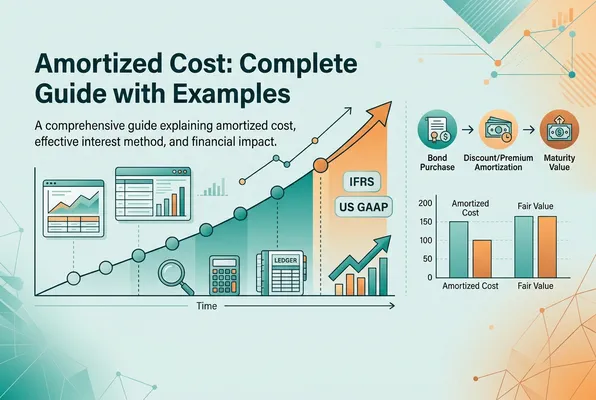

Deciding how to measure and report a financial instrument is one of the most consequential choices in accounting. Get it wrong, and your balance sheet tells a misleading story. Get it right, and stakeholders can trust the numbers they see. Amortized cost sits at the heart of that decision for millions of loans, bonds, and receivables around the world, yet many investors, students, and even practitioners struggle to explain it clearly.
This guide cuts through the jargon. You will learn exactly what amortized cost means, how the underlying math works, where accounting standards require it, and how to think about it when analyzing a company’s financial statements.
What Is Amortized Cost?
Amortized cost is an accounting measurement basis that calculates the carrying value of a financial asset or liability by starting from its initial recognition amount and then systematically adjusting it over the life of the instrument. Those adjustments include:
- Repayments of principal — cash received from borrowers or paid to lenders
- Interest accrued using the effective interest method — interest recognized based on a constant periodic rate applied to the current carrying amount
- Amortization of premiums or discounts — the gradual write-off of any difference between the amount paid and the face (par) value
- Allowances for expected credit losses — where applicable, a deduction for the probability of non-payment
At its core, amortized cost answers a simple question: after accounting for all cash flows and time-value effects, what is the true economic value of this instrument on my books today?
Why “Amortized”?
The word amortize comes from the Latin admortire, meaning “to bring to death” or “to extinguish.” In finance, it describes the process of gradually reducing or eliminating a balance over time, whether that is a loan balance, a bond discount, or a fee included in the initial cost of a financial instrument. So the “amortized” in amortized cost signals that the carrying value is not static; it moves predictably toward the instrument’s face value as time passes.
Amortized Cost vs. Fair Value: Key Differences
Understanding amortized cost is easiest when you compare it to its main alternative: fair value measurement.
| Feature | Amortized Cost | Fair Value |
|---|---|---|
| Basis of measurement | Historical cost adjusted over time | Current market price |
| Volatility in earnings | Low — changes are predictable | High — market swings hit P&L |
| Reflects current market conditions | No | Yes |
| Typical instruments | Loans, held-to-maturity bonds | Equities, trading securities |
| Accounting standards | IFRS 9, ASC 310 | IFRS 13, ASC 820 |
Neither method is universally “better.” Amortized cost gives stability and predictability, which suits instruments held for their cash flows rather than for trading. Fair value is more transparent when instruments are actively traded or when the reporting entity might sell them before maturity.
The Effective Interest Method Explained
The effective interest method is the engine behind amortized cost calculations. It ensures that interest income or expense is recognized at a constant rate over the life of the instrument — the effective interest rate (EIR) — rather than at the coupon rate printed on the face of the instrument.
How to Calculate the Effective Interest Rate
The effective interest rate is the discount rate that equates the present value of all expected future cash flows from the instrument to its carrying amount at initial recognition. In other words:
Carrying Amount = PV of (coupon payments + principal repayment)
                  discounted at the EIR
If a bond is purchased at a premium (above face value), the EIR will be lower than the coupon rate. If purchased at a discount (below face value), the EIR will be higher than the coupon rate.
Amortized Cost Formula
The carrying amount at any point in time follows this logic:
Amortized Cost (end of period) =
  Amortized Cost (start of period)
  + Interest income (EIR × opening carrying amount)
  − Cash received or paid
  ± Loss allowance adjustments
This simple sequence, repeated each period, produces the amortization schedule.
Step-by-Step Example: Bond Purchased at a Discount
Let’s make this concrete.
Scenario: A company purchases a 3-year bond with: - Face value: $10,000 - Coupon rate: 5% (paid annually) = $500/year - Purchase price: $9,520 (below face, so a discount exists) - Effective interest rate: ~7%
Step 1: Recognize the bond at amortized cost = $9,520
Step 2: Build the amortization table
| Year | Opening Balance | Interest Income (7%) | Coupon Received | Discount Amortized | Closing Balance |
|---|---|---|---|---|---|
| 1 | $9,520 | $666 | $500 | $166 | $9,686 |
| 2 | $9,686 | $678 | $500 | $178 | $9,864 |
| 3 | $9,864 | $690 | $500 | $190 | $10,054 ≈ $10,000* |
Minor rounding differences are adjusted in the final period.
Key insight: Each year, the interest income recognized ($666, $678, $690) is higher than the cash coupon received ($500). The difference is the discount being amortized. By maturity, the carrying amount reaches the face value of $10,000 — perfectly.
Accounting Standards: When Is Amortized Cost Required?
IFRS 9 — Financial Instruments
Under IFRS 9 (used in Europe, Australia, and over 140 countries), a financial asset must be measured at amortized cost if both of the following conditions are satisfied:
- Business model test: The asset is held within a business model whose objective is to collect contractual cash flows (not to trade or sell).
- SPPI test (Solely Payments of Principal and Interest): The contractual cash flows consist exclusively of principal repayments and interest on the outstanding principal — that is, straightforward debt-style returns.
Instruments that fail either test are measured at fair value through profit or loss (FVTPL) or, in some cases, fair value through other comprehensive income (FVOCI).
US GAAP — ASC 320 and ASC 326
Under US GAAP, the terminology differs slightly but the concept is analogous:
- Held-to-maturity (HTM) debt securities are carried at amortized cost when the entity has both the intent and the ability to hold them until maturity.
- ASC 326 (CECL) introduced the Current Expected Credit Loss model, which requires entities to estimate lifetime expected credit losses and deduct them from the amortized cost carrying amount to produce the net amortized cost.
Key Differences Between IFRS 9 and US GAAP
- IFRS 9 uses the “business model” concept; US GAAP uses the “intent and ability” concept.
- IFRS 9 applies an Expected Credit Loss (ECL) model; US GAAP uses CECL — both reduce the net carrying amount for anticipated losses, but the measurement mechanics differ.
- Under US GAAP, equity investments generally cannot be measured at amortized cost (they must be at fair value or cost minus impairment for certain unlisted instruments).
Amortized Cost for Financial Liabilities
Amortized cost does not apply only to assets. Financial liabilities, such as bonds payable, bank loans, and debentures, are also commonly measured at amortized cost.
The logic is symmetrical:
- The liability is initially recognized at the proceeds received (which may differ from face value due to transaction costs or issuance at a premium/discount).
- Interest expense is recognized each period using the effective interest rate.
- The carrying amount moves toward the face value at maturity.
Example: Bond Issued at a Premium
A company issues $100,000 of 5-year bonds at a coupon rate of 8%, but because market rates have fallen, it receives proceeds of $103,600. The effective interest rate is approximately 7.2%.
Each period, the interest expense recognized is less than the coupon paid (since the effective rate is below the coupon rate), and the premium is gradually amortized. By maturity, the liability balance returns to $100,000 — the amount that must be repaid.
This approach prevents a company from recognizing a large gain at issuance (from receiving more cash than the face value) and then paying excessive coupons without reflecting the true cost of borrowing.
Transaction Costs and Their Role in Amortized Cost
One nuance that surprises many students is the treatment of transaction costs at initial recognition. Under both IFRS 9 and US GAAP, transaction costs that are directly attributable to acquiring a financial asset or issuing a financial liability are included in the initial amortized cost.
For assets, this means: - Transaction costs are added to the initial carrying amount (increasing it) - They are effectively amortized over the life of the instrument as a reduction to interest income
For liabilities, this means: - Transaction costs are deducted from the proceeds received (reducing the initial carrying amount) - They are amortized over the life of the instrument as additional interest expense
This treatment ensures that the total cost of financing or investing is recognized as interest over the instrument’s life — a more accurate reflection of economic reality than expensing costs upfront.
Acquisition Cost, Book Value, and Changes in Asset Value
Every financial instrument begins with an acquisition cost, which represents the initial amount paid to obtain the asset. Over time, the book value may differ from both the acquisition cost and the current market value because amortized cost reflects repayments, accrued interest, and any discounts or premiums. This gradual change in value allows the carrying amount to move toward the amount expected at maturity while maintaining consistency in the financial statements. Understanding the relationship between the value of an asset, its adjusted carrying amount, and its market price helps analysts interpret a company’s reported asset value more accurately.
Expected Credit Losses and the Net Amortized Cost
Both IFRS 9 and ASC 326 require that the gross amortized cost of financial assets be reduced by an allowance for expected credit losses (ECL) to arrive at the net carrying amount on the balance sheet.
Three-Stage ECL Model (IFRS 9)
IFRS 9 introduces a three-stage “buckets” approach:
| Stage | Credit Quality | Loss Allowance |
|---|---|---|
| Stage 1 | No significant increase in credit risk since origination | 12-month ECL |
| Stage 2 | Significant increase in credit risk (but not yet credit-impaired) | Lifetime ECL |
| Stage 3 | Credit-impaired (e.g., past due > 90 days, restructured) | Lifetime ECL; interest on net carrying amount |
The key implication is that the reported amortized cost of a loan portfolio is not simply its gross value. It is the gross amortized cost minus the ECL allowance, and that allowance can change dramatically when economic conditions deteriorate, even for loans that have not yet defaulted.
Practical Applications of Amortized Cost
1. Bank Loan Portfolios
Banks hold enormous portfolios of loans measured at amortized cost. The difference between gross loans and the ECL allowance (the “net” amortized cost) is one of the most important figures for assessing a bank’s balance sheet health.
2. Corporate Bond Investments
A treasury department that invests excess cash in investment-grade bonds and intends to hold them to maturity will typically account for those bonds at amortized cost. This keeps investment income stable and avoids mark-to-market volatility in earnings.
3. Mortgage Portfolios
Mortgage lenders use amortized cost to track the outstanding principal balances of home loans. The amortization schedule of a mortgage is essentially the same concept applied from the borrower’s perspective — each payment reduces the principal balance, which is the amortized cost of the liability.
4. Trade Receivables
Short-term trade receivables are typically measured at amortized cost (often approximated as their face amount, since the effect of discounting is immaterial for instruments due within 12 months). The ECL allowance for trade receivables is often calculated using a simplified approach, a provision matrix based on historical default rates.
How to Analyze Amortized Cost on Financial Statements
When reviewing a company’s financial statements, look for these disclosures related to amortized cost:
Balance Sheet
- Gross amortized cost — sometimes disclosed in the notes even if only the net figure appears on the face of the statement
- ECL allowance — disclosed separately, often in a table showing movements during the year
- Net carrying amount — the figure that appears on the balance sheet
Income Statement
- Interest income / interest expense — calculated using the effective interest rate on the amortized cost balance
- Impairment losses — changes in the ECL allowance flow through the income statement as credit loss expense
Notes to the Financial Statements
- The effective interest rates applied to major categories of financial instruments
- Maturity profiles showing when cash flows are expected
- Sensitivity analyses showing how ECL estimates change under different economic scenarios
Common Misconceptions About Amortized Cost
Misconception 1: “Amortized cost never changes.”
Wrong. The carrying amount changes every single period, it increases by interest accrued and decreases by cash collected. Additionally, changes in the ECL allowance can shift the net carrying amount up or down significantly.
Misconception 2: “Amortized cost always equals face value.”
Only at maturity (for a standard instrument without credit impairment). During the life of the instrument, amortized cost will differ from face value whenever the instrument was acquired at a premium or discount, or when transaction costs were included.
Misconception 3: “Only banks use amortized cost.”
Any entity that holds financial assets or liabilities applies amortized cost measurement, including manufacturers with trade receivables, retailers with installment loans, and governments with bond portfolios.
Misconception 4: “Amortized cost is simpler than fair value.”
In concept, amortized cost is straightforward. In practice, especially with complex instruments, renegotiated terms, or expected credit loss modeling, the calculations can be highly sophisticated.
Amortized Cost in Personal Finance
The concept of amortized cost is not exclusive to corporate accounting. It appears in everyday personal finance too:
- Mortgage amortization: Your bank maintains an amortized cost record of your outstanding loan. Each monthly payment you make reduces the principal (the amortized cost of the bank’s asset / your liability).
- Car loans: Auto lenders track the amortized cost of each loan in their portfolio.
- Student loans: Loan servicers apply the same logic, your outstanding balance is the amortized cost of the liability you owe.
Understanding how amortized cost works helps you see why the early payments on a loan are mostly interest and later payments are mostly principal, this is the effective interest method working from the borrower’s side.
Tools and Technology for Amortized Cost Calculations
Manual amortization schedules work well for simple instruments. For portfolios of thousands of loans or bonds, purpose-built financial software is essential. Modern platforms like Finflexia help finance teams and investors model amortized cost calculations, build amortization schedules, and track the effective interest method across complex portfolios, reducing the risk of manual errors and saving significant time.
When choosing a tool, look for: - Support for multiple compounding frequencies - Built-in ECL modeling capabilities - Flexible handling of variable-rate instruments - Audit trails for regulatory compliance
Amortized Cost and Other Accounting Methods
Although amortized cost refers primarily to financial instruments, it shares similarities with other methods used in tax and accounting. For example, businesses allocate the cost of an asset over its useful life through depreciation or amortization, depending on whether the asset is tangible or an intangible asset. While an accelerated depreciation method may recognize expenses more quickly for certain fixed assets, amortized cost follows the effective interest method to determine the adjusted cost of financial assets and liabilities. In both cases, the objective is to reflect the economic consumption or financing cost over time rather than recognizing the entire expense at the date of purchase.
Summary: Key Takeaways
- Amortized cost is a measurement basis that starts at initial recognition and adjusts the carrying amount over time for interest, repayments, and credit losses.
- The effective interest method ensures that interest income or expense is recognized at a constant rate — the effective interest rate — applied to the current carrying amount.
- Under IFRS 9, assets are measured at amortized cost when they pass both the business model test and the SPPI test.
- Transaction costs are included in the initial amortized cost and amortized over the instrument’s life.
- The net amortized cost on the balance sheet reflects the gross carrying amount minus the expected credit loss allowance.
- Amortized cost applies to both financial assets and liabilities, and its underlying logic appears in everyday personal finance products like mortgages and car loans.
Mastering amortized cost gives you a powerful lens for reading financial statements, evaluating credit risk, and understanding how the time value of money is reflected in accounting. Whether you are a student preparing for professional exams, a CFO overseeing a bond portfolio, or an investor analyzing a bank’s balance sheet, this concept will serve you well.

Written by
Dominik KonoldFounder
Dominik is the founder of Finflexia and an expert in treasury accounting, financial instrument valuation and IFRS compliance. Since 2016, he's been a certified Professional Risk Manager (PRMIA) and also lectures for the Association of Public Banks and the Academy of International Accounting. He built Finflexia to help treasury teams automate complex accounting workflows.
Related Posts
Cash Flow Hedge: A Complete Guide to Hedging Cash Flows
This guide explains how cash flow hedges protect future cash flows, covering hedge accounting, effectiveness, practical examples, and the difference between cash flow and fair value hedges.
Effective Interest Rate: The Complete Guide
This guide explains how the effective interest rate reveals the true cost of borrowing and the actual return on savings by considering compounding, cash flows, and the real financial impact of different products.
IFRS 13 Fair Value Measurement: Complete Guide
This guide provides a comprehensive overview of IFRS 13, explaining the principles of fair value measurement, valuation techniques, the fair value hierarchy, disclosure requirements, and practical guidance for applying the standard in financial reporting.
Ready to simplify your treasury accounting?
See how Finflexia helps you manage financial instruments with ease. Book a demo to learn more.
Book a Demo